Utility knives: the blade toward the hand
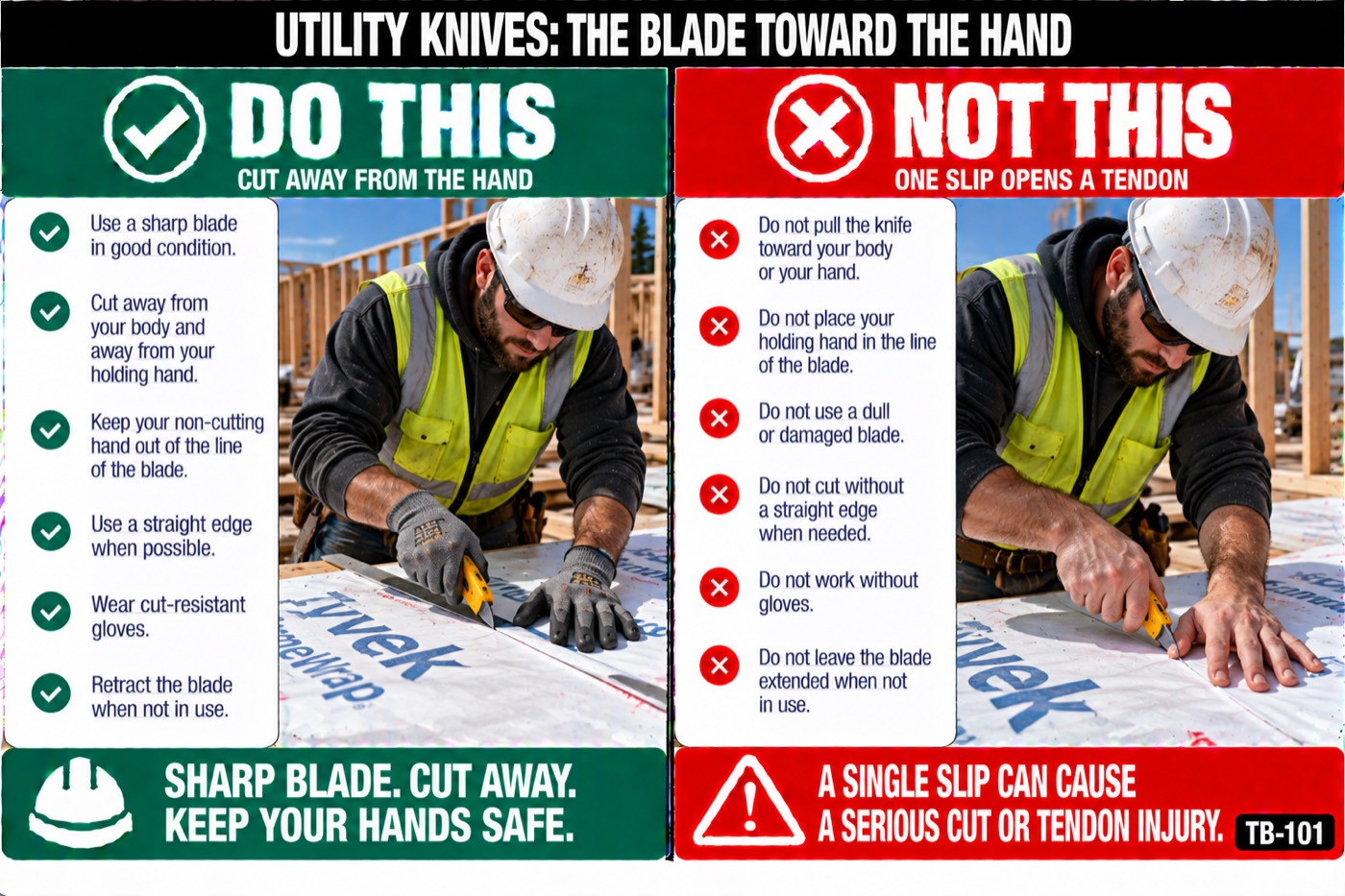
The cut that needs stitches on a framing crew almost never comes from a saw. It comes from a utility knife pulled toward the hand holding the piece, and it takes a tendon in the time it takes to say it.
The points
- A utility knife opens a hand to the tendon in one slip, and a cut tendon is surgery and months off. A chisel driven toward the hand does the same, and a mushroomed chisel head throws steel chips into an eye.
- The rule: no unsafe hand tools issued or used, chisels kept free of mushroomed heads, and wooden handles free of cracks and tight in the tool. A tool that fails that is out of the bags, not in the bottom of one.
- Cut away from your body and away from the hand holding the work, every cut, even the small one. If the blade has to come toward you, the hand in front of it is the problem, not the technique.
- A dull blade needs more force, and force is what slips. Change the blade when it drags. Retract it before it goes in a pocket or a bag; a knife left open in a bag cuts the hand that reaches in.
- A chisel gets struck with a smooth-face hammer or a mallet, never the claw or a waffle face. The hand holding the chisel stays behind the edge, everyone else stays out of the line the chip flies, and eye protection is on.
Why it goes wrong
The knife goes through the material all at once, house wrap, shingle, banding, foam, and then it finds the hand or the thigh on the other side. A cut across the palm or the base of the thumb goes into the flexor tendons and the nerves that run just under the skin. A half-inch cut in the right spot is a hand surgeon, a splint for six weeks, and a hand that may never close all the way.
The rule in 1926.301 is short: employers do not issue or permit unsafe hand tools, wrenches with sprung jaws are out, impact tools like chisels and drift pins are kept free of mushroomed heads, and wooden handles are kept free of splinters and cracks and tight in the tool. The general rule in 1926.300 adds that every tool, yours or the company's, is kept in safe condition.
Knife practice: blade out only as far as the cut needs, a hooked blade for house wrap and shingles, snips instead of a knife for banding, and the work on a surface, not in your hand. For anyone cutting all day, a self-retracting knife and a cut-resistant glove on the holding hand. The knife closes before it leaves your hand, every time.
A mushroomed chisel head spreads and cracks, and a hammer blow sends a chip off it at hammer speed. Grind the head back to a bevel or throw the chisel out. A framing hammer's milled face does the same thing to a chisel head in a week, and a chisel used as a pry bar snaps at the shank. A split wooden handle puts the tang into your palm.
The rest of the bag: a hammer head loose on the handle comes off on the swing, a cat's paw or a pry bar that lets go puts you over backward off the deck, and a screwdriver used as a chisel breaks. Tools are handed over, or sent up in a bucket, never thrown.
A cut that gapes, that is still bleeding after ten minutes of pressure, or where a finger will not bend or straighten or has lost feeling, is the emergency room, not tape and glue. Say so before it gets wrapped.
Questions for the crew
- Who has a knife in their bag right now with the blade out?
- Which chisel or hammer on this crew has a mushroomed head or a loose handle?
- What are you cutting with a knife today, and what is holding it while you cut?
To close
Today every cut goes away from the hand, every blade is closed before it goes in a bag, and the mushroomed chisel gets ground or tossed.
To hold this talk with your crew
1
Read it aloud. Five minutes, before the work starts.
2
Ask the questions. A crew that talks is a crew that remembers.
3
Have them sign on their own phones, and the record is sealed.