PV modules: live the moment the sun is up
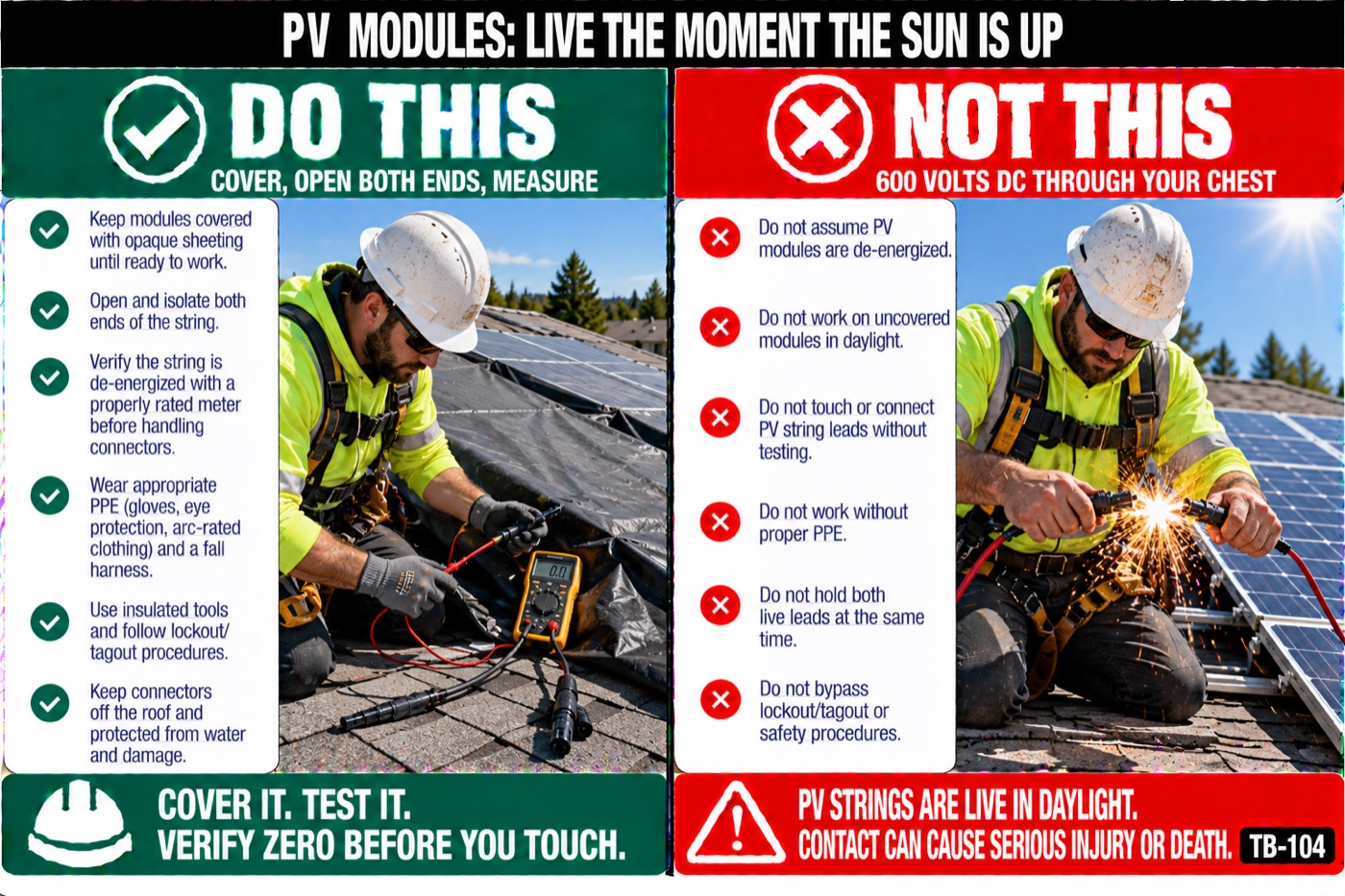
There is no off switch for the sun. A module on the pallet in the driveway is making 40 volts right now, and a string of them on the roof is making 600.
The points
- Fifteen modules in series is 600 volts DC. Take hold of the wrong two ends and that current runs through your chest.
- A string is live from first light to dark, and voltage comes up to almost full on a cloudy morning. Open circuit voltage does not care how bright it is.
- DC has no zero crossing, so a DC arc does not go out by itself. Break a live connector and the arc keeps burning until something melts apart.
- Before you touch a string you know its voltage, you have covered it with opaque sheeting, or you are doing it in full dark, before first light, and the meter says so.
- The rule is that nobody works close enough to contact a live circuit unless it is deenergized or guarded. On a PV string, deenergized means covered, opened at both ends, and measured.
Why it goes wrong
A single residential module sits around 40 to 50 volts open circuit and 10 to 14 amps short circuit. Alone, that is a bad shock. In a string of 12 to 15 modules the voltages add, so residential strings run to 600 volts, commercial to 1,000, and large ground mounts to 1,500. Nothing about the module changes; the series wiring is what makes it lethal.
Voltage on a module rises to near open circuit at a few percent of full sun. Overcast, dawn, a shaded roof, all of them put almost the full string voltage on the leads. Current is what drops in low light, and current is what you would be trying to survive. Treat every connected string as full voltage at any hour you can see your hands.
Alternating current crosses zero 120 times a second, and that is what usually lets an AC arc go out. DC has no zero. A DC arc drawn at 600 volts sustains itself across an inch or more of air at several thousand degrees. This is why the connectors are marked do not disconnect under load.
Covering the array is the only way to actually turn it off, and it only works with opaque material. A blue tarp lets enough light through to keep voltage up. Use black plastic or a purpose-made cover, tape it down against wind, and check with a meter that the string voltage dropped before you trust it.
The common mistake is treating a string that has been disconnected from the inverter as dead. The inverter side is dead. The string still has full open circuit voltage across its own two ends, and if a connector is open somewhere on the roof, both halves are live to ground through any fault in the wiring.
Working at dawn is a real option, not a joke. Connector work done in full dark, before first light, can be on a string that measures only a few volts, and the meter is what tells you. Once the sky is light, the string is near full voltage. Plan the wiring for the dark and the mechanical work for the rest of the day.
Questions for the crew
- What is the string voltage on this array, and who measured it this morning?
- Which strings are already connected to the roof and which are still on the pallet?
- If someone has to open a connector at noon today, how is that string getting covered first?
To close
Nobody opens a connector on this roof today until the string is covered or measured, and the meter reading gets said out loud.
To hold this talk with your crew
1
Read it aloud. Five minutes, before the work starts.
2
Ask the questions. A crew that talks is a crew that remembers.
3
Have them sign on their own phones, and the record is sealed.