Roof anchors: the screw that went into decking
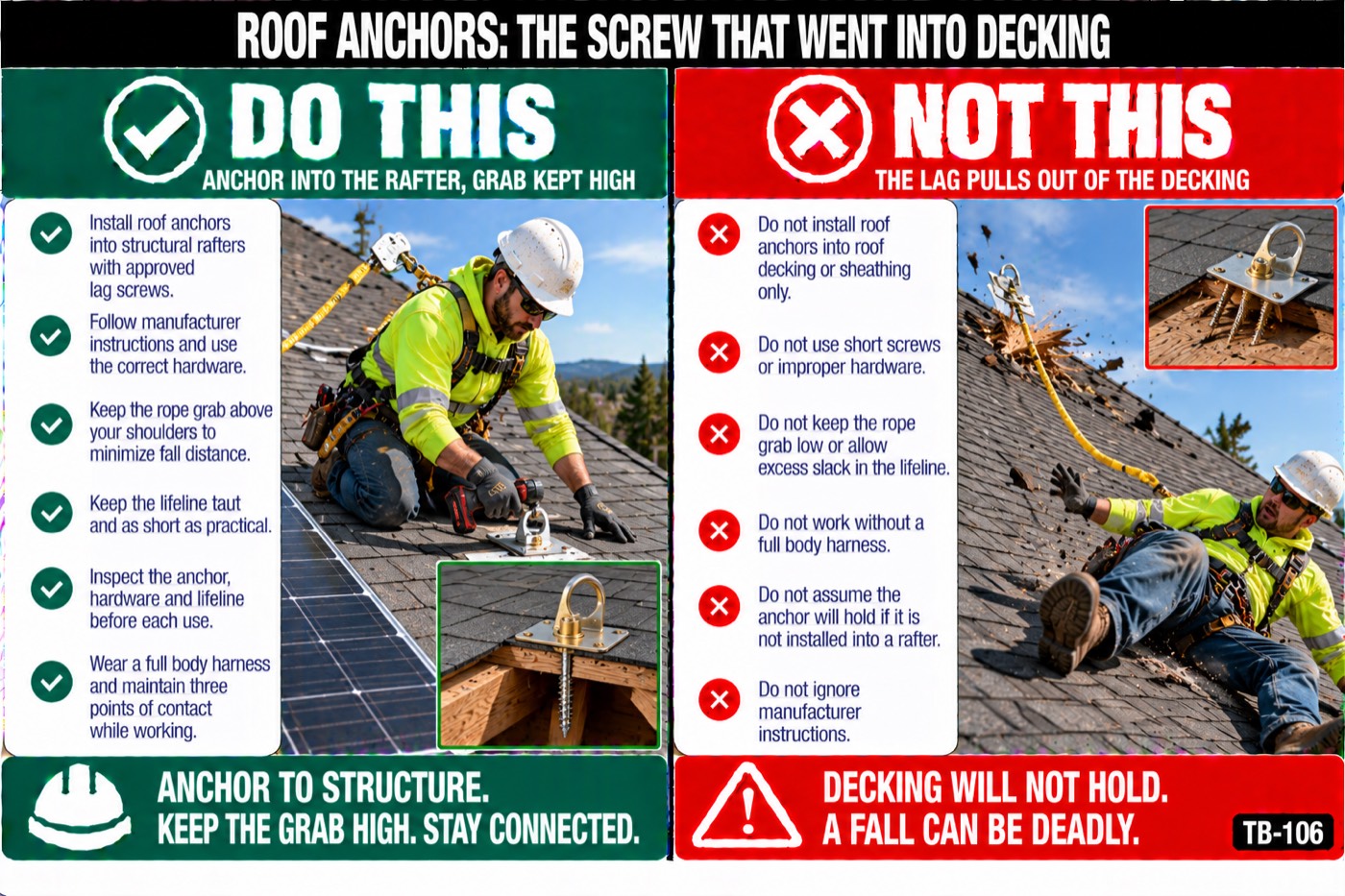
An anchor has to hold 5,000 pounds. Half-inch OSB holds a lag screw with a few hundred. Someone this year found out which one they were tied to on the way to the driveway.
The points
- A fall off a single-story eave is 10 to 12 feet, and it kills people. Head first onto concrete from that height is the injury the harness was supposed to prevent.
- The anchor goes into a rafter or truss, through the sheathing, with every fastener the anchor's instructions call for. Find the rafter first; do not guess from the shingle nails.
- The rope grab stays above your shoulders. Slack in the line below you is fall distance you added yourself, and on a low roof there is none to spare.
- A 6 foot shock-absorbing lanyard needs about 18 feet of clearance below the anchor. On a residential roof you do not have it, so use a rope grab kept short or a self-retracting line rated for the job.
- Tie in before you leave the ladder and stay tied in until you are back on it. The move onto the roof and the move off are where the harness is usually unhooked.
Why it goes wrong
The rule says an anchor for personal fall arrest supports at least 5,000 pounds per person attached, or is designed with a two-to-one safety factor by a qualified person. Temporary residential ridge anchors reach that only when fastened as the maker states, which is usually several 16d nails or #14 screws driven into a rafter, not into deck. Rafters are 16 or 24 inches on center; a stud finder, a look in the attic, or a test screw tells you where.
A fall is caught in stages. The lanyard comes tight, the shock absorber tears out up to 3.5 feet, the harness stretches, and your body swings. With a 6 foot lanyard the numbers add to roughly 18 feet from anchor to the lowest point of your body. If the anchor is at the ridge and the eave is 11 feet off the ground, you hit the ground before the system finishes.
A rope grab on a vertical lifeline is only as good as where you left it. Every step down the slope, slide it down with you and keep it above your chest. If it is 4 feet below you when you slip, you fall 8 feet before it locks, plus the rope stretch. On a 6:12 pitch a 12 foot fall down the slope is a trip over the eave with the line trailing behind you.
Arresting force on the body is limited to 1,800 pounds with a full body harness, which is why body belts are not allowed for fall arrest. A harness that is loose, with the D-ring slid down below the shoulder blades instead of centered between them, puts that force in the wrong place and can drop you out the bottom.
Inspect the rope before every shift for cuts and glazing. Rope on hot standing seam or over a module edge gets abraded; a lifeline shall be protected against being cut. Route it over the ridge, not over the rail ends, and never over the gutter edge where the sheet metal is a knife.
The common mistake is the transition. People clip in after they are up on the roof, standing at the eave, and unclip before the ladder because it is awkward. Set the anchor so the line reaches the top of the ladder, clip in from the ladder, and do the reverse on the way down.
Questions for the crew
- Where are the rafters on this roof and how do you know?
- With the anchor where it is, how far does anyone fall before the line catches, and what is below the eave there?
- Who is checking that each rope grab is above the person using it, and when?
To close
Every anchor on this house goes into a rafter with all its fasteners today, and every rope grab stays above the person on it.
To hold this talk with your crew
1
Read it aloud. Five minutes, before the work starts.
2
Ask the questions. A crew that talks is a crew that remembers.
3
Have them sign on their own phones, and the record is sealed.