Racking at the edge: the rail that overhangs
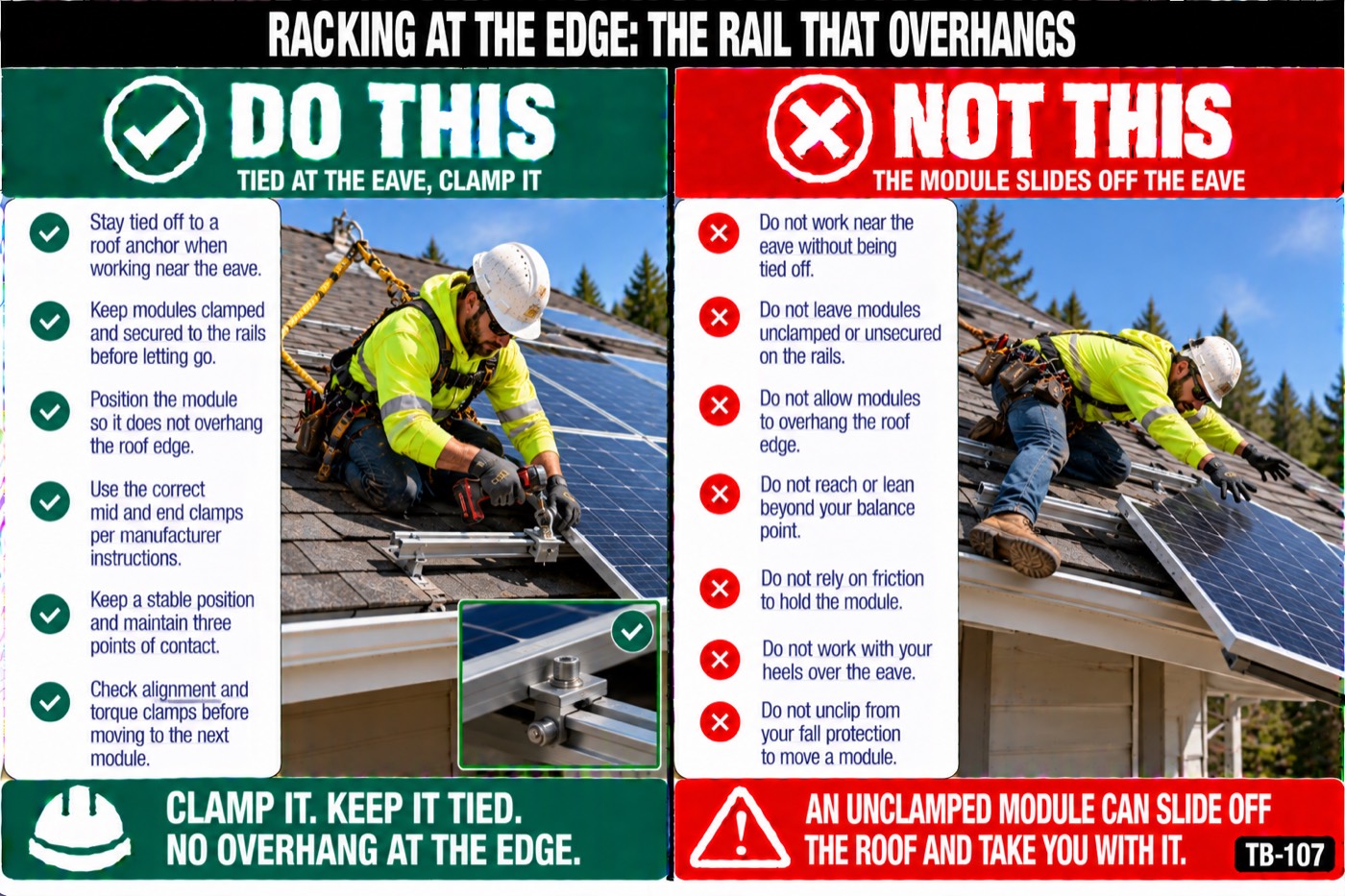
The first rail on most layouts sits within 3 feet of the eave, and the last module goes on with someone's heels over the gutter. The work is at the edge by design.
The points
- A worker walking a rail out to the edge to trim it is looking at the rail, not the eave. Six feet or more to the lower level means fall protection, and a residential eave is 10 to 12 feet.
- On a steep roof, over 4:12, a warning line is not allowed as protection. It is harness and anchor, guardrail, or net, and on a house that means the harness.
- On a flat commercial roof the warning line goes up at least 6 feet back from the edge before racking starts, flagged every 6 feet, and anyone working outside it is tied off.
- A module set on the rails but not clamped will slide. Set it, clamp it, then let go. A 50 pound sheet of glass sliding down a 5:12 pitch reaches the eave in about a second.
- Rail overhang past the last foot gets cut to length on the roof only with the cutter tied in and the drop zone below clear. Better: cut it on the ground from the layout.
Why it goes wrong
The rule puts the line at 6 feet above a lower level for unprotected sides and edges, with guardrail, net, or personal fall arrest as the choices. Steep roofs, steeper than 4 in 12, get the same three choices and nothing else. Low-slope roofs may use a warning line combined with one of those systems or with a safety monitor. Almost every residential PV roof is steep by this definition.
A warning line on a low-slope roof is a rope or chain on stanchions, at least 34 inches high and no more than 39, with 500 pounds of tensile strength and flags every 6 feet. It is set at least 6 feet from the edge, and 10 feet from an edge that mechanical equipment is moving toward, perpendicular to the edge. Inside it you can work unprotected; outside it you cannot. On a solar layout the racking usually runs right to the fire setback, which is outside the line, so people are on harnesses anyway.
Racking work pulls your attention down to a rail, a foot, and a torque wrench, and you back up along the rail without looking. The foot behind you finds the gutter. Set the layout so the rail near the eave is installed from above, working down toward the edge, never from the edge working up.
Module frames are anodized aluminum on anodized aluminum rail; the friction is low. Wet, dusty or frosted, a module set on the rails will move on any pitch above about 3:12. Bottom clamps go on first, module goes in against them, then the top clamps. Nobody leaves a module resting unclamped to fetch a tool.
Rail overhang is a trip and a spear. A rail that sticks 18 inches past the last module at the eave is what you catch a foot on or a harness line on. Trim it before modules go on, from the roof side, with the cut end going into a bucket and not off the edge.
The fall you see on solar roofs is often the last hour of the day. The array is nearly done, the anchor has been moved for the last row and the rope no longer reaches, and someone reaches for the last clamp unhooked. Move the anchor before the rope runs out, not after.
Questions for the crew
- What is the pitch on this roof, and what does that mean for warning lines versus harnesses?
- Which rails end closest to the eave, and who is setting those?
- Where does the anchor have to be for the last row, and when does it move?
To close
Nobody is at the eave today without a harness on a set anchor, and no module sits on a rail without a clamp on it.
To hold this talk with your crew
1
Read it aloud. Five minutes, before the work starts.
2
Ask the questions. A crew that talks is a crew that remembers.
3
Have them sign on their own phones, and the record is sealed.