Inverter and AC side: the breaker that was on
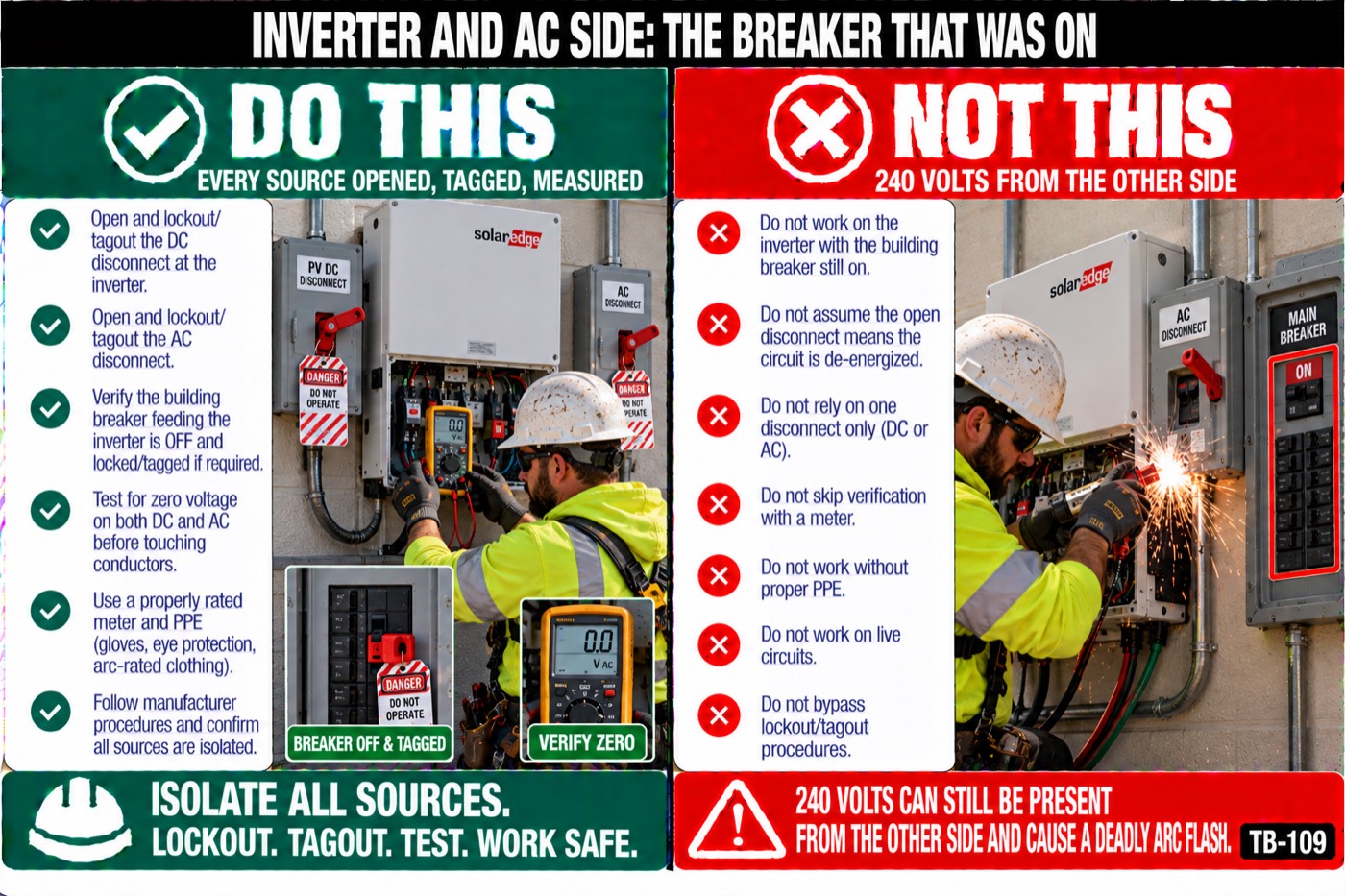
An inverter has power coming at it from two directions: 600 volts DC from the roof and 240 volts AC from the utility. Open one disconnect and you have turned off half of it.
The points
- An electrician opened the AC disconnect, checked the inverter output dead, and started landing conductors on a breaker someone had already flipped on in the main panel. The utility side put 240 volts through him on his own wire.
- Every source gets opened and tagged before you work: the DC disconnect, the AC disconnect, the PV breaker in the panel, and, if the job needs it, the meter. Tags go on at every point where the circuit can be reenergized.
- After you open the DC disconnect, wait the time the inverter manual states, usually 5 minutes, before opening the cover. The capacitors inside hold a lethal charge after the sun is gone.
- Test both sides of every disconnect with a meter you tested on a known live source first. Dead on the load side means nothing about the line side.
- The breaker you installed does not get turned on until the inspector and the utility say so, and until then it is locked or tagged off and the crew knows why.
Why it goes wrong
The rule for construction is tagging: controls that will be deactivated during the work are tagged, deenergized circuits are rendered inoperative and tagged at every point where they can be energized, and the tags plainly identify the circuit. A padlock through the disconnect handle is how you render it inoperative on a job where other trades are in the panel. Tags alone stop honest people; locks stop everybody.
A grid-tied inverter backfeeds. Once it is commissioned it pushes current toward the panel, and the PV breaker is a source, not a load. The 120 percent bus rule and the opposite end of the bus placement in NEC 705.12 exist because that breaker feeds in, and it is why you treat the panel as having two supplies once the system is live.
Inverter DC bus capacitors store enough energy to stop a heart for minutes after both disconnects are open. The manual gives the wait time, typically 5 minutes, sometimes 10. Open the disconnects, start the clock, then open the cover and measure the bus before you touch anything inside. A bleeder resistor can be failed; the meter is the only proof.
The utility meter is the utility's, and on many jobs you do not pull it. What you do is know whether the service has been disconnected at the meter, whether a supply-side tap is being made on live service conductors, and who is qualified for that. A supply-side connection is work on conductors with no overcurrent protection on the utility side at all; the fault current there is the full transformer capacity.
Testing dead is a sequence, not a glance. Test the meter on a known live circuit, test the circuit you are about to touch, phase to phase and each phase to ground, then test the meter again on the live circuit. A meter with a dead battery reads zero on everything. An open fuse in the disconnect reads dead on one side and live on the other.
The common mistake is a crew of two working from different assumptions. The roof lead thinks the inverter person opened the DC; the inverter person thinks the roof is covered. Before anyone touches a conductor, both say out loud what is open and what is tagged.
Questions for the crew
- What are all the sources into this inverter, and which disconnects and breakers control them?
- Who is putting on the tags and locks today, and who has the keys?
- What is the wait time in this inverter's manual before the cover comes off?
To close
Before anyone touches a conductor at this inverter today, every source is opened, tagged, and measured dead on both sides, and both of us say it.
To hold this talk with your crew
1
Read it aloud. Five minutes, before the work starts.
2
Ask the questions. A crew that talks is a crew that remembers.
3
Have them sign on their own phones, and the record is sealed.