Standing seam: slick when wet, no parapet
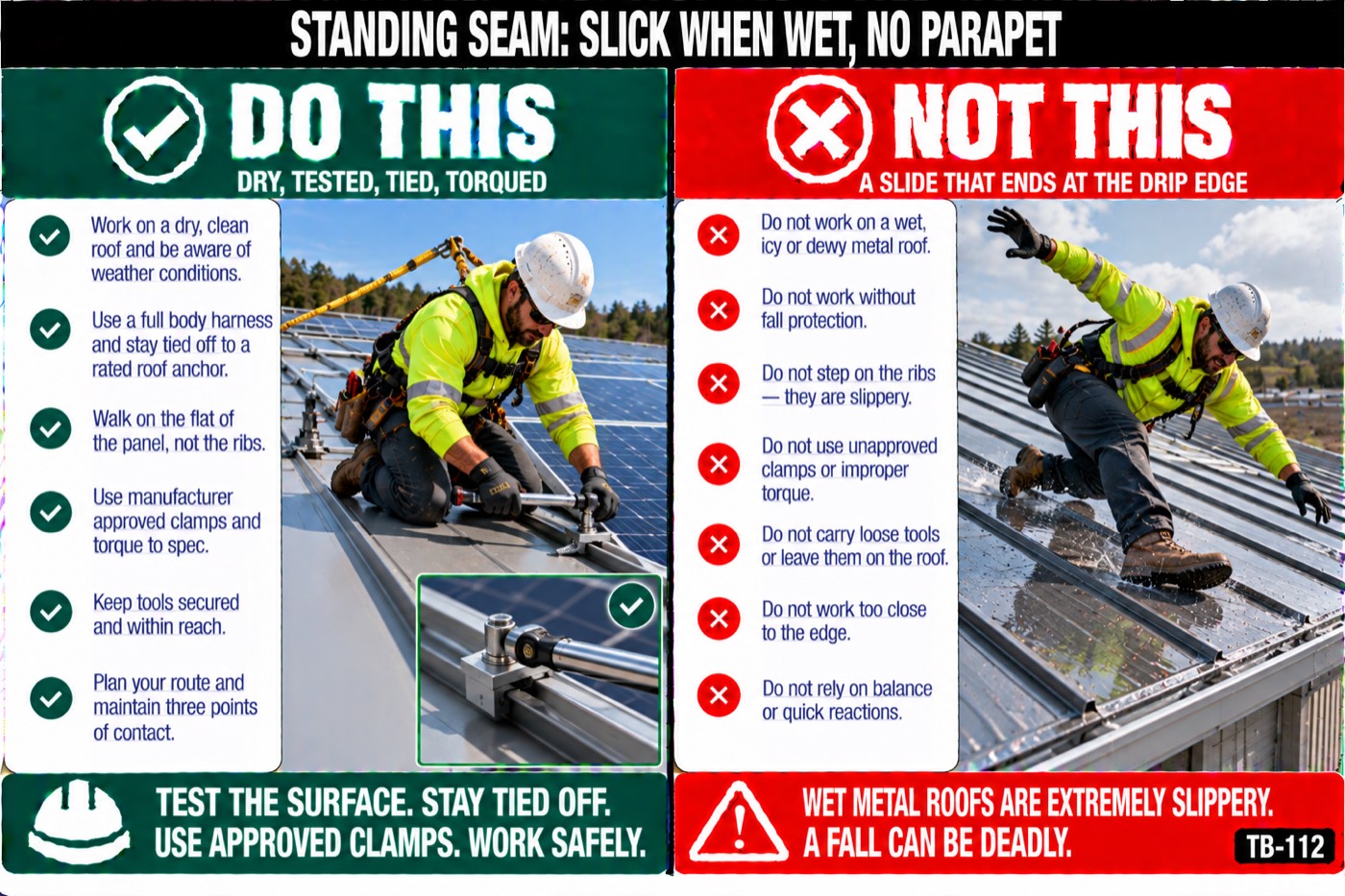
Painted standing seam with dew on it has about the grip of a wet bathtub. On a 3:12 pitch that is enough to walk on dry and enough to slide on wet, and the roof ends at a drip edge, not a wall.
The points
- A worker who slips on wet metal does not stop. The panels have no shingle grain to catch a boot, the ribs are a foot apart, and the slide ends at an edge with a gutter or nothing.
- Frost, dew, rain and pollen all make painted metal slick. Nobody walks the roof until it is dry and a foot test at the ladder says it holds.
- Six feet to the lower level means fall protection, and a metal roof with no parapet is exactly the edge the rule describes. Anchor and harness, or a rail, before the first clamp goes on.
- Seam clamps hold the whole array by friction on the rib. Every clamp gets set with a torque wrench to the maker's number and a sample gets a pull test; a clamp torqued by feel slips in the first wind.
- Walk on the flat of the pan near the seam, never on the rib, and never on the panel's unsupported center where it oil-cans and throws you off balance.
Why it goes wrong
Painted or Galvalume standing seam has a coefficient of friction on dry rubber that lets you walk a moderate pitch. Wet, it drops by roughly half, and with frost it is close to ice. Dew forms on metal roofs before it forms on shingles because the metal radiates heat overnight and gets colder than the air. A 7 a.m. start on a clear fall morning is a wet roof even if it did not rain.
The rule requires guardrail, net or personal fall arrest at 6 feet for unprotected edges and for low-slope roofing work, with warning lines allowed only in combination on low-slope roofs. Metal roofs on shops and barns are often 3:12 or less, but solar installation is not roofing work under the rule, so the warning line option does not apply. Use guardrail, a net, or a harness tied off. The edge has no parapet, so there is nothing to stop a slide and nothing to grab.
Standing seam anchors clamp to the seam without penetrating the roof, which is why they are used, and they hold by the same friction as the racking clamps. Set them per the anchor's instructions, usually two or more clamps per anchor, and torque them. An anchor that slides down the seam under load is a fall with the harness on.
Seam clamp makers publish a torque value, commonly in the range of 13 to 15 foot-pounds for a set screw into the seam, and a tested holding strength that depends on that torque and on the panel's metal and profile. Under-torqued clamps let the rail creep downhill in thermal cycling and in wind. Over-torqued set screws strip the seam and cut the paint, which starts rust at every clamp. Use the wrench and record the number.
Metal panels move. A 40 foot panel grows and shrinks a quarter inch or more between a cold night and a hot afternoon, and the clips under it are designed for that. Racking that is fixed to the seams rides with it, but a conduit run or a cable tray screwed through the pan does not; it tears the panel or the screw. Attach to the seams and let the roof move.
The common mistake is treating the roof as a floor because it looks flat and solid. People run across it, carry modules with both hands and no line, and step on the rib because it feels stronger. The rib bends under a boot, the boot rolls, and there is nothing to stop you. Every step on metal is a placed step.
Questions for the crew
- What is the roof surface like right now, and who tested it at the ladder?
- What torque do these clamps take, and who has the wrench set to it?
- Where does the roof edge go if you slide, and is there anything at all between you and the ground?
To close
Nobody steps onto this metal roof today until it is dry and tested, and every seam clamp gets the torque wrench and a pull.
To hold this talk with your crew
1
Read it aloud. Five minutes, before the work starts.
2
Ask the questions. A crew that talks is a crew that remembers.
3
Have them sign on their own phones, and the record is sealed.