Testing PV: dead means every string checked
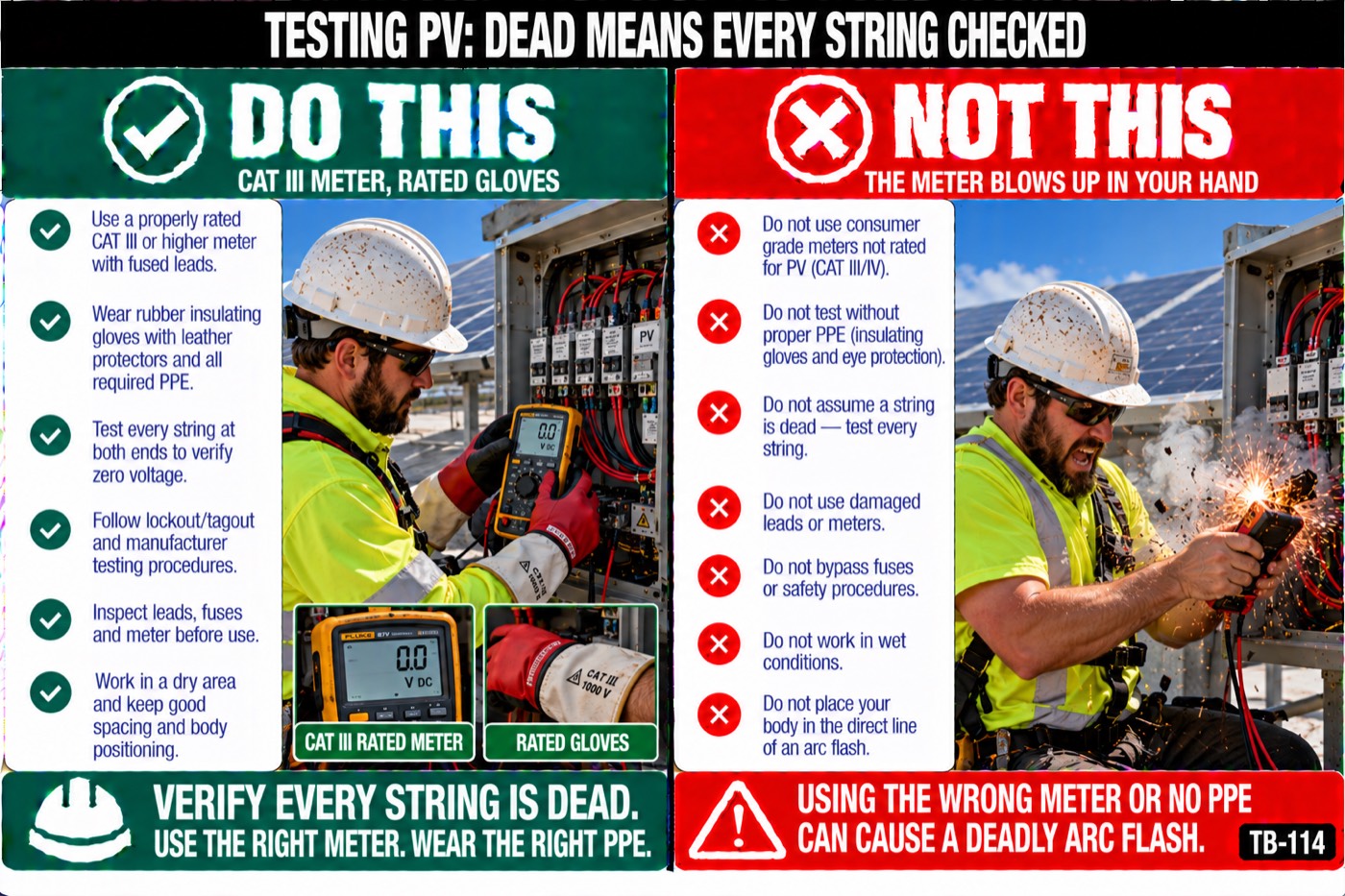
A meter rated CAT II on a 600 volt DC string can blow up in your hand. Not read wrong, blow up, with the arc coming out through the case at your face.
The points
- A meter with the wrong rating or a blown internal fuse turns a live string into an arc flash at your hands and eyes. The burn is from the meter, not the wire.
- The meter is rated CAT III, 1000 volts, with leads rated the same and fuses in it. Check the meter on a known live source before and after you test a circuit.
- Rubber insulating gloves rated for the voltage, with leather protectors, on every test of a string or a disconnect that could be live. Class 00 covers 750 volts DC; above that is class 0.
- Safety glasses at minimum and an arc-rated long sleeve shirt for testing at the combiner or the inverter. Cotton burns; polyester melts into the burn.
- Dead is a measurement, not a switch position. Every string gets measured at its own ends, positive to negative and each to ground, and the reading gets written on the string tag.
Why it goes wrong
Meter categories describe how much transient energy the meter can survive. CAT II is for outlets and plug-in loads; CAT III is for distribution and fixed equipment, which includes PV combiners, disconnects and inverters; CAT IV is the service entrance. A meter used above its category can arc internally when a transient hits it, and the plasma vents through the case. Look for the CAT III 1000 V mark on the meter and on both leads, and for the fuse rating on the back.
The rule requires protective equipment for eyes, face, hands and body wherever the hazards of the process call for it, selected and fitted for the work. For electrical testing that is rubber insulating gloves with leather protectors, safety glasses or a face shield, and clothing that will not melt. The gloves are tested and dated; a glove past its test date or with a pinhole found by air test is not protection.
Rubber glove classes are rated by voltage. Class 00 is good to 500 volts AC and 750 volts DC; class 0 to 1,000 AC and 1,500 DC. A residential string at 600 volts DC is class 00 territory; a 1,000 volt commercial string or a 1,500 volt ground mount needs class 0. Leather protectors go over the rubber every time, because a cut in the rubber is a hole in your protection.
Rapid shutdown, an open DC disconnect and a dark inverter screen all make it easy to believe the roof is dead. None of them is a measurement. A string with a rapid shutdown device that failed closed, a home run that is landed on the wrong side of a disconnect, or a module-level electronics box that did not get its signal is still at full voltage. Measure the string you are about to touch, at the point you are going to touch it.
Checking polarity is part of checking dead. Two strings landed in a combiner with one reversed put twice string voltage across the reversed string's blocking diode or the inverter input, and the smoke happens when the disconnect is closed. Measure each string open circuit before it lands: positive to negative should read positive and close to the calculated Voc for the temperature. A string reading low by one module's voltage has a module bypassed, often by failed bypass diodes, or one module too few. An open connector reads zero.
The common mistake is a meter with a dead battery or a blown fuse. A dead battery reads zero. A blown current fuse reads zero on the amps range. The live-dead-live check catches both: test on a source you know is hot, test the circuit, test the hot source again. If the meter cannot read the known live source, nothing it said in between counts.
Questions for the crew
- What meter is on this job, what category is it rated, and when was it last checked on a live circuit?
- Whose gloves are we using for string testing today, and what class and test date are on them?
- How many strings are on this array, and where is each one getting measured before anyone touches it?
To close
Every string on this job gets measured at its own ends with a CAT III meter and rated gloves before anyone handles it, and the number goes on the tag.
To hold this talk with your crew
1
Read it aloud. Five minutes, before the work starts.
2
Ask the questions. A crew that talks is a crew that remembers.
3
Have them sign on their own phones, and the record is sealed.