Paver and roller: the roller backing into the screed crew
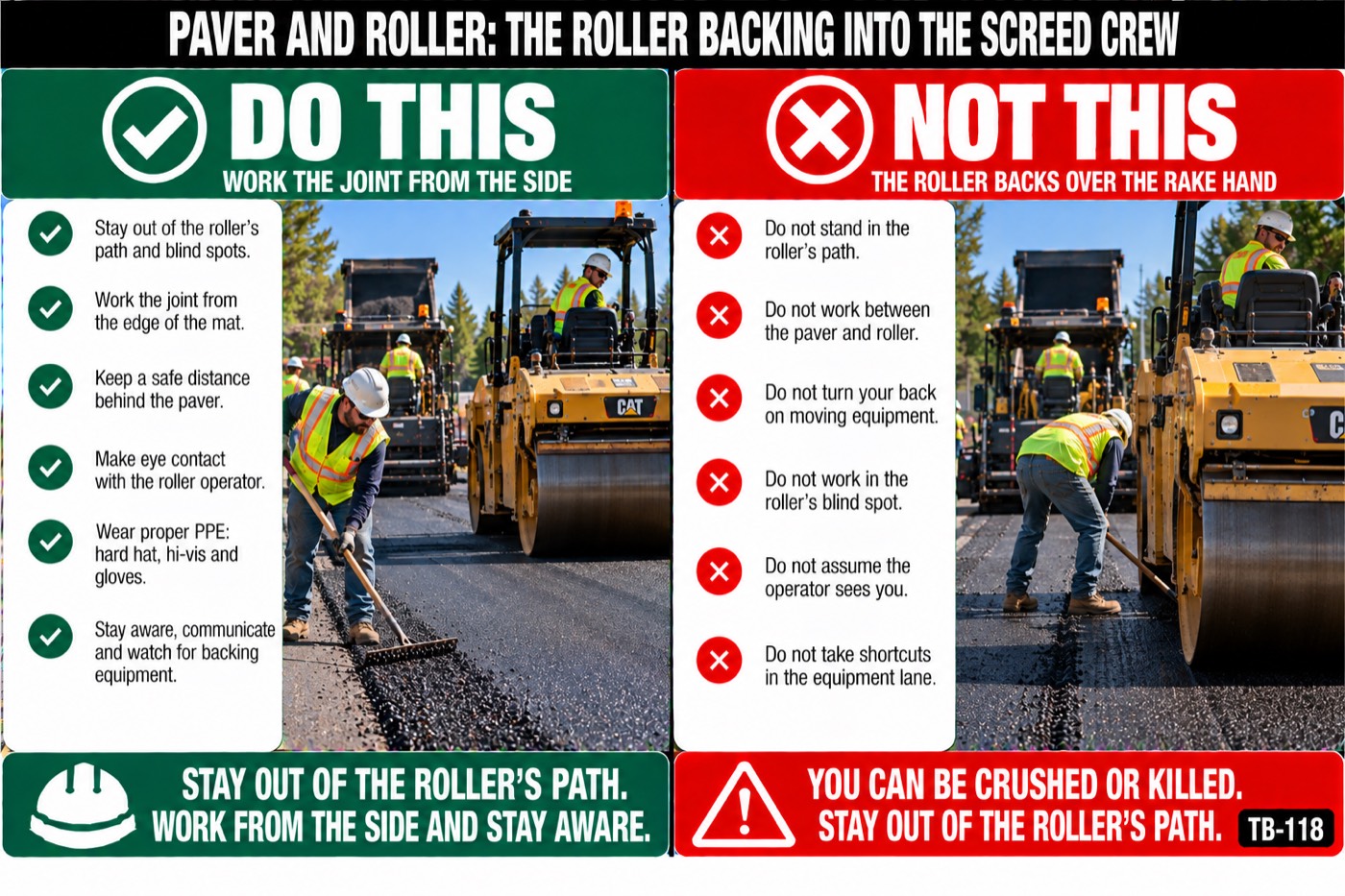
A tandem steel-drum roller weighs 10 to 15 tons and works 50 feet behind the screed, going forward and backward all day. The screed operator is looking down at the mat. The roller operator is looking at the drum edge. Neither of them is looking at the rake hand between them.
The points
- The roller backs over the rake hand who stepped back to check the joint. It is the paving death that repeats: a bidirectional machine, a crew that works with its back to it, and a mat that is loud, hot and full of people looking down.
- 1926.602 names rollers and compactors as bidirectional machines and requires a horn the operator can reach and uses. The rule does not say the horn stops the machine. It says the horn has to be heard over the noise and used as needed whenever the machine moves.
- Nobody walks or stands in the roller's lane behind the paver. The rake crew works the joint from the side of the mat, never from the center between the screed and the drum.
- The screed operator's blind spot is directly behind and below the screed, where the roller stops on its forward pass. The roller operator's blind spot is the near side of the drum on the reverse pass. Both know it, so both stop and look before changing direction.
- Every machine gets a 360 walk-around before it starts, every start. Cracked mirrors, a dead backup alarm, a rake leaning on the drum, a person on the far side of the roller. Look before you climb, not after.
Why it goes wrong
The breakdown roller has to stay close behind the paver because the mat is only compactable while it is hot, roughly above 185 °F for dense mix. That puts a 12-ton machine changing direction every 50 to 100 feet in the same space as the screed crew, the rake hands, and the string-line person. The physics is simple. The drum is smooth, it does not stop fast on hot mix, and a person's foot under it is gone.
1926.602(a)(9) requires a horn on rollers and other bidirectional machines. The reverse alarm on a roller is often a beeper that runs constantly, and constant beepers get tuned out within a shift. That is why the practice on a good crew is positional, not audible. There is a place the roller goes and a place the people go, and they do not overlap.
The zone directly behind the screed and in front of the roller is where the joint gets checked and the mat gets touched up, and it is exactly where the roller stops and reverses. The rake crew works from the outside edge of the mat inward and steps off the mat to the shoulder side, never toward the center, when the roller approaches. The roller operator sees a body at the edge; they do not see one in the drum's shadow.
Screed operators have their heads down for hours. The blind spot is straight back over their shoulder and below the platform, plus whatever the screed extensions and the auger chamber hide. A roller creeping up on the forward pass is inside that blind spot for the last 10 feet. The screed hand does not step off the back of the platform without turning around first, and the roller operator does not close the last 20 feet to the screed without eyes on the platform.
The walk-around is in the motor vehicle rules for trucks and it is plain good practice for every machine on the mat. It takes two minutes: mirrors, alarm, horn, steps, tires or drums, water spray nozzles, nothing leaning on the machine, nobody under it or behind it. The roller that killed someone in the yard had a backup alarm that had been dead for a week; the walk-around is where that gets found.
Radios or hand signals between the paver operator and the roller operator settle who moves first when the paver stops for a truck. Most roller strikes at the paver happen during that pause, when people cluster at the hopper and the roller keeps its pattern.
Questions for the crew
- Where does the rake crew stand today when the breakdown roller comes forward, and is that off the drum's line?
- Does the roller's horn and backup alarm work this morning, and who checked?
- When the paver stops for a truck, who tells the roller operator, and how?
To close
Today nobody stands between the screed and the drum, and every machine gets its walk-around before the first start.
To hold this talk with your crew
1
Read it aloud. Five minutes, before the work starts.
2
Ask the questions. A crew that talks is a crew that remembers.
3
Have them sign on their own phones, and the record is sealed.