Tack coat: hot emulsion and the slip on fresh tack
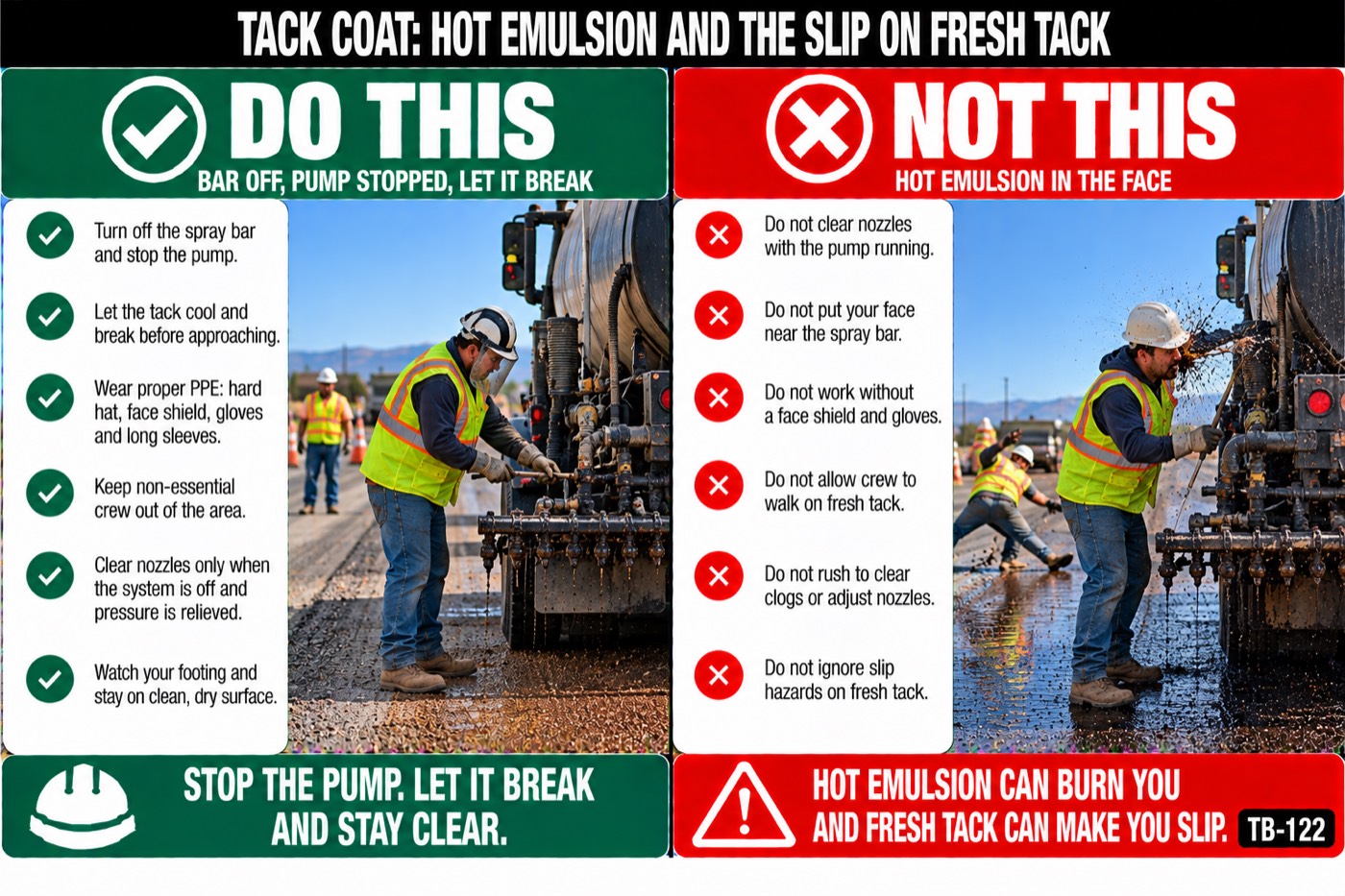
The emulsion in the distributor is sprayed at 120 to 180 °F, and it is mostly asphalt and water under pressure in a bar with 30 nozzles. Fresh tack on a milled surface is as slick as ice until it breaks, and it breaks on its own schedule.
The points
- The spray bar splashes hot emulsion into the face of the person clearing a plugged nozzle, and the rake hand slips on fresh tack and goes down on a milled surface with a hot rake in hand. Neither of those is a big injury on paper until you are the one with emulsion in your eye.
- 1926.28 puts the employer on the hook to require PPE wherever there is exposure to a hazard. At the distributor that means safety glasses or a face shield, gloves, long sleeves, and boots with a sole that grips, every time the bar is live.
- Nozzles get cleared with the bar shut off and the pump stopped. A clogged nozzle is a nozzle under pressure. Poke it with a wire while the pump runs and it clears into your face.
- Fresh tack is walked on as little as possible, and never in a hurry. Wait for it to break, brown to black, before the crew and the trucks are on it. Trucks that track tack onto the street are also the trucks that slide at the first stop sign.
- Cutback asphalts and some primes are thinned with kerosene or diesel and are flammable. Know which product is in the tank. No smoking, no torch, no grinder within 50 feet of a distributor loading a cutback.
Why it goes wrong
Asphalt emulsion is asphalt suspended in water with a soap. It is sprayed warm, 120 to 180 °F depending on the grade, and it is under pump pressure in the spray bar. That is not a 300-degree burn, but it is hot enough to scald, and it is sticky enough to hold on skin and in an eye. The distributor operator and anyone at the bar wear eye protection whenever the pump is on.
The spray bar clogs. Fines in the tank, emulsion that broke early, a nozzle turned the wrong way. The temptation is to clear it live with a wire so the pattern is not lost. The pump shuts off, the bar is bled, and then the nozzle comes out. A distributor that has a hand-spray wand adds a second hazard: the wand hose is under the same pressure and it whips if a coupling lets go.
The slip is the injury nobody writes up until it is a broken wrist. Fresh emulsion on a milled surface is a film of soapy water over asphalt on a corrugated floor. Boots skate on it. Add a hot rake or a shovel in hand and a fall becomes a burn as well. Tack is sprayed ahead of the paver by the distance the crew needs it to break, not by how far the truck can reach, and nobody walks the fresh tack to save 30 seconds.
Trucks and equipment that drive on fresh tack pick it up on the tires and leave the tack somewhere else, usually the street the public is driving on, and the same tires then have less grip. A haul truck tracking wet tack onto a crossroad has slid through a stop sign into traffic more than once. Time the spray to the paver.
Cutback asphalt is asphalt thinned with a petroleum solvent, and the light cutbacks flash at temperatures well below what the tank is heated to. Emulsions do not burn; cutbacks do. The delivery ticket tells you which is in the tank. If it is a cutback, the distributor is a flammable liquid tank and it is treated as one: no ignition sources near it, grounded when it loads, and 1926.152 governs.
Clean-up is skin exposure. Emulsion comes off with water while it is fresh and with a citrus cleaner after. Diesel on the hands takes the tack off and puts the diesel through the skin. Keep the cleaner and water on the distributor, not back at the yard.
Questions for the crew
- What is in the distributor today, emulsion or a cutback, and who read the ticket?
- How far ahead of the paver are we spraying, and who is going to have to walk across it?
- When a nozzle plugs this morning, what does the operator do before anyone touches the bar?
To close
Today the bar is shut off and bled before anyone touches a nozzle, and nobody walks the tack until it has broken.
To hold this talk with your crew
1
Read it aloud. Five minutes, before the work starts.
2
Ask the questions. A crew that talks is a crew that remembers.
3
Have them sign on their own phones, and the record is sealed.