Post hole auger: the sleeve it winds up in half a turn
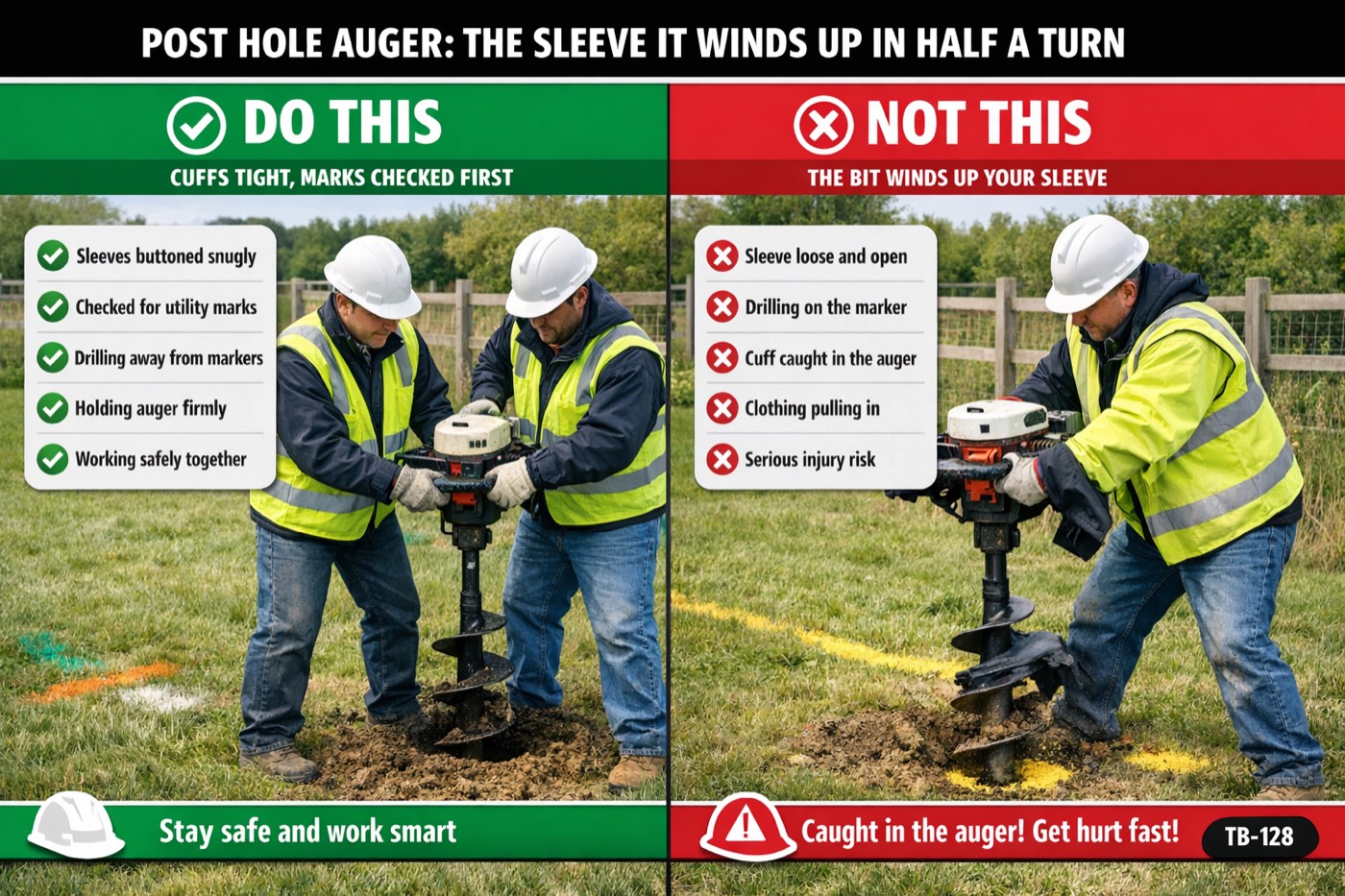
A two-man auger bit turns about 150 times a minute. A loose sleeve wraps on it in less than half a turn, and the auger does not stop because your arm is in the way.
The points
- The bit catches a root, the engine keeps pushing, and the handles swing around into the ribs of the man on the other end. That is torque reaction, and a two-man auger does it every time the bit stops and the engine does not.
- Nothing loose near the bit: no drawstrings, no open jacket, no loose glove cuff, no lanyard, no hair out of the shirt. Sleeves down and cuffs tight, because the bit only needs to catch an edge.
- Post holes are excavation: call 811 before the first hole, wait the notice period, usually two to three working days, and never auger through a paint mark. A gas lateral can be 18 inches down and a fence hole goes 24 to 36.
- On the skid steer auger, the operator stays in the seat and nobody guides the bit by hand while it turns. If a rock has to come out or the bit cleared, the machine stops and the hydraulics go dead first.
- The throttle on a two-man auger is a dead-man: let go and the bit stops. If it binds, let it stop, do not fight it, and back it out under power only when both of you have your feet set.
Why it goes wrong
A 2 to 3 horsepower engine through a gear reduction puts a few hundred foot-pounds of torque at the bit. When an 8- or 10-inch bit stops dead on a root or a rock, that torque has nowhere to go but the handles and the two people holding them. Broken ribs, dislocated shoulders and a man thrown into the hole he was drilling are the usual results. A one-man auger is worse for the same reason: the operator's body is the only thing resisting the torque.
At 150 rpm a bit wraps a sleeve in a quarter of a second, faster than anyone can let go, and once the fabric is wrapped the arm follows it around the shaft. The dead-man throttle only helps if the hand on it is the free hand. Treat the bit the way you would treat a PTO shaft: nothing loose, nothing hanging, no gloves with wide cuffs.
29 CFR 1926.651 says the utility owners are contacted and the locations established before excavation starts, and a post hole is excavation. Gas service laterals commonly run 12 to 18 inches deep, and fiber and phone drops can be 6 inches. Most states require the 811 call two to three working days ahead and the ticket runs out after a set time that varies by state, 45 days in Washington. If you hit gas: shut off the engine, get everyone upwind and away, call 911 and the utility, and do not try to plug it.
A skid steer auger runs on 3,000 PSI hydraulics through a planetary drive, and the bit is not something a person steadies with a hand or a foot. The common mistake is the ground man guiding the bit onto the mark while it turns, when the operator cannot see the foot next to the bit from the seat. Set the mark with a stake, drop the bit on it with nobody within the length of the bit, and stop the machine before anyone walks up.
Other ways the auger gets you: wet clay that lets the bit pull itself down until it binds and reverses, a slope where your footing gives the moment the torque hits, and refueling a hot engine. The hole itself is a hazard once the auger leaves it: a 10-inch hole 3 feet deep in grass breaks an ankle. Cover or flag every open hole before lunch and before you leave.
Questions for the crew
- Has the 811 ticket for this line been called in, and where are the marks compared to the post line?
- Who is on the auger today, and what is each of you wearing that could catch on the bit?
- If the bit hits a root and stops, what does the man on the other handle do?
To close
Nobody starts the auger today until the marks are checked against the post line and every sleeve and cuff on both men is tight.
To hold this talk with your crew
1
Read it aloud. Five minutes, before the work starts.
2
Ask the questions. A crew that talks is a crew that remembers.
3
Have them sign on their own phones, and the record is sealed.