Post drivers: the hand on top of the post
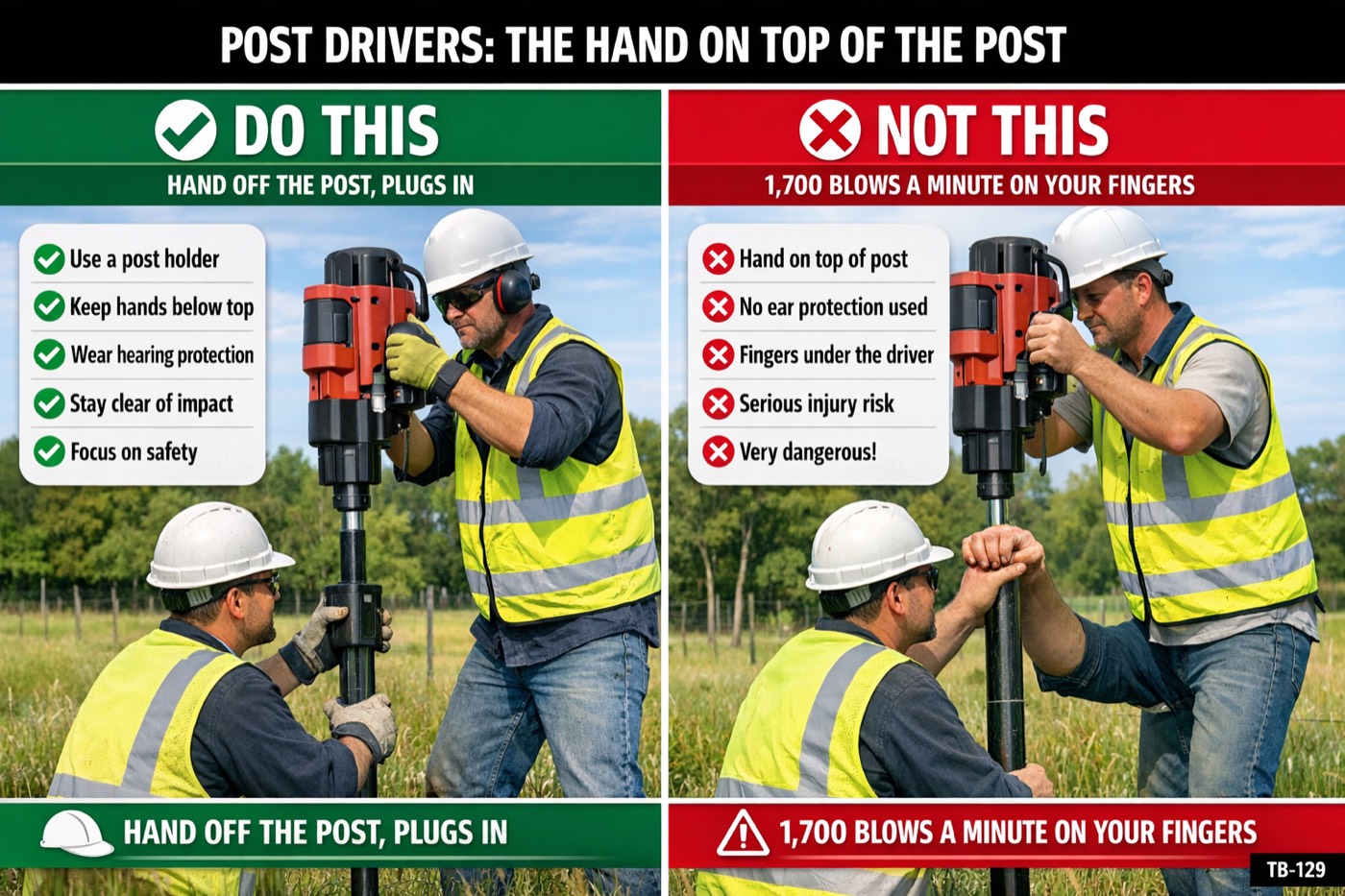
A gas post driver hits the post hundreds of times a minute. If your hand is steadying the top of that post, it gets all of them.
The points
- The injury is the hand on the post: the helper holds a T-post steady, the driver comes down, and the hand is between 30 pounds of steel and the post. Fingers do not survive that, and the ear next to a pneumatic driver at 110 decibels does not either.
- Nobody holds the post by hand under the driver. Use a post holder or a grip with a handle that keeps your hand a foot below the top, and set the post plumb before the driver goes on.
- The driver goes on the post before it starts and comes off after it stops. A running driver lifted off a post is a hammer swinging in the air, and a hand driver that misses the post drops onto the man swinging it.
- Pneumatic drivers run at 90 to 120 PSI. The tool is clipped to the hose so it cannot blow off, and a hose over half an inch has a safety device at the compressor that cuts the flow if the hose lets go.
- Hearing protection for the man on the driver and the man next to it: plugs or muffs, every post, not just the first ten. And glasses, because a rusted post top sheds scale with every blow.
Why it goes wrong
A manual T-post pounder weighs 14 to 20 pounds and you lift it over your head 30 to 50 times per post. The injury is the miss: the tube slips off the post and the whole weight lands on the hand below, or the closed end comes down on your head when the post kicks sideways. The other injury is the shoulder after 200 posts. Trade off every 20 posts, and keep the post inside the tube until it is set deep enough not to kick.
Gas and pneumatic drivers weigh 30 to 45 pounds and the piston hits the post hundreds of times a minute, depending on the model. Steadying the post by hand is the common mistake, because the post wants to walk as it starts. A post level with a handle, or a second man with a long grip, keeps every hand a foot below the top, and a post that is plumb before the first blow does not need steadying after it.
29 CFR 1926.302 requires the tool secured to the hose by positive means and, for hoses over a half inch inside diameter, a safety device at the source that reduces pressure if the hose fails. A 3/4-inch hose at 100 PSI that lets go whips a brass fitting around at head height faster than you can duck. Whip checks at every coupling. Never fold a hose to stop the air; shut the valve.
A pneumatic post driver runs 105 to 115 decibels at the operator's ear. The construction limit is 90 decibels averaged over 8 hours; at 105 the allowed time is one hour, and at 115 it is 15 minutes. A morning of driving posts without plugs is over the daily dose before the first break, and the loss is permanent and adds up year over year. Muffs with plugs under them on the driver, plugs on the man next to it.
Plumb the post before driving, because straightening a post that is 18 inches in means pulling it against its own hold with your back. A driver that meets rock bounces; watch the post top for mushrooming, which means the post is not going anywhere and is shedding sharp steel. Pre-drill in rock instead of beating on it.
Questions for the crew
- Who is steadying posts today, and what is keeping their hand a foot below the top?
- Where are the plugs and muffs, and does everybody on the driver have their own?
- Where does the hose run, and what is on the compressor if it lets go?
To close
Today no hand goes under the driver, and the plugs go in before the first post, not after your ears ring.
To hold this talk with your crew
1
Read it aloud. Five minutes, before the work starts.
2
Ask the questions. A crew that talks is a crew that remembers.
3
Have them sign on their own phones, and the record is sealed.