Scaffold checks before you climb on
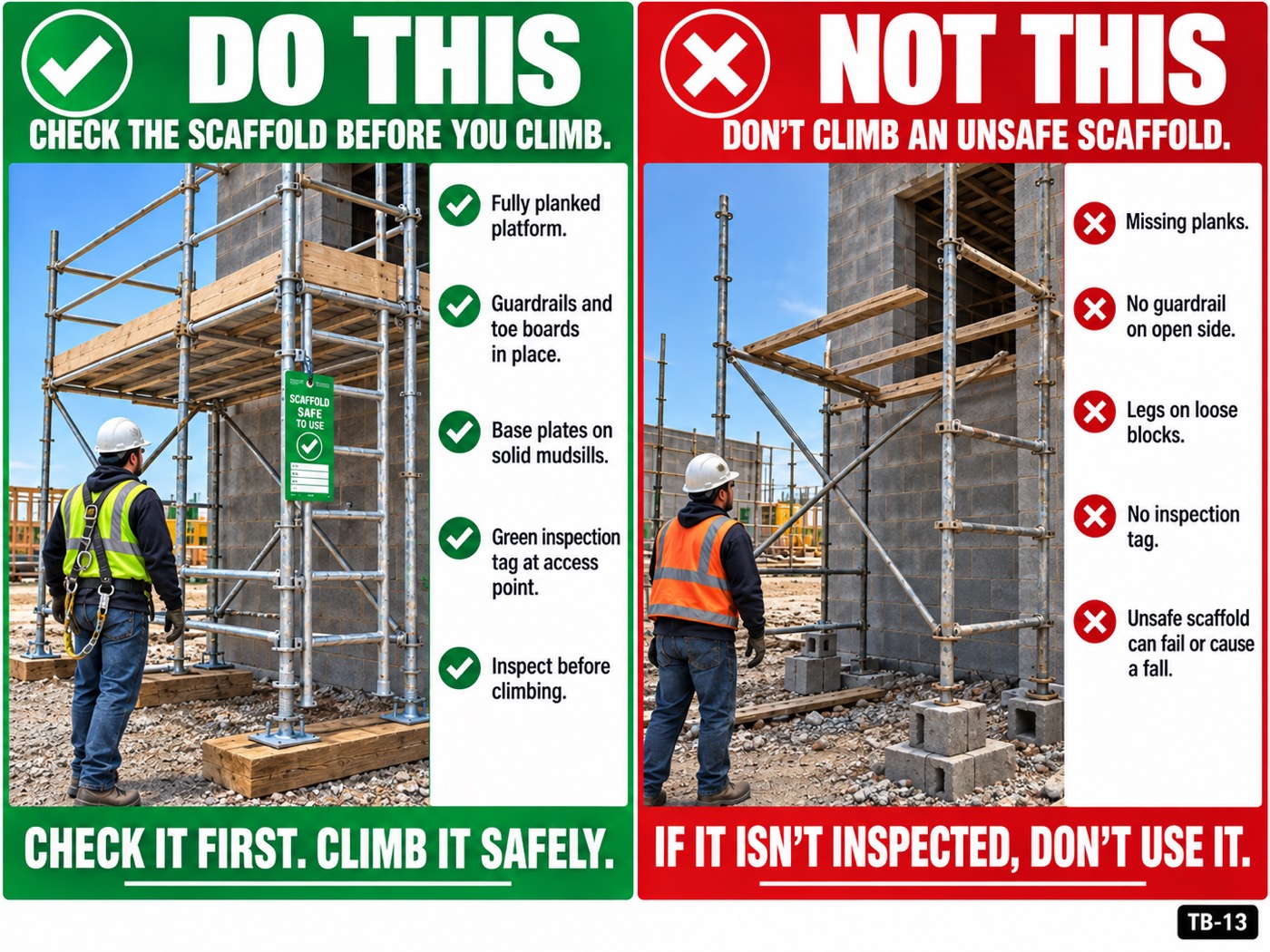
Before anybody steps on that scaffold, I want to know who built it and whether it has a tag.
The points
- Every scaffold must be erected, moved, and dismantled under the supervision of a competent person.
- Base plates and mud sills on firm footing. Not on blocks, bricks, or loose material.
- Fully planked, planks secured, and no gaps you could put a boot through.
- Guardrails on scaffolds ten feet and higher, on every open side.
- Never climb the cross braces. Use the built-in ladder or a separate one.
Why it goes wrong
Scaffolds must support their own weight plus four times the maximum intended load. That's not a suggestion; it's what the standard requires, and overloading is a common cause of collapse.
Maintain ten feet of clearance from energized power lines up to 50kV, and more above that. Scaffold and power lines together account for a steady stream of electrocutions every year.
Check the tag. If a scaffold is tagged out or has no tag at all, treat it as unsafe until the competent person clears it.
The footing is where most of the failures start, and it is the easiest thing to get wrong because it is done first and buried under everything after. Base plates and mud sills go on firm ground. Blocks, bricks, scrap lumber and loose fill all fail the same way: they hold under static weight and then shift when the load moves, which is when people are on it.
Planking is the second one. Fully planked means no gaps, and secured means the plank cannot slide or tip when weight lands on the end of it. A plank that shifts a few inches at the wrong moment does not need a big gap to put someone through.
Climbing the cross braces is common because it is faster and the braces are right there. They are not designed as a climbing surface, the spacing does not match a human stride, and there is nothing to grab at the top.
Questions for the crew
- Who put this scaffold up, and are they the competent person?
- What's the heaviest load we'll put on it today?
- How far are we from the nearest power line?
To close
Look at the base and look at the planking before your first climb today.
To hold this talk with your crew
1
Read it aloud. Five minutes, before the work starts.
2
Ask the questions. A crew that talks is a crew that remembers.
3
Have them sign on their own phones, and the record is sealed.