Heavy panels: 200 pounds and the wind that takes it
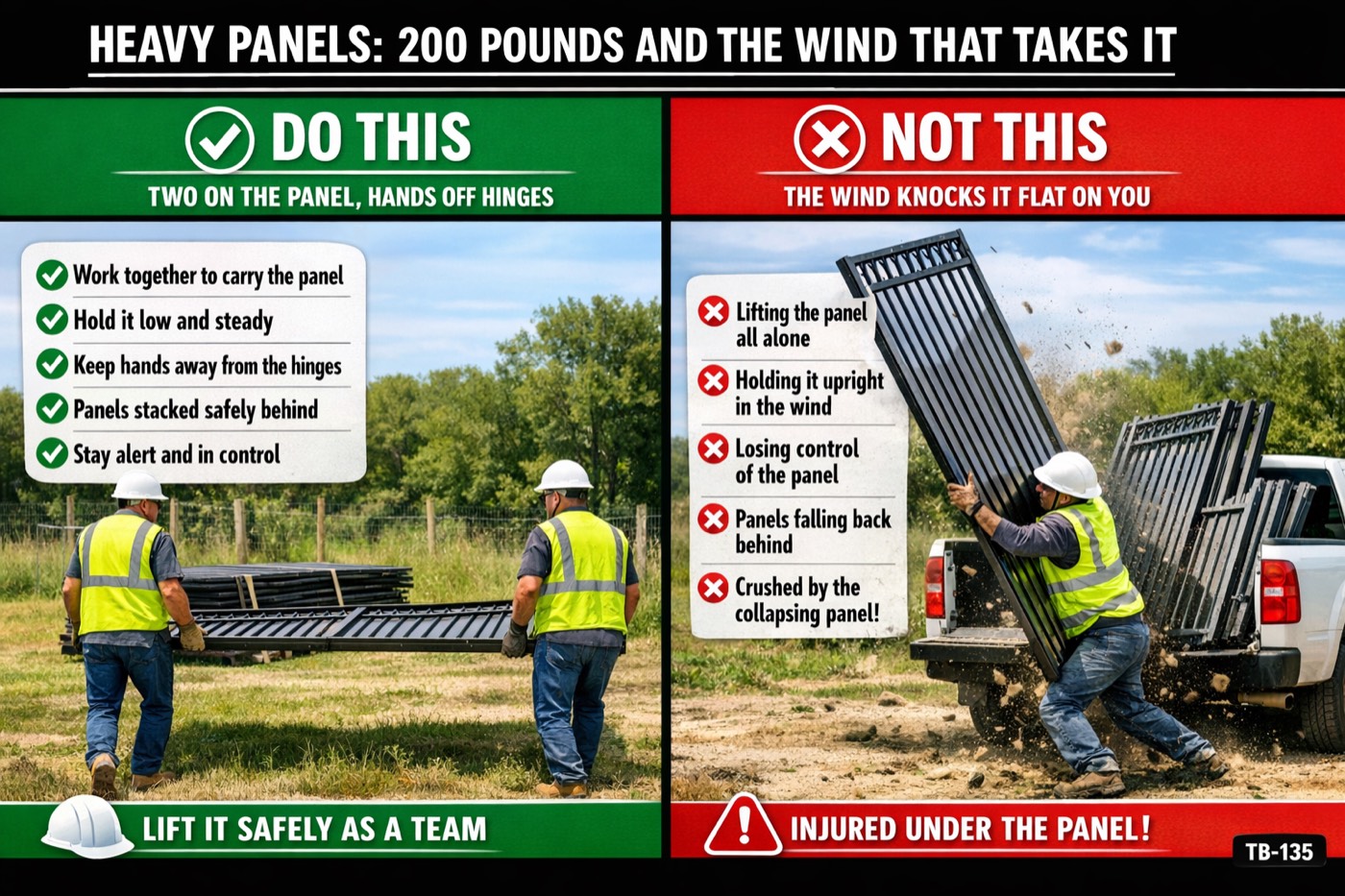
A 6-by-8 ornamental steel panel is about 48 square feet of sail. At 30 miles an hour the wind pushes on it with 110 pounds, and it does not care that two men are holding the other side.
The points
- Panel injuries are the finger at the hinge when the leaf swings shut, the back when the second man lets go early, and the man knocked flat by a panel the wind took, with the panel on top of him.
- Panels over 100 pounds, and that is most 8-foot steel and every gate leaf, get two men and a plan before the lift: who calls it, where it goes, and which way it leans. If it starts to go, let it go; the panel is cheaper than the back.
- Hands stay off the hinge line and out of the gap between panel and post. The pinch at a gate hinge is the whole weight of the leaf on a fingertip, and it closes with a gust or a bump.
- A panel on edge is a sail. Above about 20 miles an hour panels stay flat on the ground or strapped on the trailer, and a gate leaf goes on its hinges only when the crew can hold it in the gusts.
- Stack panels flat on dunnage, or lean them at a shallow angle against something that cannot move, and tie them. A stack leaned on a stake or the tailgate is a stack waiting to fall on whoever pulls the first one out.
Why it goes wrong
A 6-by-8 aluminum ornamental panel is about 40 pounds and a steel one 80 to 120. A commercial 8-foot-high three-rail steel panel runs 200 pounds, a 12-foot double-drive gate leaf 250 to 400, a 50-foot roll of 6-foot 9-gauge chain link about 120, and a wood privacy panel 100 pounds when it is wet. Anything over 50 pounds is a two-man lift by the NIOSH numbers; anything over 100 is two men or a machine without discussion.
Wind pressure in pounds per square foot is about 0.00256 times the speed squared: 20 miles an hour is 1 pound per square foot, 30 is 2.3, and 40 is 4. On a 48-square-foot panel that is 49, 110 and 197 pounds, and a gust delivers it in a second. A gate leaf hanging on one hinge with the wind on it is a lever with the hinge as the pivot; it rips the hinge out or takes the man on the free end with it. Check the forecast for gusts, not the average.
A 300-pound gate leaf swinging on its hinges closes the gap on the hinge side from 2 inches to nothing, and that is a finger amputation. Hang gates with the leaf blocked open on a jack or a stand at the right height and a second man holding it, hands on the rails, not the hinge stile. When the hinges are being welded on, the leaf is held by the stand, never by a man.
Carry a panel with two men on the same side, panel on edge, and the panel on the downwind side of both of you so a gust pushes it away rather than into you. Gloves on, hands on the rails away from the ends, because the corner of a panel is what goes into the eye of the front man when the back man trips. On a slope the downhill man has the weight; swap when the grade changes.
Stacks fall when a panel is pulled from the middle and the ones above it slide. Stack flat on dunnage where you can, and if panels have to lean, lean them shallow against a post or the truck and tie the stack. Wood panels on edge on a windy day go over like dominoes. On the trailer, release the strap only with a man holding the panels on the lee side, because the wind is waiting for the strap to come off.
Questions for the crew
- What is the heaviest section going in today, and who is on each end of it?
- What is the wind doing this afternoon, and at what point do the panels stay on the trailer?
- When the gate leaf goes on its hinges, what is holding it besides a man?
To close
Today nothing over 100 pounds moves with fewer than two men on it, and the first gust that pushes a panel around puts the rest of them flat until it passes.
To hold this talk with your crew
1
Read it aloud. Five minutes, before the work starts.
2
Ask the questions. A crew that talks is a crew that remembers.
3
Have them sign on their own phones, and the record is sealed.