Fence pliers and screw guns: the nail through the glove
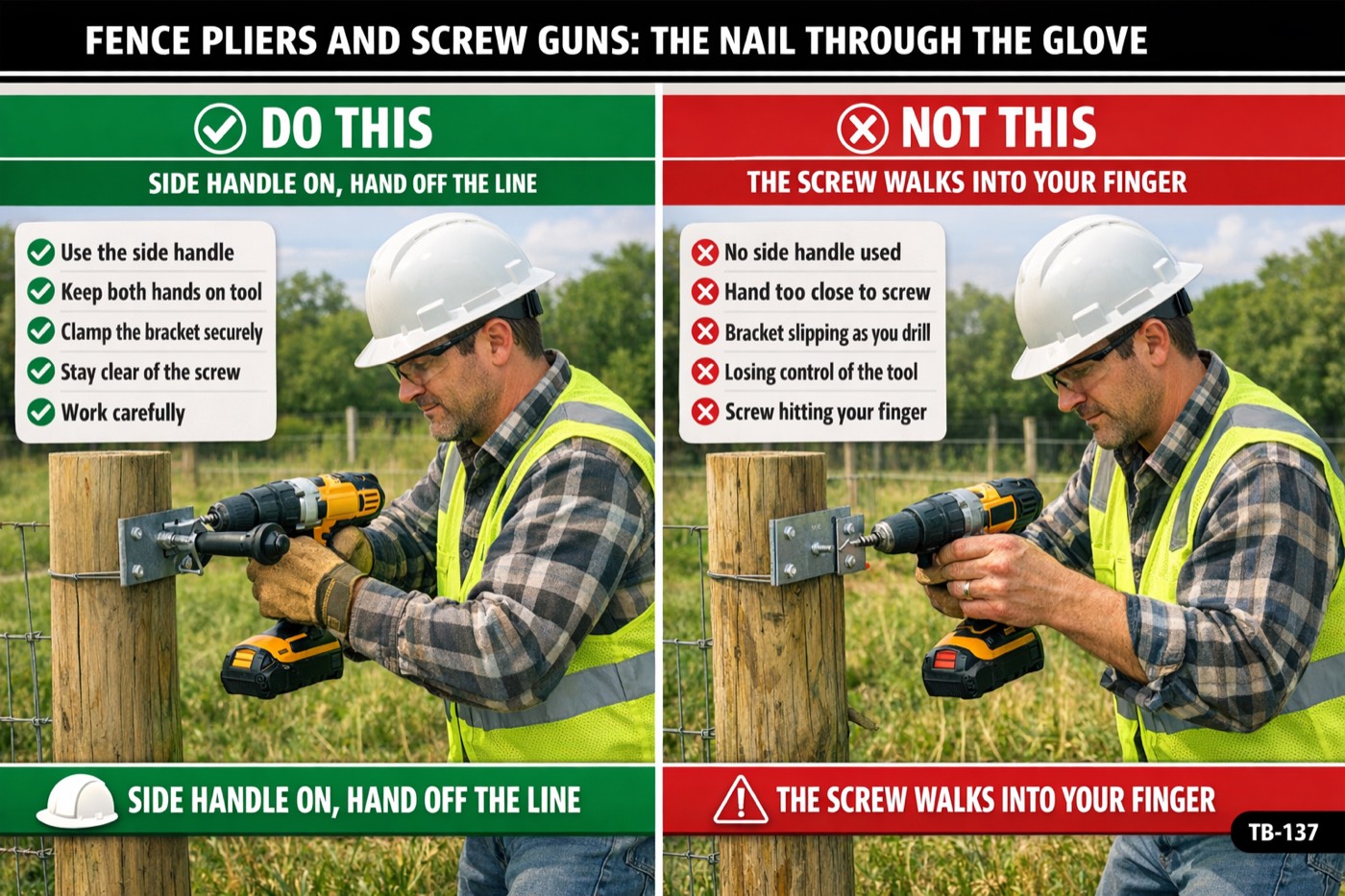
A 1/2-inch hammer drill that binds in a post puts about 50 foot-pounds into your wrist before you can let go of the trigger. That is enough to break it.
The points
- The tool injuries on a fence job are small and permanent: the hammer drill that twists the wrist when the bit binds, the screw gun that walks a 3-inch screw into the finger holding the bracket, and the nail that goes through the glove and the hand behind it.
- Drills and screw guns get the side handle on and two hands, and no hand is ever where the bit or the screw ends up if it goes through. If the piece needs holding, hold it with a clamp or pliers, further from the screw than the screw is long.
- Fence pliers cut wire under tension and the ends fly. Cut with the pliers turned away from your face, glasses on, and the wire held on both sides of the cut.
- Tools are kept in shape: a mushroomed hammer head chips and puts steel in an eye, a split handle lets the head go, a trigger taped on cannot be shut off. Tools with guards get used with the guards, and a broken tool goes back to the truck with a tag on it.
- Fasteners: hog rings, tie wire ends, ring-shank nails through the pickets. Bend the ends in, clip the tie wire flush, and pick up what you drop, because the next man kneels there.
Why it goes wrong
A 1/2-inch corded hammer drill puts out 50 to 70 foot-pounds of torque. When the bit binds in a post, in rebar in the footing or in the back of a bracket, the bit stops and the tool spins instead, and the reaction goes into the wrist on the handle. Newer tools have a kickback clutch; the old ones on the truck do not. Side handle on, both hands, feet set, moderate speed, and do not lean your body weight on the drill, because that is what keeps your hand on it after it lets go.
An impact driver sinks a 3-inch screw through a 2-by-4 in two seconds, and when the bit cams out of the head the screw goes wherever it was pointed. If the bracket is held by a finger an inch from the screw, that is where it goes. Start the screw with a tap or a pilot hole, hold the bracket with pliers, and keep the hand on the far side of the work from the screw. 29 CFR 1926.300 requires drills and screw guns with a lock-on to shut off with a single motion of the same finger; a taped trigger cannot.
Fence pliers cut 11-gauge tie wire, and both ends spring when the tension comes off the cut. The end left sticking out of the fabric is a cut for the next man and for the homeowner's kid, so twist the ends down into the mesh. Hog ring pliers close on a finger the same as on a ring. A fence staple held between finger and thumb for the hammer gets the miss; hold it with needle-nose pliers for the first blow.
A framing nailer on a wood fence follows the grain: the nail turns inside the picket and comes out the side into the hand holding it. Hands stay 12 inches from the nail line and never behind the work. Sequential trigger, air off when you climb or move the hose. A nail puncture that goes in past a quarter inch gets cleaned, watched for a week, and a tetanus booster if the last one was 5 or more years ago.
29 CFR 1926.300 says all tools, the company's or your own, are kept in safe condition and used with the guards they came with. On a fence truck that means the post driver and hammer heads ground back when they mushroom, chisels and punches the same, no cracked handles, no cords with the ground pin missing, and a grinder that has its guard. A tool that is not right goes on the seat with a tag, not back in the box for the next man to find the hard way.
Questions for the crew
- Which tools on this truck have a problem right now, and which one has been that way for a month?
- When you hold a bracket for a screw, where is your hand, and where does the screw go if it misses?
- Who here has had a drill twist their wrist, and what was different about that hole?
To close
Today every drill has its side handle on, every screw starts with the hand out of its line, and the broken tool goes on the seat with a tag, not back in the box.
To hold this talk with your crew
1
Read it aloud. Five minutes, before the work starts.
2
Ask the questions. A crew that talks is a crew that remembers.
3
Have them sign on their own phones, and the record is sealed.