Lockout tagout before you reach in
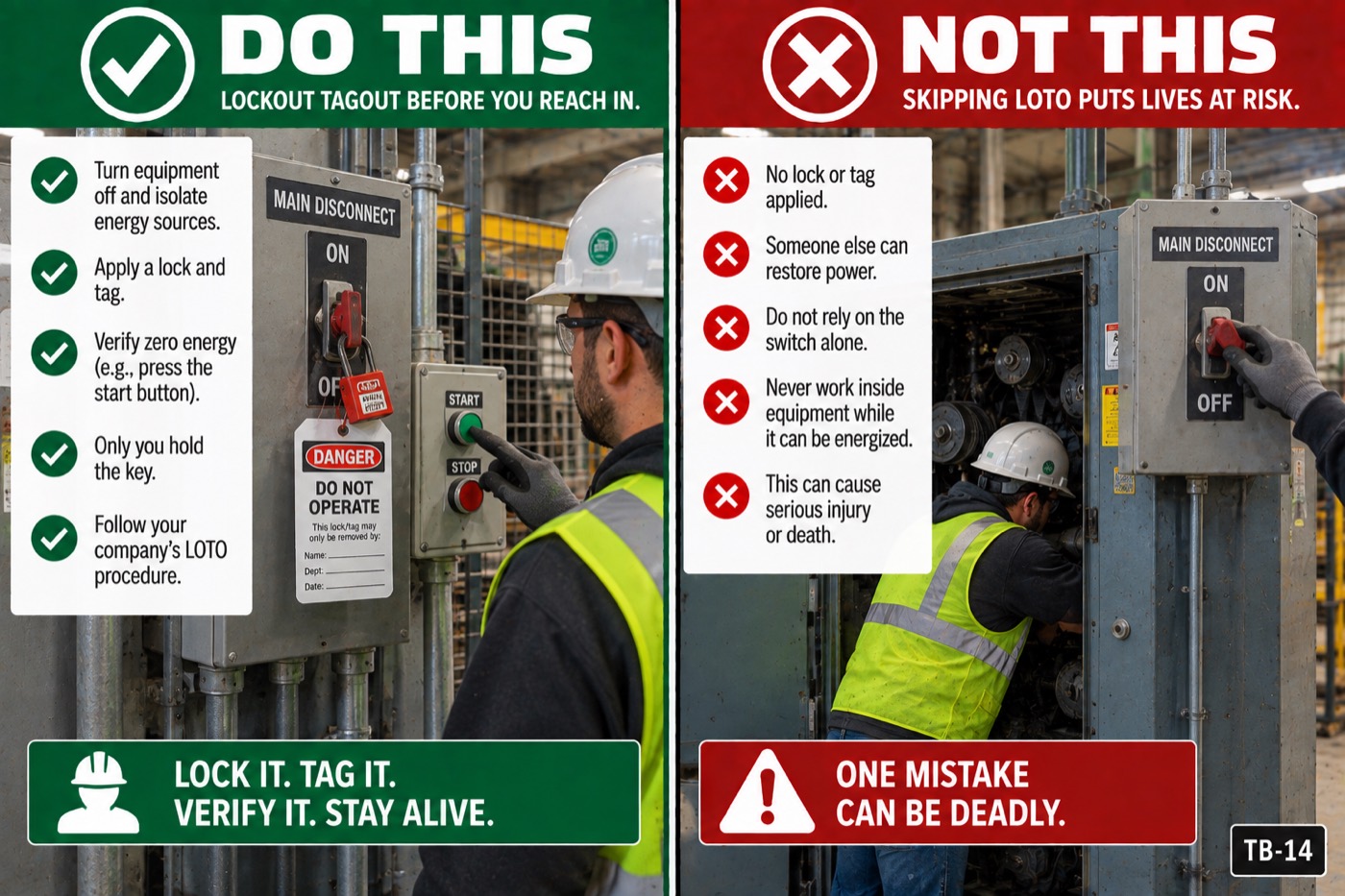
Your lock, your key. Nobody takes that lock off but you - and that is a promise the crew makes to you, not a rule I am reading out.
The points
- If the machine can start while your hand is in it, it will eventually start while your hand is in it.
- Shut it down, isolate the energy, lock it, tag it, then test that it's actually dead.
- Your lock, your key. Nobody removes another person's lock. Ever.
- Stored energy counts: springs, hydraulics, capacitors, raised loads, compressed air.
- Multiple people means multiple locks on a group lockout device. One person, one lock, one key.
Why it goes wrong
The step people skip is verification. Turning the switch off and assuming it worked has killed people. Try to start the equipment after you lock it out, then return the controls to off.
Removing someone else's lock is the single most dangerous shortcut in this whole procedure. There is a formal process for it involving the employer, documented attempts to reach the person, and notification before they return to work. It is not something a supervisor does because a shift is ending.
Stored energy is what catches experienced people. The power is off and the machine is still holding a raised bucket, a compressed spring, a charged capacitor, pressure in a hydraulic line, or air in a receiver. All of it releases when something is disconnected, and it releases at the speed the system was designed to move. Isolating means bleeding it down and blocking it, not just switching it off.
Verification is the step that turns a procedure into protection. Breakers get mislabeled, disconnects fail to open all poles, valves pass when they are supposed to seat. Trying to start the equipment is the only thing that tests what actually happened rather than what should have.
Group lockout exists because a single lock protects a single person's assumptions. When several people are working, each puts their own lock on the device, and the machine cannot be restored until the last one comes off. That way nobody's safety depends on someone else remembering they are in there.
Questions for the crew
- What energy sources does the equipment we're working on have besides electrical?
- Where are the locks and tags kept on this job?
- What would you do if you found a lock and nobody knew whose it was?
To close
After you lock it, try to start it. If you skip that step you have not locked anything out.
To hold this talk with your crew
1
Read it aloud. Five minutes, before the work starts.
2
Ask the questions. A crew that talks is a crew that remembers.
3
Have them sign on their own phones, and the record is sealed.