The morning after: a 0.03 at 6 a.m. still counts
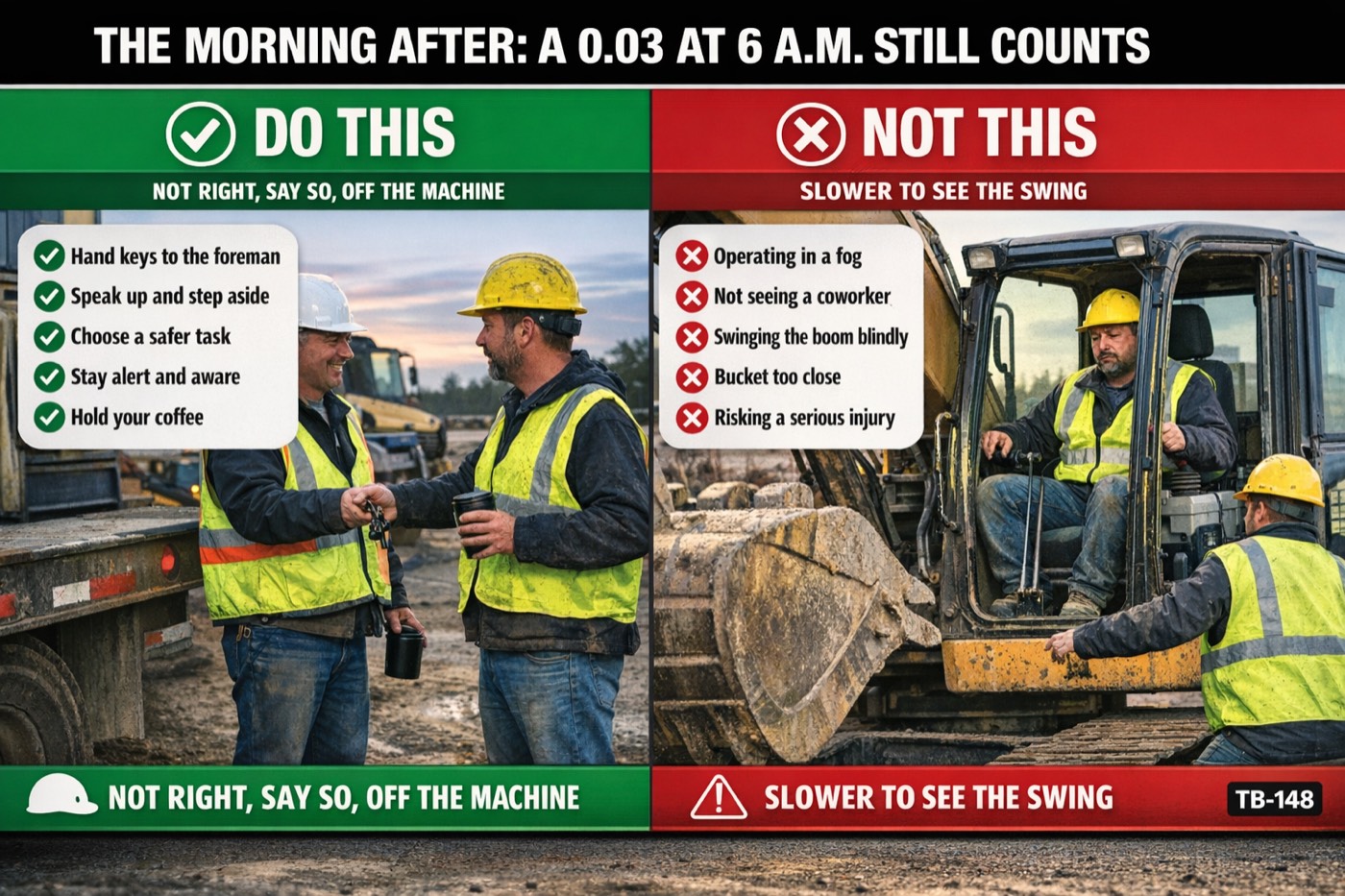
Your liver clears about one drink an hour, roughly 0.015 of blood alcohol. Six beers between ten and midnight put a 180-pound man near 0.12, and at 6 a.m. he is still around 0.03 and reading like a hangover. He is not sober. He is less drunk.
The points
- Impaired does not mean falling down. At 0.03 you are slower to see the excavator swing, slower to step back, worse at judging the edge. A hangover with a zero alcohol level still cuts reaction time and attention for most of the morning.
- The company rule is simple and it is not a moral position: nobody works impaired, by anything. Alcohol, weed, pills, the legal ones and the other ones. The rule is there because the excavator does not care what it was.
- Prescriptions count. If the bottle says may cause drowsiness or do not operate machinery, tell the foreman before the shift. We will find you work; that is easier than finding a new operator.
- Weed: legal in the state does not mean legal on the job, and the impairment lasts hours past the feeling. Commercial drivers on this crew are under DOT rules, and a positive test ends that license for a long time.
- If you show up and you are not right, say it. Being sent home with a warning is the good outcome. Being the reason for the accident is the other one.
Why it goes wrong
How alcohol leaves: the body burns roughly 0.015 to 0.017 BAC per hour and nothing speeds it up, not coffee, not a shower, not breakfast. So a man who stopped drinking at midnight at 0.12 is still at about 0.03 at 6 a.m. and does not reach zero until around 8. If he drove to work he drove impaired; if he climbs at 7 he climbs impaired. DOT pulls a commercial driver off the road at 0.02.
The hangover after the alcohol is gone: dehydration, low blood sugar, poor sleep and inflammation. Studies of pilots and drivers show reaction time and attention still measurably worse at zero BAC the morning after heavy drinking. It does not show on a breath test. It shows on the saw table.
Cannabis: THC impairs reaction time, tracking and judgment of distance for three to six hours after smoking and longer for edibles, and the feeling wears off before the impairment does. There is no roadside number for it the way there is for alcohol, which is why company rules go by fitness for duty and by the test after an incident. State legalization did not change federal DOT rules or the company's.
Prescriptions and the label: opioids for the back, muscle relaxers, some antihistamines, sleep aids, and a lot of anxiety medication carry the drowsiness warning, and the first week on a new one is the worst. Telling the foreman is not telling the crew your business; it is the foreman's job to put you on the job you can do that day. The employer's duty under 1926.20(b)(4) is to let only qualified people run equipment, and a qualified operator on a new sedative is not qualified that morning.
There is no OSHA construction section on alcohol or drugs. What there is: the employer's duty under 1926.20(b) to keep the site safe, the company policy you signed, the DOT rules in 49 CFR Part 382 for anyone with a CDL, and the post-accident test that will be done and will be read. Impairment turns a small mistake into a fatality and a fatality into a criminal case.
The energy drinks, the pills to stay awake, the guy who is fine because he does this every day: tolerance changes how you feel, not how you perform. The man who says he works better after a couple has been measured, and he does not. None of this is about who you are on Saturday. It is about who is on the lift on Monday.
Questions for the crew
- What on this site today would go wrong first if the man doing it was at 0.03?
- Is anyone here on a new prescription this week, and does the foreman know what it says on the label?
- If a guy on this crew showed up rough, would you say something, and to whom?
To close
Anyone here who is not right this morning says so now, gets off the equipment today, and we sort the rest out with the office, not at the tailgate.
To hold this talk with your crew
1
Read it aloud. Five minutes, before the work starts.
2
Ask the questions. A crew that talks is a crew that remembers.
3
Have them sign on their own phones, and the record is sealed.