New site: the walk before the first cut
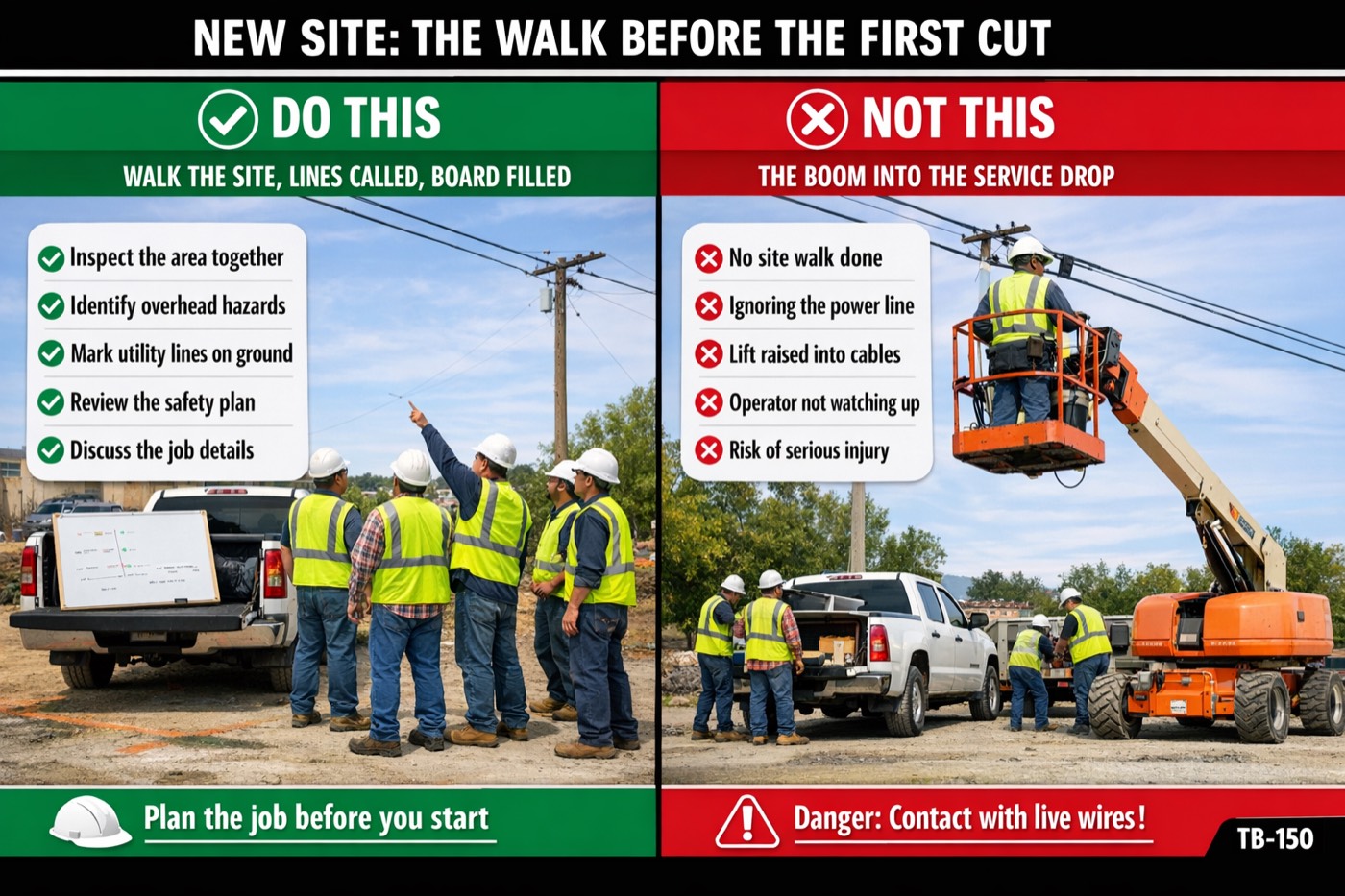
The overhead line you did not see is the one you drive the boom into. On a site you have never stood on, everything you know about the last site is a guess about this one.
The points
- The first day on a new site is when the crew hits the service drop, backs into the trench the other sub dug yesterday, and cannot tell the ambulance where to come. Nothing here is where it was last week.
- The rule is training in recognizing and avoiding unsafe conditions and the rules that apply to the work, and every new site has its own. The GC's orientation is not a formality; it is where you find out what they know that you do not.
- The walk, before any tool starts: overhead lines and the 10-foot clearance, underground locates and their paint, the excavations and edges, where the other trades are, where the trucks come in, where the muster point is.
- Emergencies: the site address said out loud, the nearest hospital and the drive time, where the first aid kit and the AED are, and who the GC's competent person is. Put it on the whiteboard or the tailgate before the first cut.
- The GC's rules are the rules on their site: the PPE they require, the hours, the hot work permit, the sign-in, the lift inspection tags. You follow them even where your own are looser, and you tell the foreman where theirs are looser than ours.
Why it goes wrong
1926.21(b)(2) requires the employer to instruct each employee in recognizing and avoiding unsafe conditions and in the regulations that apply to his work environment. The environment changed, so the instruction has to happen again. The first-day walk is that instruction, done on the ground, with the hazards pointed at, not read from a form in the truck.
Overhead lines: crane and lift work needs at least 10 feet from lines up to 50 kV under 1926.1408 and 1926.600(a)(6), and more as voltage rises. The line you miss is the service drop to the house next door, or the one behind the tree line, or the one the last sun angle hid. On the walk, every man looks up and somebody says the lines out loud. The overhead lines talk covers the rule; this one is about doing the walk on a site nobody has been on.
The muster point and egress: 1926.34 says exits are kept clear and marked where they are not obvious. On a new site, ask the GC where they gather, and walk to it once so your feet know the way in a fire or a gas leak. Then pick your own crew's spot if the GC does not have one, say it, and the foreman counts heads there.
The nearest hospital: know the name, the address, and roughly how long the drive is, because 1926.50(f) says emergency numbers and the site location are posted, and because a site 45 minutes from a trauma center changes what a bad bleed means. In a 911 area, the address of this site is the first thing said on the call, so the whole crew hears it on day one.
Site-specific hazards you inherit from other trades: the trench the plumber left, the floor hole the framer covered with a loose sheet, the scaffold that is somebody else's and has no tag, the live panel the electrician is working, the fuel and the gas cylinders somebody stored under the stair. Ask the GC's super what is open, what is energized, and what is scheduled for today near where you will be, including deliveries and cranes.
The common mistake is treating the first hour as lost time and skipping the walk to get set up. A 20-minute walk with the whole crew is the cheapest thing on the schedule, and it is when the foreman finds out the GC's rules on lifts, tie-off, hot work permits, and the hard hat and vest policy, and finds out who to call when something is wrong on their side. Write down the super's cell.
Questions for the crew
- What did you see on the walk this morning that is different from the last site, and who else on the crew saw it?
- Where is the muster point here, and who is the GC's super, by name and by number?
- Which overhead or underground lines are within reach of anything we will lift or dig today?
To close
Nobody starts a tool on this site today until the walk is done, the lines are called, and the address and the hospital are on the board.
To hold this talk with your crew
1
Read it aloud. Five minutes, before the work starts.
2
Ask the questions. A crew that talks is a crew that remembers.
3
Have them sign on their own phones, and the record is sealed.