Adhesive vapors: the pilot light 30 feet away
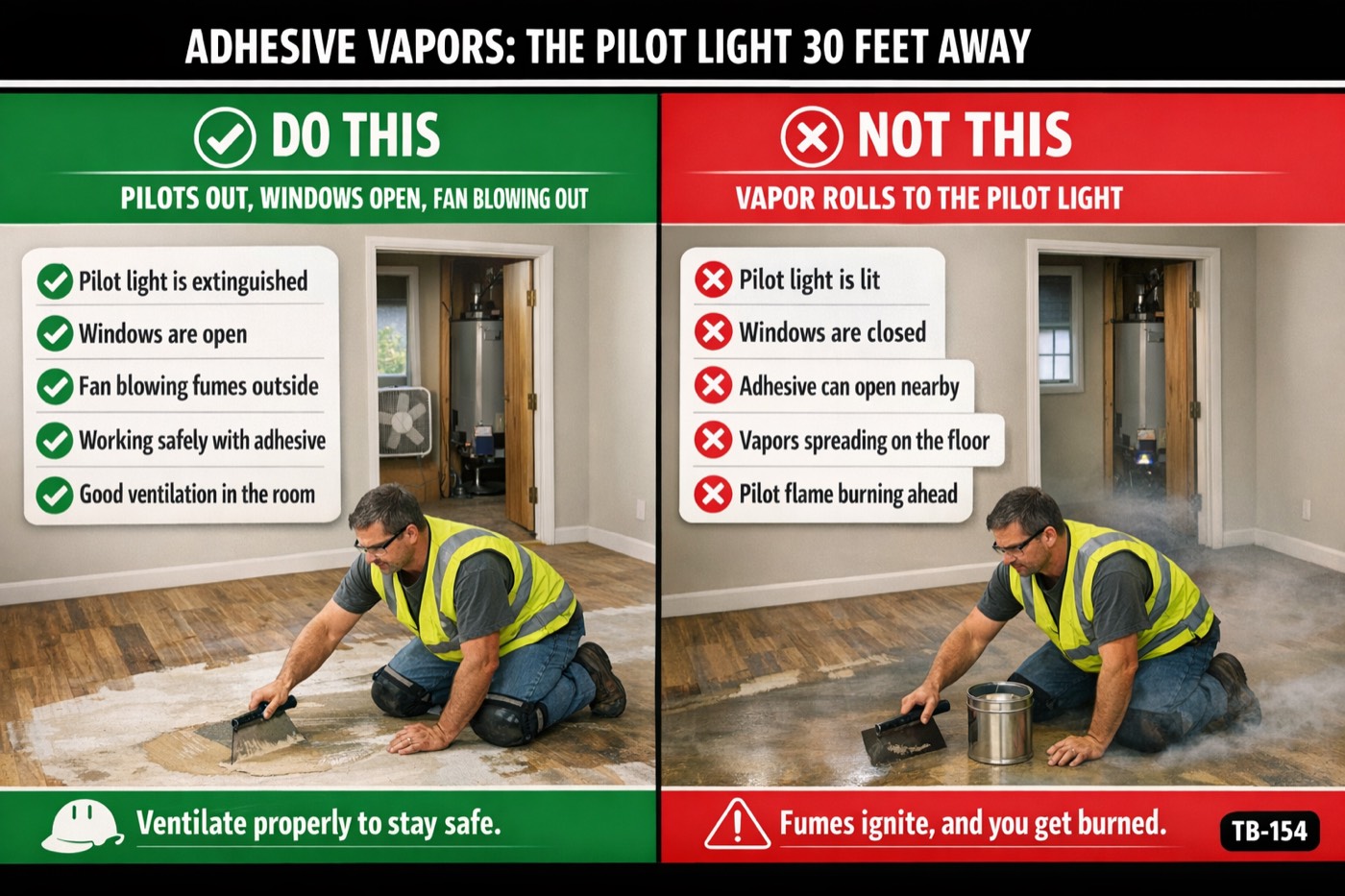
Solvent vapor is heavier than air. It rolls off the floor you are spreading, along the hallway and under the door of the closet where the water heater pilot has been burning since 2009.
The points
- Contact adhesive, seam sealer, solvent primers and some cove-base cements flash below 100 °F, which means the vapor over the pail will light at room temperature. The flame front runs back through the vapor to you and the room goes up around you.
- The rule says a flammable liquid is used only where there is no open flame or other ignition source within 50 feet, and the container is closed whenever it is not actually in use. In a house that means the water heater and furnace pilots are out, and nobody smokes at the door.
- Ventilation is a window open on each side of the room and a fan blowing out. It is not the furnace fan, which pulls the vapor through the whole house and past the burner.
- Low-VOC is not no-VOC. A label that says low odor or green means the product is under a regulatory number, not zero, and a closed bedroom fills anyway.
- Headache, dizziness or a taste in your mouth means you are over the limit right now. Get out, get air, and fix the ventilation before anybody goes back in.
Why it goes wrong
A flammable liquid is one with a flash point under 199.4 °F, and the ones that matter here, in categories 1 through 3, flash at or below 140 °F, and most of the ones in this trade flash below 100 °F. Solvent-based contact adhesive, carpet seam sealer and many cove-base and rubber-floor cements are in that group, and so is the acetone or mineral spirits in the truck for cleanup. Read the SDS, section 9, for the flash point, and section 2 for the pictogram. If there is a flame on the label, this talk is about that pail.
Vapor from these products is two to four times heavier than air. It does not rise and drift out the window; it pools on the floor you are working on and flows downhill like water, into the hall, down the stairs, under doors. A pilot light in a water heater closet, a furnace burner cycling on, a gas dryer, a refrigerator compressor relay clicking, a light switch. Any of them is an ignition source, and the flash goes back along the vapor trail to the pail and to the person kneeling over it.
The rule at 1926.152 is written for storage and dispensing, but the point-of-use line is plain: category 1, 2 or 3 flammable liquids may be used only where there are no open flames or other sources of ignition within 50 feet, unless conditions call for more. Fifty feet in a house is the whole floor. Turn the water heater to off or vacation, shut the furnace and any gas appliance off at the control, and tell the homeowner you did it so it gets relit properly when the vapor is gone.
Ventilation for solvents is cross-draft: an opening low on one side for air to come in and a fan in a window on the other side pushing out, so the vapor at floor level actually leaves. Running the home's HVAC does the opposite. It draws the vapor into the return, spreads it through every room and past the burner. Keep the lids on pails and cans when you are not dipping into them; an open gallon of contact cement evaporates for hours and puts out far more vapor than the floor you spread.
Water-based and low-VOC adhesives have taken most of the fire risk out of carpet and vinyl work, and they are still not nothing. Low-VOC means under a regulatory limit in grams per liter, not zero, and a full spread in a closed room with the windows shut still gives people headaches. Some of these products carry a mold inhibitor or an ammonia component that irritates the eyes and throat. Open the room up regardless of what the label says.
Your body is the meter you have. The air contaminant limits for toluene, xylene, hexane and the rest are set in parts per million; you cannot measure that, but a headache, light-headedness, a sweet taste or nausea means you are past the point where the exposure is safe. An N95 does nothing against vapor. If the job needs a respirator it is a half-mask with organic vapor cartridges, fit-tested, and the cartridge changed on a schedule, because you stop smelling the solvent long before the cartridge stops working.
Questions for the crew
- Which product on this job has a flame on its label, and where is the nearest pilot light to where it is going down?
- How is this room going to be ventilated with the doors closed, and who is checking the fan is still running at noon?
- If somebody gets a headache in that room after lunch, what happens next?
To close
Before the first pail is opened today, the pilots are out, a window is open on each side and the fan is blowing out.
To hold this talk with your crew
1
Read it aloud. Five minutes, before the work starts.
2
Ask the questions. A crew that talks is a crew that remembers.
3
Have them sign on their own phones, and the record is sealed.