Heat on a roof in summer
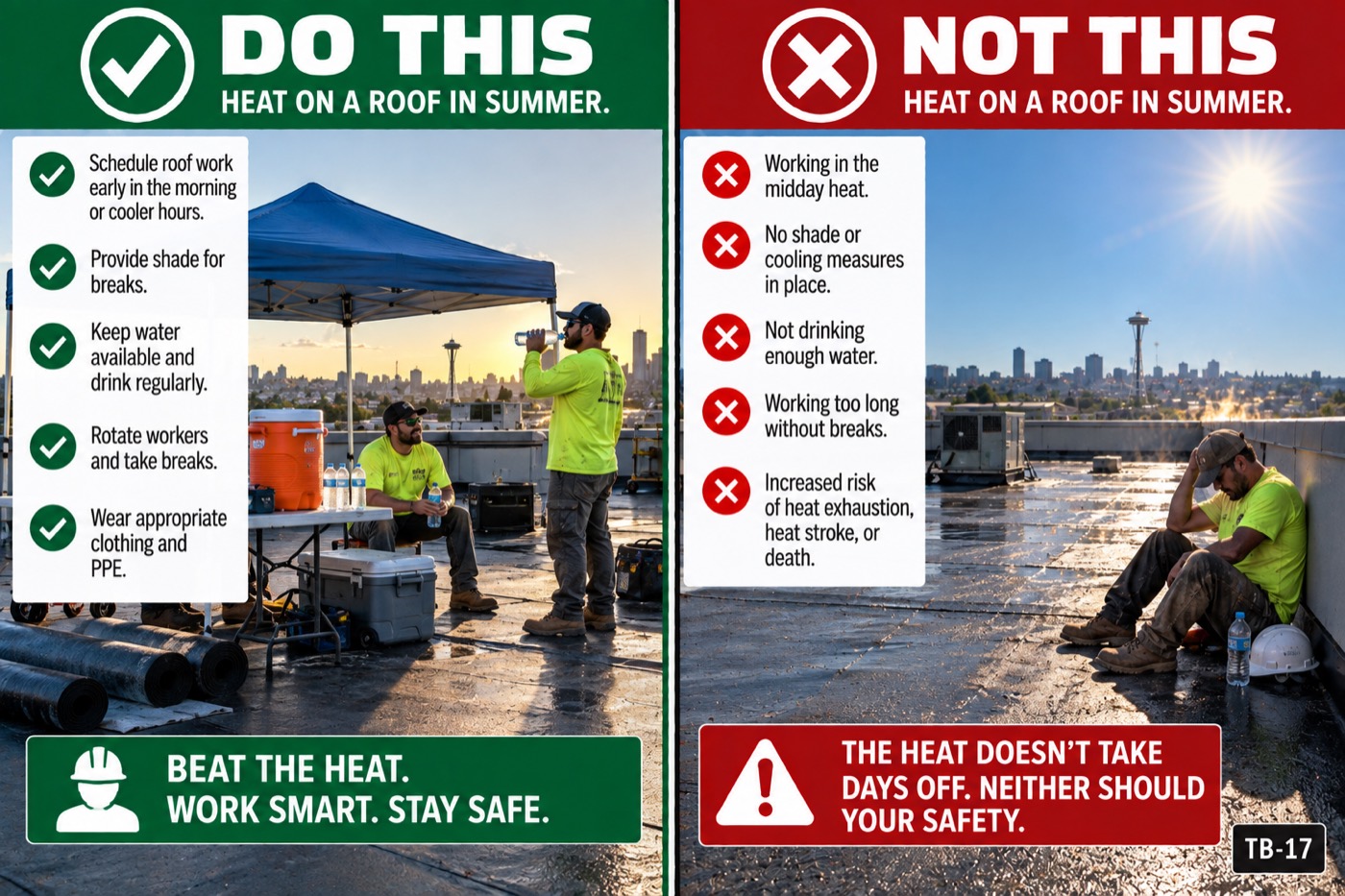
The air says ninety today. Where we are working it will be a lot more than that, and there is no shade up there at all.
The points
- A dark roof in direct sun runs far hotter than the air temperature, and there is no shade up there.
- Drink about a cup of water every twenty minutes. Don't wait until you're thirsty.
- Take breaks in real shade, at ground level, not behind an HVAC unit.
- New workers and people back from time off need to build up over the first week.
- Confusion, stumbling, or someone who stops sweating is a 911 emergency. Cool them immediately.
Why it goes wrong
Heat stroke is not heat exhaustion that got worse; it's a different medical emergency. Body temperature above 103, hot dry skin or heavy sweating, confusion, slurred speech, seizure. Untreated, it kills quickly, and even treated it can cause permanent organ and brain damage.
Cool the person immediately while waiting for the ambulance. Cold water immersion is the most effective method. Ice packs at the neck, armpits, and groin help. Do not wait for EMS to arrive to start cooling.
A roof is its own climate. A dark membrane in direct sun runs far above the air temperature, and it radiates that heat upward at the people standing on it, so the crew is taking it from above and below at once. The forecast is close to meaningless as a guide to what the work is actually like.
There is also nowhere to recover. On the ground, people drift into shade without deciding to; on a roof there is none, so rest has to be a deliberate trip down. That is why breaks get skipped - the cost of taking one is a climb, and by the time somebody feels bad enough to make that climb, they are already in trouble.
The shadow of an HVAC unit is not shade. It blocks some sun and blocks all the air, and the surrounding deck and the unit itself are both radiating heat. Real shade at ground level with moving air is what lets a body actually shed heat.
Acclimatization applies here more than anywhere. New workers and anyone back from time off need their hours built up across the first week - the fatalities cluster in the first few days.
Questions for the crew
- Where's our shade and water on this job, and is it close enough to actually use?
- Who here is new or just back from vacation?
- What would you do right now if someone became confused and stopped sweating?
To close
Come down for your breaks. Behind an HVAC unit is not shade.
To hold this talk with your crew
1
Read it aloud. Five minutes, before the work starts.
2
Ask the questions. A crew that talks is a crew that remembers.
3
Have them sign on their own phones, and the record is sealed.