Fresh foam burns: the pilot light and the thick pass
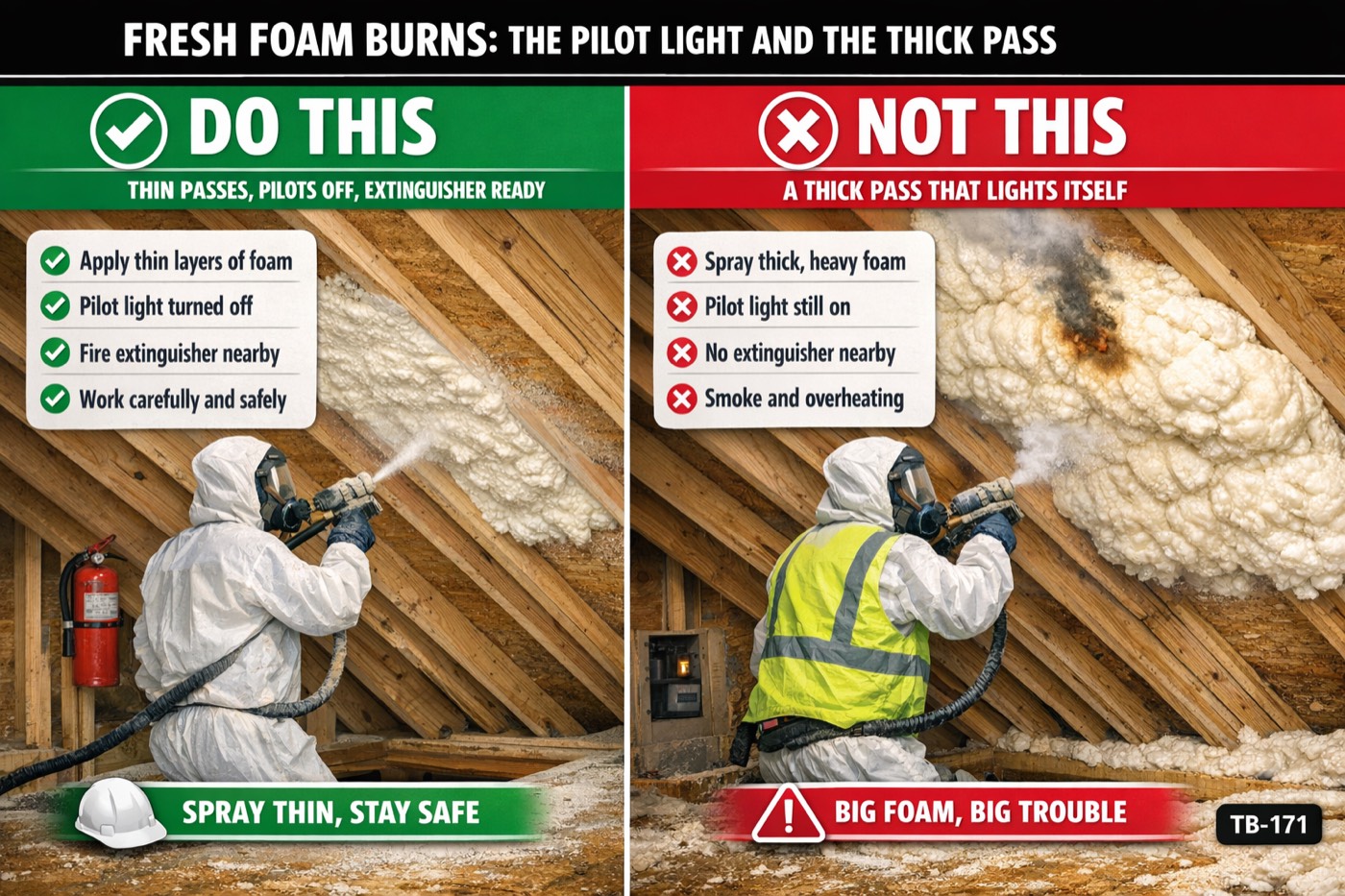
Spray foam is petroleum. A thick pass of closed cell heats itself past 200 °F as it cures, and there have been houses that burned from foam alone with nobody holding a torch.
The points
- Foam burns fast and the smoke is cyanide and carbon monoxide. Before the drywall goes over it, a plumber's torch, a grinder spark or a pilot light next to it is a house fire in an attic with you in it.
- Lift thickness per the manufacturer, typically 2 inches for closed cell, and wait for the pass to cool before the next. A 4-inch pass in one go traps its own heat, chars in the middle and can catch hours later.
- Every pilot light and gas appliance in the spray zone is off before you start: water heater, furnace, the attic unit. Flammable vapor from the B-side and overspray dust do not care that the flame is small.
- No hot work within 35 feet of exposed foam, and no torch or grinder in a foamed attic at all until the ignition barrier is on. If another trade needs to solder there, it happens before you spray or after the barrier.
- A 10-pound ABC extinguisher at the hatch or the door of every spray zone, and someone who knows where it is. Foam scraps and trimmings go out of the building in bags, not swept into a corner.
Why it goes wrong
Closed-cell foam cures with an exotherm: the reaction makes heat, and the foam is an insulator, so a thick pass keeps its own heat in the middle. A 2-inch lift peaks and cools; a 4- or 6-inch lift in one go can pass 300 °F in the core, char, scorch the framing, and smolder into a fire hours after the crew left. Put a hand on the pass before the next one; if it is too hot to hold, wait.
The thermal barrier rule is building code, not OSHA: foam inside a house needs 1/2-inch gypsum or an approved 15-minute barrier between it and the room, and attics and crawl spaces entered only for service need an ignition barrier, such as 1-1/2 inches of mineral fiber or an approved intumescent coating. Until that is on, the foam is exposed fuel, and every trade in the house is working next to it.
29 CFR 1926.352 bars welding, cutting and heating where flammable compounds create a hazard, and where hot work is done on a wall or ceiling, the same precautions apply on the other side. A plumber sweating copper in the wall cavity you foamed last week is hot work on your foam. Fire watch for 30 minutes after, extinguisher in reach, foam shielded or the work moved.
Check the B-side SDS for the blowing agent. Some are nonflammable HFOs; some blends and every gun-cleaning solvent are flammable, and overspray dust in the air is fuel as well. Pilot lights in the water heater and furnace, and the attic air handler's heat strips, go off before the first pass, and the solvent cans stay closed and outside the zone.
Polyurethane smoke carries hydrogen cyanide and carbon monoxide. In an attic, a foam fire fills the space with black smoke in under a minute, and you are 40 feet from the hatch on your knees. Know the way out before you start, keep it clear, and if there is smoke, go, do not fight it from inside.
The common mistake is the tool. A heat gun to warm a stubborn drum, a hot knife to trim, a halogen work light lying face down on fresh foam, a grinder on a bracket 10 feet away. Each one is an ignition source in a room lined with fuel. The extinguisher at the hatch is for the fire you catch in the first ten seconds, not the one you find at lunch.
Questions for the crew
- Which appliances in this house have a pilot light or heat strips, and who turned them off?
- What thickness are you laying per pass today, and how long between passes?
- Where is the extinguisher, and which way is out from the far end of this attic?
To close
Pilots off, passes at the sheet thickness with a cooling wait, and the extinguisher at the hatch before the first pull of the trigger.
To hold this talk with your crew
1
Read it aloud. Five minutes, before the work starts.
2
Ask the questions. A crew that talks is a crew that remembers.
3
Have them sign on their own phones, and the record is sealed.