Rigid board: the utility knife, the table saw and the dust
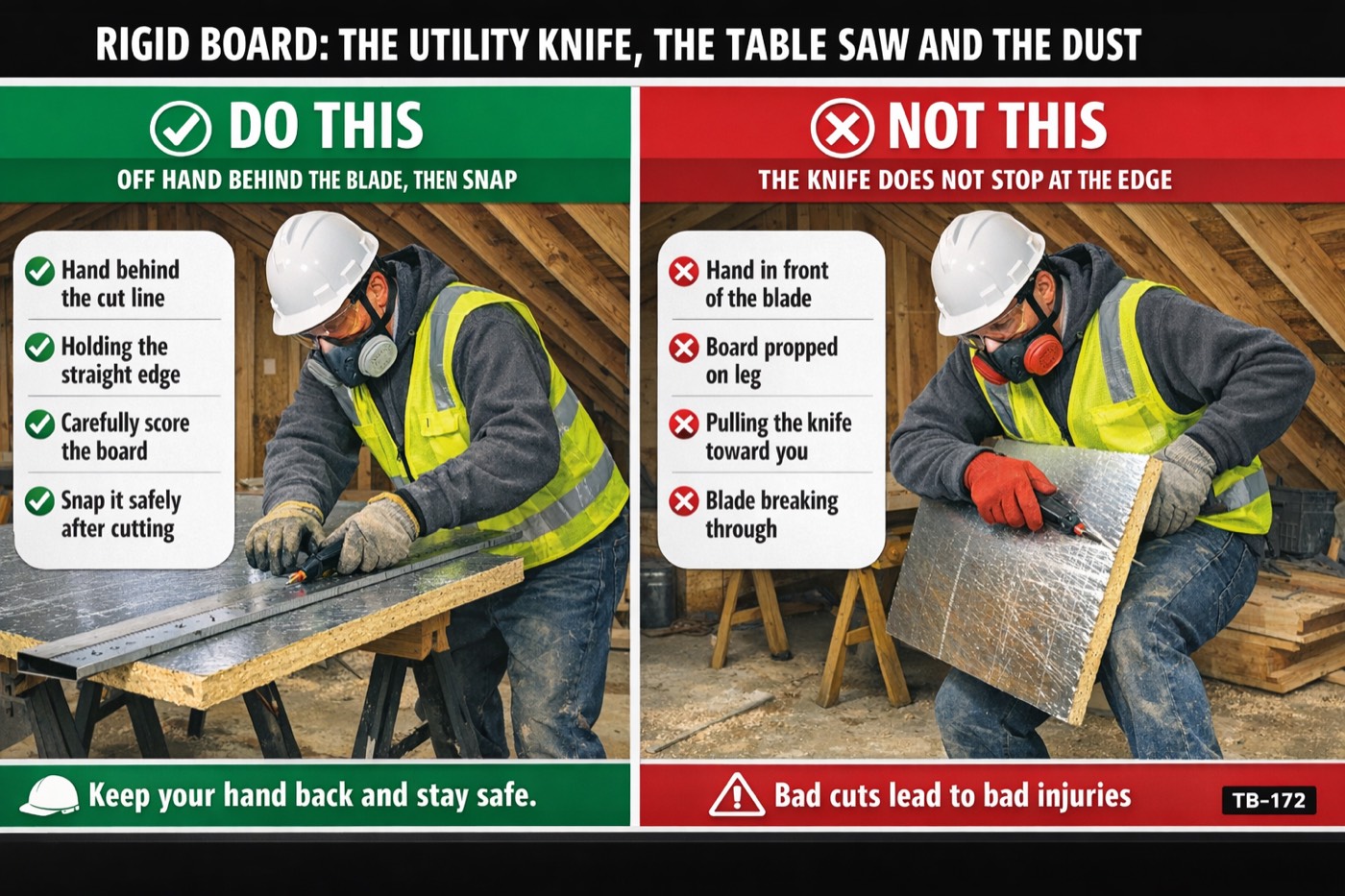
A 4-by-8 sheet of polyiso takes a two-foot draw cut with a knife you are pulling toward yourself. The sheet is soft, the foil facer is not, and the knife does not stop at the edge.
The points
- Utility knife cuts on board work are the deep kind: the blade breaks through the facer, keeps going, and lands in the thigh or the hand holding the straightedge. Stitches at best, a tendon at worst.
- Score against a straightedge with the off hand behind the blade, never ahead of it, and snap the board rather than trying to cut through. Snap a dull blade off; a dull blade needs force, and force is what goes into your leg.
- The table saw keeps its guard and gets a push stick for anything under 6 inches. Free-handing foam board along the fence with no guard is how a hand goes into the blade, and rigid board kicks back like plywood.
- Polyiso and XPS dust is a fine plastic and glass-fiber dust. N95 and glasses when sawing or rasping, cut outside or with a vacuum on the saw, and never blow it off with compressed air.
- The foil facer is a razor edge and the board is a sail. Gloves for carrying, and a 4-by-8 sheet on a roof or a scaffold comes down in any wind you can feel on your face.
Why it goes wrong
A draw cut on foam board is a long pull with real force behind it, and the blade exits the far edge still moving. The off hand holding the straightedge is in the path, and so is the thigh if the board is on your lap. Off hand behind the blade, board on sawhorses or the floor, and a cut-resistant glove, ANSI A4 or better, on the hand that is not holding the knife.
Fixed-blade knives and snap-off blades both work; either way the blade is sharp, because a dull blade takes twice the force and the force is what goes into you when it breaks through. Snap or change blades every few sheets. For 2-inch and thicker board, score both faces and snap over an edge; sawing through with a knife is where the deep cuts happen.
29 CFR 1926.304 covers the table saw: a disconnect that can be locked off, guards in place, PPE. Foam board is light and wants to lift and ride the blade, so it kicks back, and the foil facer catches. Guard on, riving knife on, push stick for anything narrower than 6 inches, and the fence set, never free-hand. Vacuum on the saw, because foam dust builds static and packs the housing.
Polyiso dust is fine plastic plus glass fiber from the facer; XPS and EPS dust is fine polystyrene. N95 and glasses for sawing and rasping, cut outside or at a vacuum, and no compressed air for cleanup. A hot-wire cutter on EPS gives off styrene and needs open air; never use one on polyiso, which is an isocyanurate and gives off hydrogen cyanide when it burns.
Every foam board burns. Store it away from the torch-down crew, the heat gun and the temporary heater, and get the thermal barrier over it inside the schedule the fire talk covers. A stack of board on a roof is also a sail: a 4-by-8 sheet at 15 mph wind pulls hard enough to take a person off balance at the edge, so sheets are carried edge-on with the wind and stacks are strapped or weighted.
The common mistake is cutting with the board braced against the leg, or with the board across the knees, because the sawhorses are downstairs. The knife breaks through into the thigh, and the femoral artery is right there. Bring the horses up, or cut on the floor with a kneeling pad.
Questions for the crew
- What knife are you using today, and where is the off hand during the cut?
- Is the table saw guard on, and who is running it with the push stick?
- Where are you cutting today, and what is the wind doing up there?
To close
Off hand behind the blade, guard on the saw, glasses and a mask when the dust flies, starting with the first cut this morning.
To hold this talk with your crew
1
Read it aloud. Five minutes, before the work starts.
2
Ask the questions. A crew that talks is a crew that remembers.
3
Have them sign on their own phones, and the record is sealed.