Restoration chemicals: ozone, fogging and the family dog
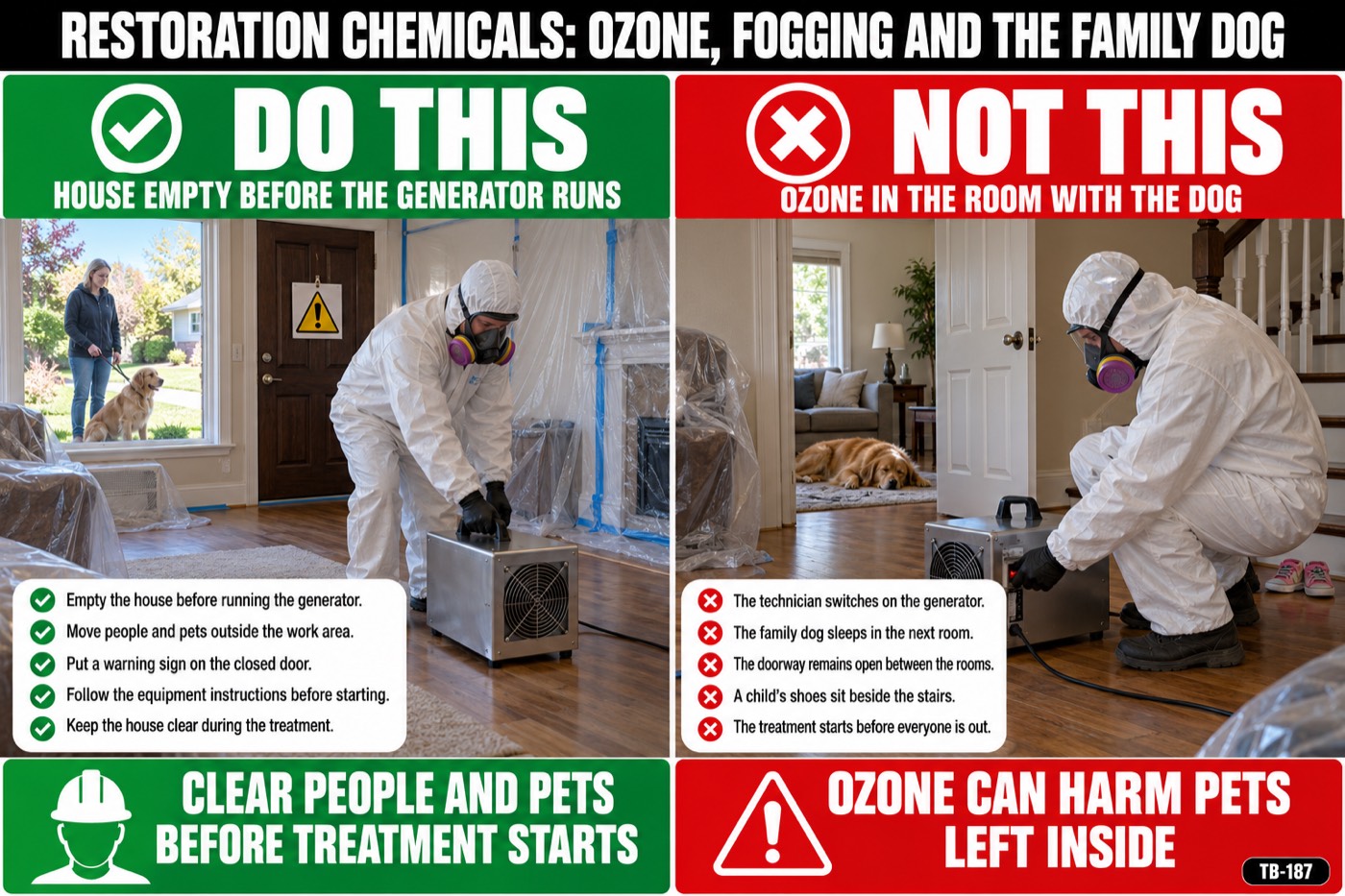
Ozone smells like a thunderstorm and the limit is 0.1 parts per million, the same as chlorine dioxide. The machine in that living room is making many times that, and the family dog is asleep in the next room.
The points
- Restoration chemicals hurt you two ways: the ones you can smell, ozone and chlorine dioxide, burn the lungs at a tenth of a part per million; the ones you cannot, quats and phenolics in antimicrobials, sensitize the skin and airway with repeated exposure. Every one of them is worse for a bird, a cat or a fish tank.
- Hazard communication in construction is 29 CFR 1926.59, which points to 1910.1200: an SDS for every product on the truck, a label on every spray bottle, and training on what it does to you. If you cannot name what is in the fogger, you are not trained on it.
- Ozone and chlorine dioxide generators run in an empty building: no people, no pets, no plants, the door signed, and a wait after shutdown before anyone goes back in. Hydroxyl generators are sold as safe for occupied spaces; read the sheet on the one you own before you believe it.
- Antimicrobials and disinfectants are EPA-registered pesticides. The label gives the PPE, the contact time, and whether it needs a rinse on food surfaces; using more than the label says is illegal, not extra clean.
- Encapsulants and sealers throw solvent or ammonia vapor in a room with no ventilation. Respirator with organic vapor cartridges, the room vented, and no pilot lights or open flames while it is being sprayed.
Why it goes wrong
Ozone has an OSHA limit of 0.1 ppm as an 8-hour average, and it damages the lung lining at levels you can barely smell. A commercial ozone generator for odor work can put a room well above 1 ppm. It also attacks rubber, so it degrades gaskets, cords and the respirator you left on the counter. Ozone breaks back down to oxygen on its own, but only after 2 to 4 hours of ventilation, and nobody re-enters before that.
Chlorine dioxide is a gas released from tablets or a two-part mix and carries the same 0.1 ppm limit; it is a strong respiratory irritant at 5 ppm and worse fast. It is used in shock treatments for odor and mold, always in an unoccupied and sealed structure, with a meter before re-entry. Mixing the parts in a closed bucket in the van has burned crews.
Antimicrobials are the everyday exposure. Quaternary ammonium compounds and phenolics cause contact dermatitis, and repeated inhalation of the mist sets off asthma in people who never had it. Fogging puts the product in the air on purpose. Respirator with a P100 and an organic vapor cartridge for fogging, nitrile gloves and eye protection for spraying, and the family out of the structure until the mist has settled and the label's re-entry time has passed.
The customer's pets do not know the sign is on the door. Birds die at ozone and chlorine dioxide concentrations that would only give you a cough. Cats groom the residue off their fur. A fish tank pulls room air through its pump. Before any generator or fogger starts, the customer confirms every animal is out, including the reptile in the kid's room they forgot to mention, and the aquarium is covered and its air pump off.
The SDS is where the answers are, and 29 CFR 1926.59 requires it to be available on the job, not in an office binder. Section 2 is the hazard, section 4 is first aid, section 8 is the PPE and exposure limit. Every product on the truck has one on the phone or in a folder, and every bottle you decant into gets labeled with the product name and the hazard words.
Never mix products. Bleach with any acid, including some descaling and rust products, makes chlorine gas; bleach with ammonia makes chloramine; the two-part oxidizers with anything organic get hot. Two products used one after another on the same wet surface is also mixing. The label says whether a rinse is needed between products; if you did not read it, rinse.
Questions for the crew
- What is in the fogger today, and where is the SDS for it?
- Who confirmed every animal is out of this house, and where is the fish tank?
- How long after the generator shuts down before anyone goes in, and who is timing it?
To close
No fogger or generator starts today until the family and every pet are out and the SDS for what is in it is on the phone.
To hold this talk with your crew
1
Read it aloud. Five minutes, before the work starts.
2
Ask the questions. A crew that talks is a crew that remembers.
3
Have them sign on their own phones, and the record is sealed.