Confined space before you enter
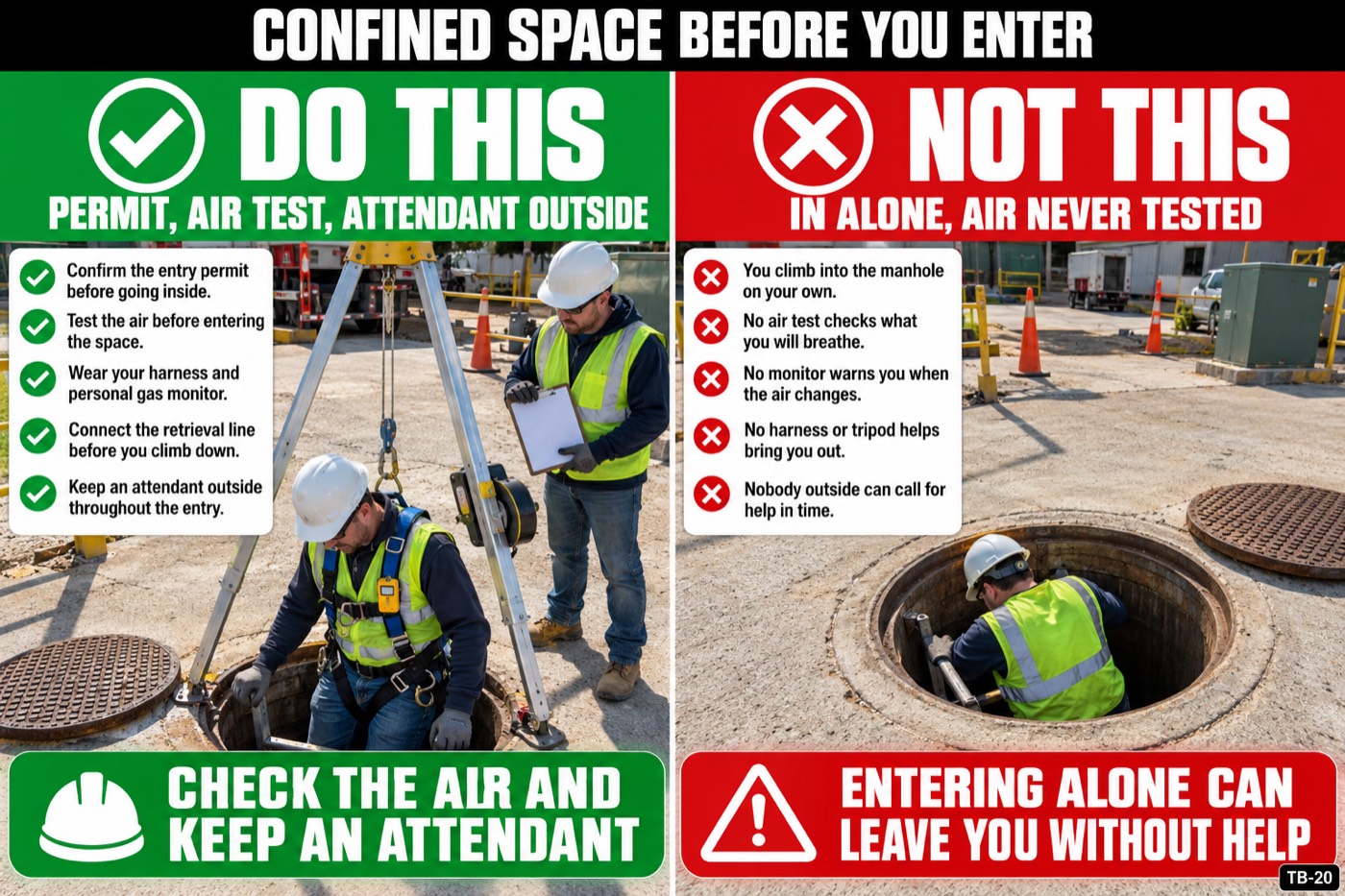
Most people who die in confined spaces did not go in to work. They went in to pull out somebody who was already down.
The points
- A confined space is big enough to enter, has limited entry or exit, and isn't designed for continuous occupancy. Crawlspaces, tanks, vaults, ducts, pits.
- If it's a permit-required space, nobody enters without a permit, testing, and an attendant.
- Test the air before entry and continuously during: oxygen, flammables, toxics. In that order.
- The attendant stays outside, keeps count, and never enters to rescue.
- Most confined space deaths are would-be rescuers who went in after someone else.
Why it goes wrong
Oxygen deficiency is the most common killer and gives no warning. Below about 16 percent, judgment and coordination go. Below 10, unconsciousness comes in seconds. You cannot smell it, feel it, or tough it out.
Hydrogen sulfide deadens your sense of smell at exactly the concentrations that become dangerous. The classic mistake is smelling rotten eggs, then not smelling it anymore, and concluding the air cleared.
Rescue must be planned before entry, with the equipment on site and the retrieval line attached. Calling 911 after someone collapses is not a rescue plan.
The reason so many of the dead are rescuers is that the atmosphere gives no sign of what it did. Seeing a person collapsed reads as a medical event, not as a warning about the air, so the next person goes in and goes down within seconds of the same cause. This pattern repeats itself so reliably that the attendant's single hardest rule - never enter - is the rule the whole system rests on.
The order of testing is oxygen, then flammables, then toxics, and it is that order for a reason: the readings of the other instruments depend on oxygen content, so a low-oxygen atmosphere makes the rest of the results unreliable. And testing is continuous, not once at the door, because conditions change as work generates fumes and consumes air.
The definition catches more spaces than people expect. Big enough to get into, limited entry or exit, not designed for people to stay in - that is a crawlspace, a vault, a manhole, a duct, a tank, and a pit that nobody thinks of as confined until it is.
Questions for the crew
- What spaces on this job count as confined, and have we treated them that way?
- Who's our attendant, and do they know they never go in?
- What's our actual rescue plan, with what equipment, on site right now?
To close
If our attendant has to go in today, the plan already failed. Nobody enters on a rescue.
To hold this talk with your crew
1
Read it aloud. Five minutes, before the work starts.
2
Ask the questions. A crew that talks is a crew that remembers.
3
Have them sign on their own phones, and the record is sealed.