Ladder jacks: 20 feet, two ladders and a rated plank
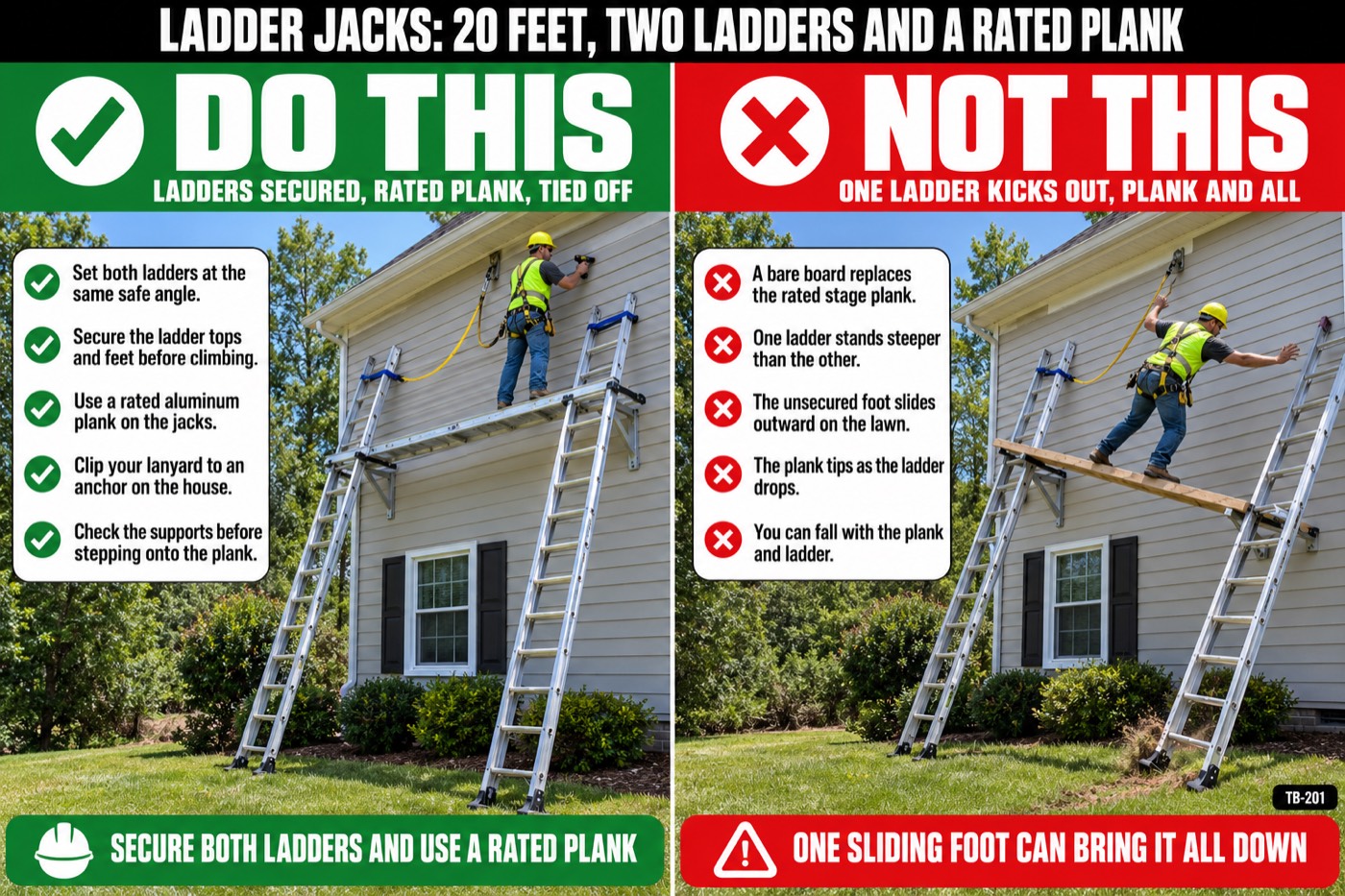
A fall from a ladder jack plank at 12 feet puts you on the ground at about 19 miles an hour. Nobody is catching you, and the ladder is coming with you.
The points
- Ladder jack falls are ugly because the plank is narrow, the ladders are at an angle, and one ladder kicking out drops the whole plank with you on it.
- The rule caps a ladder jack platform at 20 feet. Above that it is a scaffold, a lift or a pump jack, not two extension ladders and a board.
- The jacks bear on both rails and the rungs, or on the rungs alone with at least 10 inches of rung contact. Both ladders are Type I or IA, set at the same angle, feet on the same kind of ground, and secured so they cannot walk.
- The plank is a rated scaffold plank or an aluminum stage, at least 12 inches wide, rated for the two people and the boxes of siding you are putting on it. A 2x10 from the lumber pile is not a plank.
- Plank ends rest at least 6 inches past each jack and not much more than a foot, and above 10 feet you are tied off to something that is not the ladder.
Why it goes wrong
Physics does not care that it was only 12 feet. Free fall from 12 feet takes under a second and you land at about 28 feet per second. From the 20-foot limit it is 36 feet per second, 24 miles an hour, onto a driveway or a walkway edge. Hips, wrists and skulls are what break.
The ladders are the scaffold legs here, and the rule says they have to comply with the ladder standard, no job-made ladders, and be placed, fastened or fitted with slip-resistant feet so they cannot move. Same angle on both, about one-quarter of the working length out, on the same footing. One ladder on the concrete and one on the lawn will settle differently the moment you step on.
Ladder jacks are made for the ladder they fit. A jack that bears on the rungs alone needs at least 10 inches of rung in contact, so a jack hooked on the outside of a 3-inch rung is holding the plank on a lip. Set the jack, then pull up on it hard before the plank goes on.
Every scaffold component, and that includes the plank and the jacks, has to hold four times the load you are going to put on it. A stage plank stamped 500 pounds is a two-person plank, and two people plus a 300-pound stack of fiber cement is over it. Wood planks are scaffold grade and stamped, not the cleanest 2x10 on the job.
Overhang is a see-saw. Ends resting less than 6 inches past the jack can slide off when the ladder flexes; ends hanging a foot or more past the jack tip when someone steps on them. The rule also says no bridging one ladder jack platform to another. One plank between two ladders, and that is the whole scaffold.
At more than 10 feet up on any scaffold the rule wants fall protection. On a ladder jack that means a harness and a lanyard to an anchor that is not the ladder or the plank, because when the ladder goes, the anchor goes with it. If there is nothing to tie to above 10 feet, this is a pump jack or a lift job.
Questions for the crew
- What is the plank we are using rated for, and is the stamp still on it?
- Where do the feet of both ladders sit today, and are they on the same kind of ground?
- If we are above 10 feet, what are we tied off to that is not the ladder?
To close
No plank goes on a ladder jack today until both ladders are set at the same angle, secured, and someone has pulled hard on each jack.
To hold this talk with your crew
1
Read it aloud. Five minutes, before the work starts.
2
Ask the questions. A crew that talks is a crew that remembers.
3
Have them sign on their own phones, and the record is sealed.