Window units: 150 pounds of glass and two people
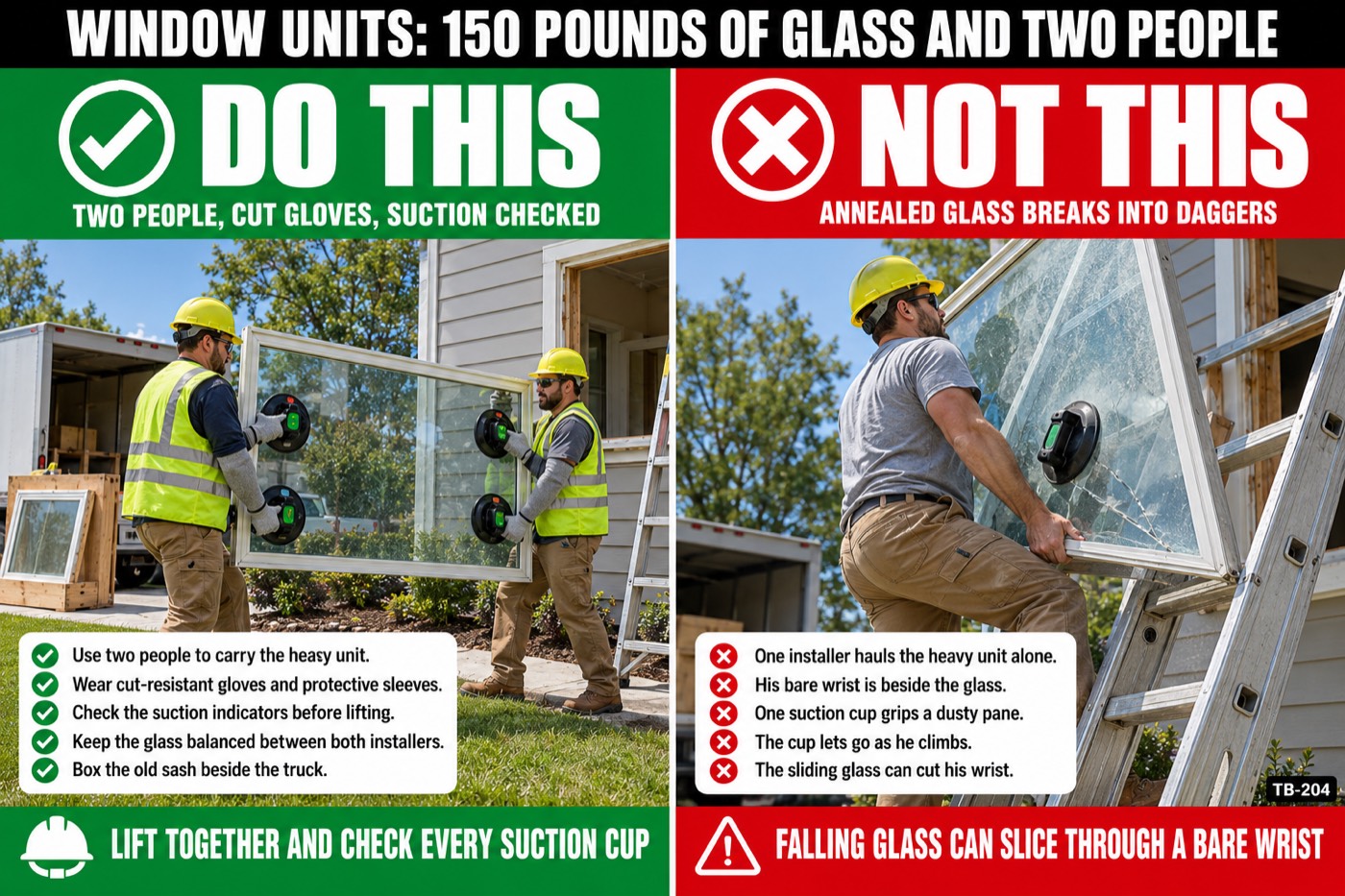
A big picture window unit is 100 pounds of glass before the frame, and when annealed glass breaks it breaks into daggers. The cut that kills is on the inside of the wrist or the inside of the thigh.
The points
- Glass injuries are cuts that go deep and fast. A shard through the forearm hits the arteries and tendons an inch under the skin, and you can bleed out in the yard before the ambulance arrives.
- Cut-resistant gloves, sleeves and eye protection for anyone touching a unit, a sash or old glass. The employer buys them and they go on before the unit comes off the truck.
- Anything over 50 pounds or wider than you can spread your arms is a two-person lift, and a big unit with an unbalanced frame is a two-person lift no matter what it weighs.
- Suction cups go on clean, dry glass; you check the vacuum indicator before you lift and again before you tilt. A cup on a dusty pane or a low-E coating can let go halfway up the ladder.
- Old sashes come out with the sash held and the cords cut, never tilted out and dropped, and old glass goes into a box or a can, never leaned against the wall.
Why it goes wrong
Glass weighs about 1.6 pounds per square foot for every 1/8 inch of thickness. A double-pane unit with two 1/8-inch lites is about 3.3 pounds per square foot before the frame, so a 5-by-6 picture window is 100 pounds of glass and 130 to 150 pounds with the frame. It is awkward, it wants to twist, and one corner catching the jamb is what flexes it to breaking.
Tempered glass breaks into pebbles; annealed glass breaks into long shards. Most old sashes and many new fixed lites are annealed. When a unit breaks in the frame the pieces fall out of the top while the bottom is still in your hands. Look away and drop your face, do not try to catch it. Then somebody gets the shards out with a broom and a box, not by hand.
A deep cut to the forearm bleeds from the radial and ulnar arteries, and the flexor tendons are right there. Direct pressure with a gloved hand, elevate, and if the bleeding is spurting or soaking through, the tourniquet in the truck goes on 2 inches above the wound and someone calls 911 with the house address. A cut to the inner thigh is a femoral bleed and is the same emergency.
Suction cups are rated per cup, typically around 100 to 125 pounds on clean, dry, flat glass. Dust, condensation, cold, and coated or textured glass all cut that. Pump cups with a red-line indicator tell you when they are losing vacuum; check before you lift, at the ladder, and before you tip the unit into the opening. Two cups per person on a big unit, and the unit rides low, not overhead.
The PPE rule is short: protective equipment gets provided, used and maintained wherever it is necessary by reason of hazards, and it has to fit the person. Cut-resistant gloves two sizes too big are worse than none, because you cannot feel the edge. Sleeves cover the inside of the forearm, which is where glass cuts land.
Old double-hung sashes have iron weights on cords or chains inside the jamb. Cut the cord and the weight drops into the pocket, which is fine. Cut the cord with the sash in the frame and nobody holding it, and the sash comes out onto your foot or your helper's face. Sash held first, then cords, then the stops.
Questions for the crew
- What is the heaviest unit going in today, and who is on the other end of it?
- Where do the old sashes and old glass go once they are out, and who walks that path?
- Where is the tourniquet, and who here has put one on before?
To close
Nobody lifts a unit alone today, and nobody touches glass without cut gloves and sleeves on.
To hold this talk with your crew
1
Read it aloud. Five minutes, before the work starts.
2
Ask the questions. A crew that talks is a crew that remembers.
3
Have them sign on their own phones, and the record is sealed.