The homeowner's yard: the door opens under your plank
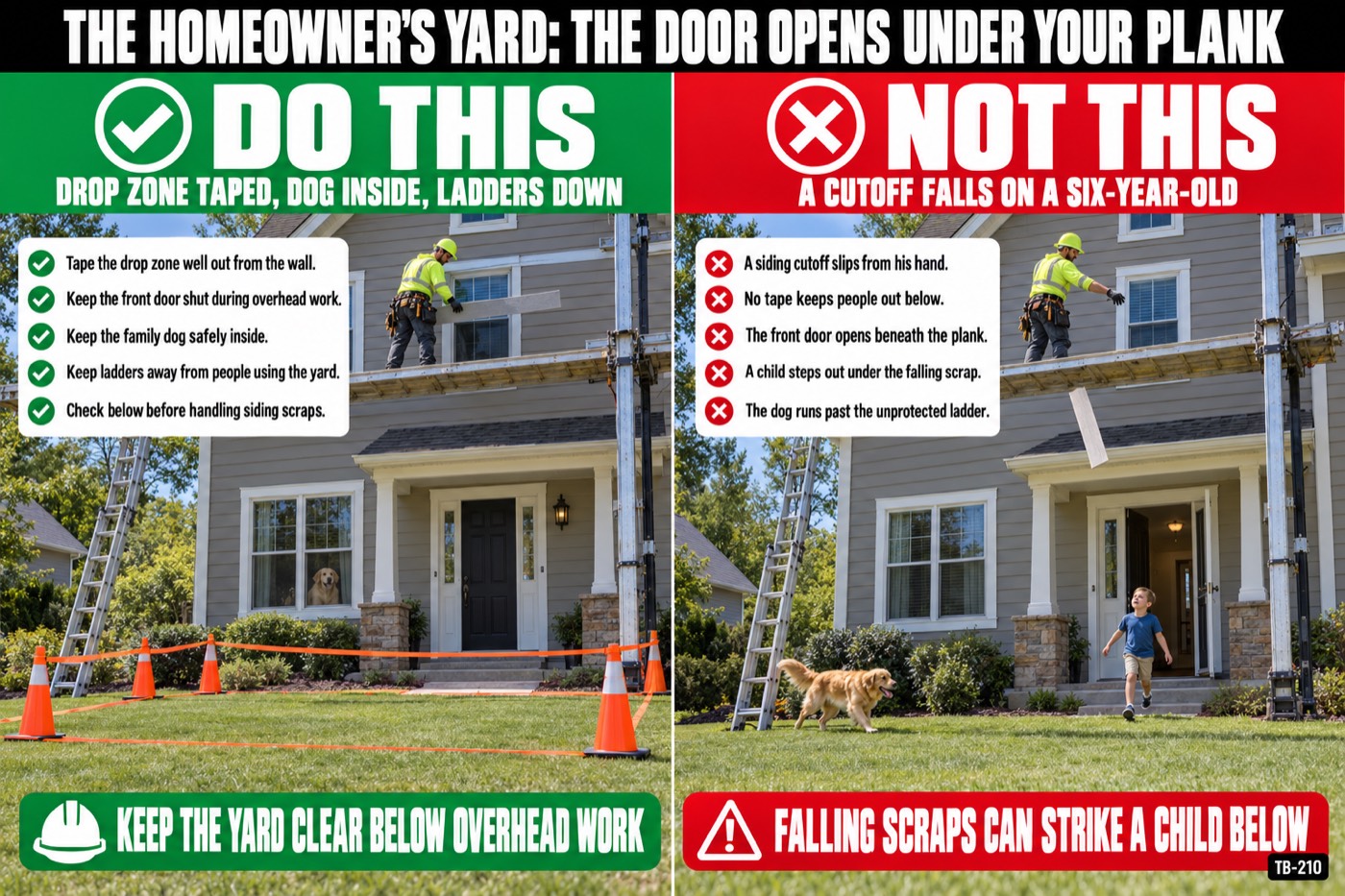
The front door of this house is inside your drop zone. The family uses it, the kid uses it, the dog uses it, and none of them are looking up.
The points
- A piece of scrap fiber cement off a plank at 20 feet hits the ground at 25 miles an hour. On a hard hat it is a headache. On a six-year-old it is a funeral, and the public does not wear hard hats.
- The employer's duty is to run a program that finds and controls the hazards on the site, and on a residential job the site includes the sidewalk, the driveway and the front door.
- Set the drop zone before the first cut. Tape or cones 10 feet out from the wall, and it moves with you. Tell the homeowner which door to use today, and mean it.
- No ladder stays standing at lunch or at the end of the day. A kid climbs a ladder every time; lay it down or take it to the truck.
- The dog is on a leash or in the house before the crew goes up. It runs under ladders, it takes a cutoff in the mouth, and it bites the person who steps on it.
Why it goes wrong
The rule puts the responsibility on the employer to initiate and maintain programs that find the hazards, with frequent and regular inspections by a competent person. It does not stop at the property line, and the hazards on a residential exterior are mostly hazards to people who are not on the crew: the family, the neighbor, the delivery driver, the kid on the sidewalk.
Drop zone: everything that comes off the wall or the plank lands in a strip along the base of the wall, and gusts push it 10 feet out. Nails, cutoffs, a downspout section, a tool. Rope it off, keep the trash on the ground inside it, and keep everyone else outside it. If the front door opens into it, the front door is out of service and someone told the homeowner where the other door is.
The sidewalk is public. A gutter run being carried across it, a ladder foot on it, a cord across it, a pile of old siding with nails on it: a person with a stroller or a kid on a bike goes through all of that. Anything on the sidewalk gets a person standing at it or gets moved, and the scrap pile is never between the truck and the street.
Ladders left up are the thing you read about. A ladder against a house at lunch is a climbing frame to a child, and the top of it is a roof edge with no rail. Lay every ladder flat on the ground or in the truck when nobody is on it for more than a few minutes. Same for the scaffold: the access ladder comes off at the end of the day.
Dogs bite when they are scared, and they are scared of strangers on ladders. Ask the homeowner to put the dog inside before the crew starts, every day, not just the first day. A bite to the hand is a hospital visit and a lost week, and a dog under the ladder is the ladder foot moving.
Nails. A siding tear-off leaves hundreds of nails in the lawn, and a 2-inch galvanized nail through a bare foot or a bike tire is on the company. A rolling magnet sweep at the end of every day, and again before the family gets the yard back. Cutoffs with the fastener still in them go in the bucket, not on the grass.
Questions for the crew
- Which door is the family using today, and who told them?
- Where is the drop zone taped, and what is inside it that should not be?
- Where is the dog, and where is the closest kid?
To close
Drop zone taped before the first cut today, the dog inside, and every ladder flat on the ground at lunch.
To hold this talk with your crew
1
Read it aloud. Five minutes, before the work starts.
2
Ask the questions. A crew that talks is a crew that remembers.
3
Have them sign on their own phones, and the record is sealed.