Torsion springs: 2,100 foot-pounds on a 1/2-inch bar
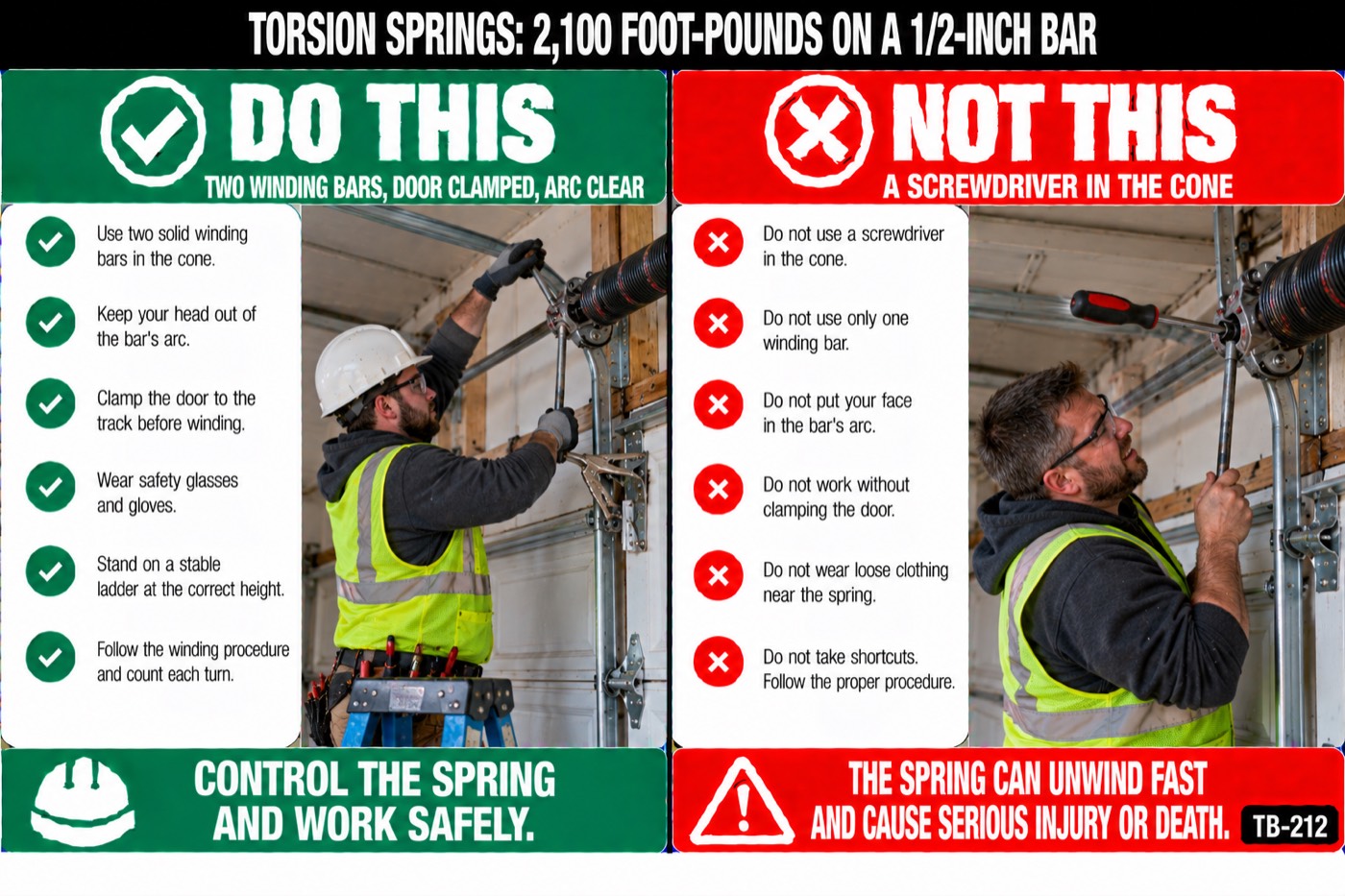
The two wound springs over a 16-foot door are holding about 2,100 foot-pounds. That is a 300-pound door lifted seven feet, stored in two coils right above your head.
The points
- A torsion spring that lets go with a screwdriver in the cone takes the screwdriver, the hand, and whatever is in the arc. Springs have taken fingers, broken jaws and put eyes out, and it happens faster than a blink.
- Winding bars only: solid steel, 1/2-inch diameter, 18 inches long, seated all the way into the cone. Never a screwdriver, a bolt, a piece of rebar, or a bar with the tip worn round.
- Two bars in the cone every moment the set screws are loose. One bar holds while the other moves, and the bar you are pushing on is the one that hits you if the other is not there.
- The count is real: about 7.5 turns on a 7-foot door, 8.5 on an 8-foot door, and the drum size changes it. Mark the shaft and count out loud.
- Both set screws tight, 1/2 to 3/4 turn past contact, before the last bar comes out. And nothing in the path of the bar: not your head, not your chest, not the guy on the other ladder.
Why it goes wrong
Where the number comes from: a 300-pound door lifted 7 feet is 2,100 foot-pounds of work, and the springs store all of it so the door feels like 10 pounds in your hand. Two springs share it, so each cone you touch is holding about 1,050 foot-pounds. When a cone slips, the bar swings through a quarter turn faster than you can pull your hand back.
The bar has to match the cone hole, which is 1/2 inch on most residential cones and 5/8 on some heavier ones. A screwdriver is a loose fit in a hole that size and it cams out; a bolt does the same. A cheap bar with the tip rounded from years of use walks out of the cone under load, so look at the tips before you climb.
The set screws are what keep the cone from spinning on the shaft, and they only work if they bite. A shaft that is already chewed up from an old cone, or a screw run in by hand and never tightened, lets the cone spin under full winding. Tighten each screw 1/2 to 3/4 turn past the point where it touches the shaft. Cranking them further flattens the shaft and does nothing for you.
Turns are set by door height and drum size, not by feel. The rough count is one turn for each foot of door height plus a half turn, and the manufacturer's sheet gives the exact number for the drum. Too few turns and the door is heavy; too many and it flies up and hits the stops. Write the number on the shaft with a marker before you unwind, so the next guy is not guessing.
The door is closed and clamped before anyone winds. A pair of vise grips on each track just above the bottom roller keeps the door from lifting when the springs come up to tension. Stand to the side of the cone on a stable ladder, never directly under it, and never with a hand on the spring coils.
Springs are rated in cycles, 10,000 on a standard spring, and at four cycles a day that is about seven years. There is no OSHA rule that names a torsion spring; the employer's duty under 1926.20(b) to keep hazardous equipment out of untrained hands is what covers it, and DASMA's technical data sheets on counterbalance springs are the industry's written procedure. A spring is a job for a person who has done it with someone who knew how.
Questions for the crew
- Where are the winding bars on this truck, and what do the tips look like?
- What is the door on this job, height and drum, and what turn count are we starting from?
- When the last bar comes out of the cone, where is everybody standing?
To close
Nobody touches a spring today without two bars, the door clamped to the track, and the arc of the bar clear.
To hold this talk with your crew
1
Read it aloud. Five minutes, before the work starts.
2
Ask the questions. A crew that talks is a crew that remembers.
3
Have them sign on their own phones, and the record is sealed.