Sections and hinges: the joint that closes on a finger
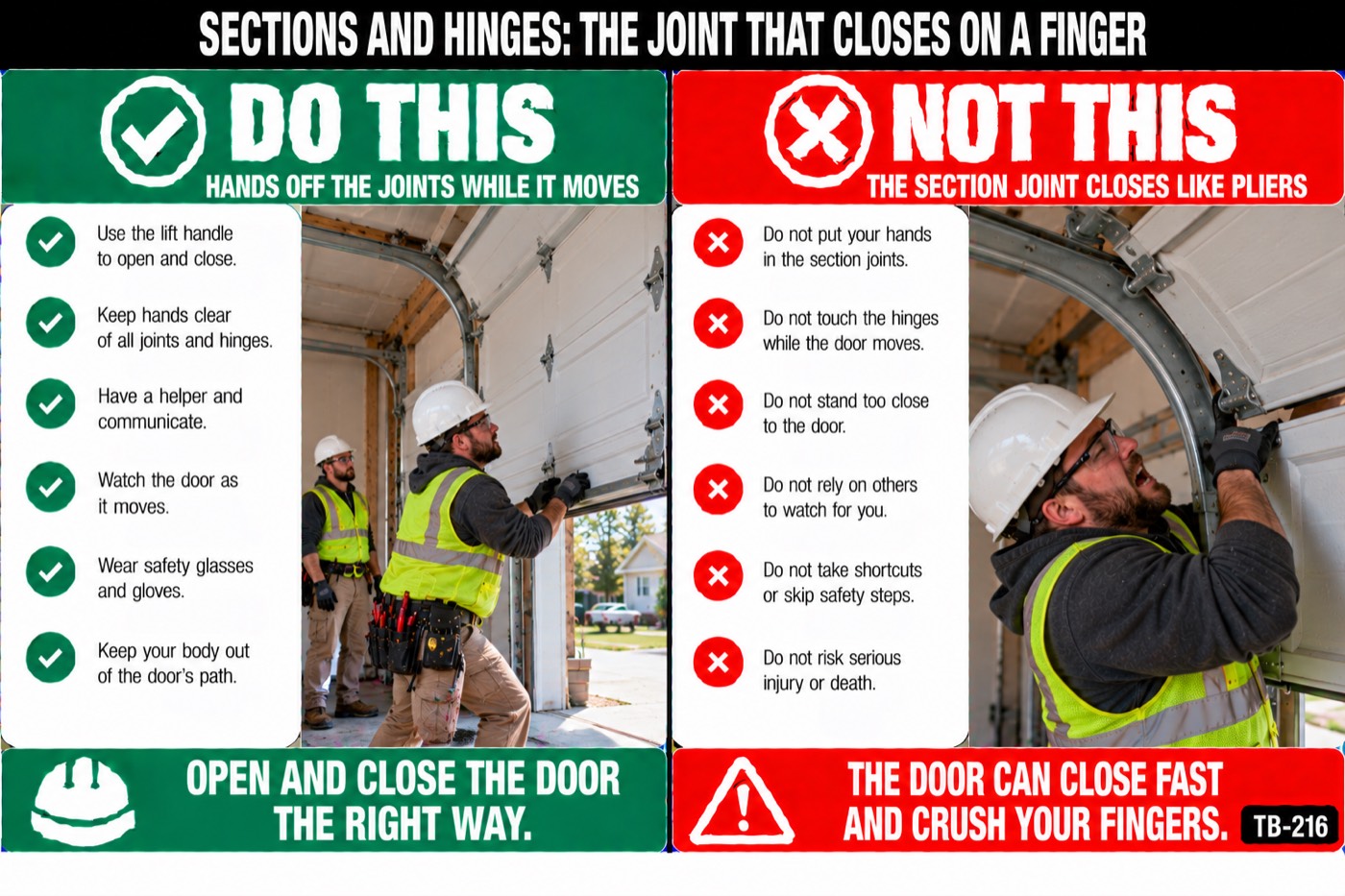
A sectional door has a joint every 18 to 24 inches, and each joint opens and closes like a pair of pliers as the door goes around the curve. A finger in a joint when the door moves stays in the garage.
The points
- The joint between sections pinches shut as the door rounds the radius. Fingers have been amputated between sections, in the hinge knuckle, and between the roller and the track.
- Move a door by the lift handles or the bottom section, never by the section joint, and never with a finger through a hinge.
- Before the opener runs or anyone pulls on the door, hands are off the sections and out of the track. Say 'door moving' out loud and wait for the answer.
- The roller stem sits in the hinge and the track carries it. A hand between roller and track while the door moves is a hand in a shear.
- Hinges are numbered from the bottom, and number 1 goes on the bottom joint. The wrong hinge on the wrong joint puts the roller out of line and the door binds or pops out of the track.
Why it goes wrong
The pinch happens at the top of the vertical track, where the door goes from flat to curved. On the outside of the curve the joint opens; on the inside it closes, with the full weight of the sections above it. Pinch-resistant sections with a shaped joint push a finger out instead of cutting it, but most doors in service do not have them, and even those pinch at the hinge.
The hinge knuckle closes with the joint. A finger through a hinge while you are lining up a roller is in the one spot that cannot be pulled out once the section starts to move. Line rollers up with the door closed and clamped, and pull hinge bolts one hinge at a time so the section above never hangs on your hand.
Rollers ride in a 2-inch or 3-inch track that is a guide, not a handle. When the door moves, the roller and the track edge shear together at every point along the curve, and the space between them is exactly finger-sized. Track work happens with the opener unplugged and the door clamped.
Hinge numbers match the depth of the roller stem to the track's offset: number 1 on the bottom joint, then 2, 3, 4 up the door, and the top fixture at the top. Put a number 3 where a 1 belongs and the roller sits proud of the track, the door binds on the way up, and the opener pulls the top section off. The number is stamped on the hinge.
The rule behind this talk is the training duty in 1926.21(b)(2): everyone on the crew has been shown where the door pinches and where hands go while it moves. Gloves help with the sharp edges on a steel section; they do nothing for a finger in a closing joint.
Questions for the crew
- Where does this door pinch, and where are hands going while it moves?
- Who says 'door moving' on this job, and who answers?
- What hinge numbers are on this door, and do they match where they sit?
To close
Nobody's hand is on a section, a hinge or in the track today while the door moves.
To hold this talk with your crew
1
Read it aloud. Five minutes, before the work starts.
2
Ask the questions. A crew that talks is a crew that remembers.
3
Have them sign on their own phones, and the record is sealed.