Mowers, trimmers, and thrown objects
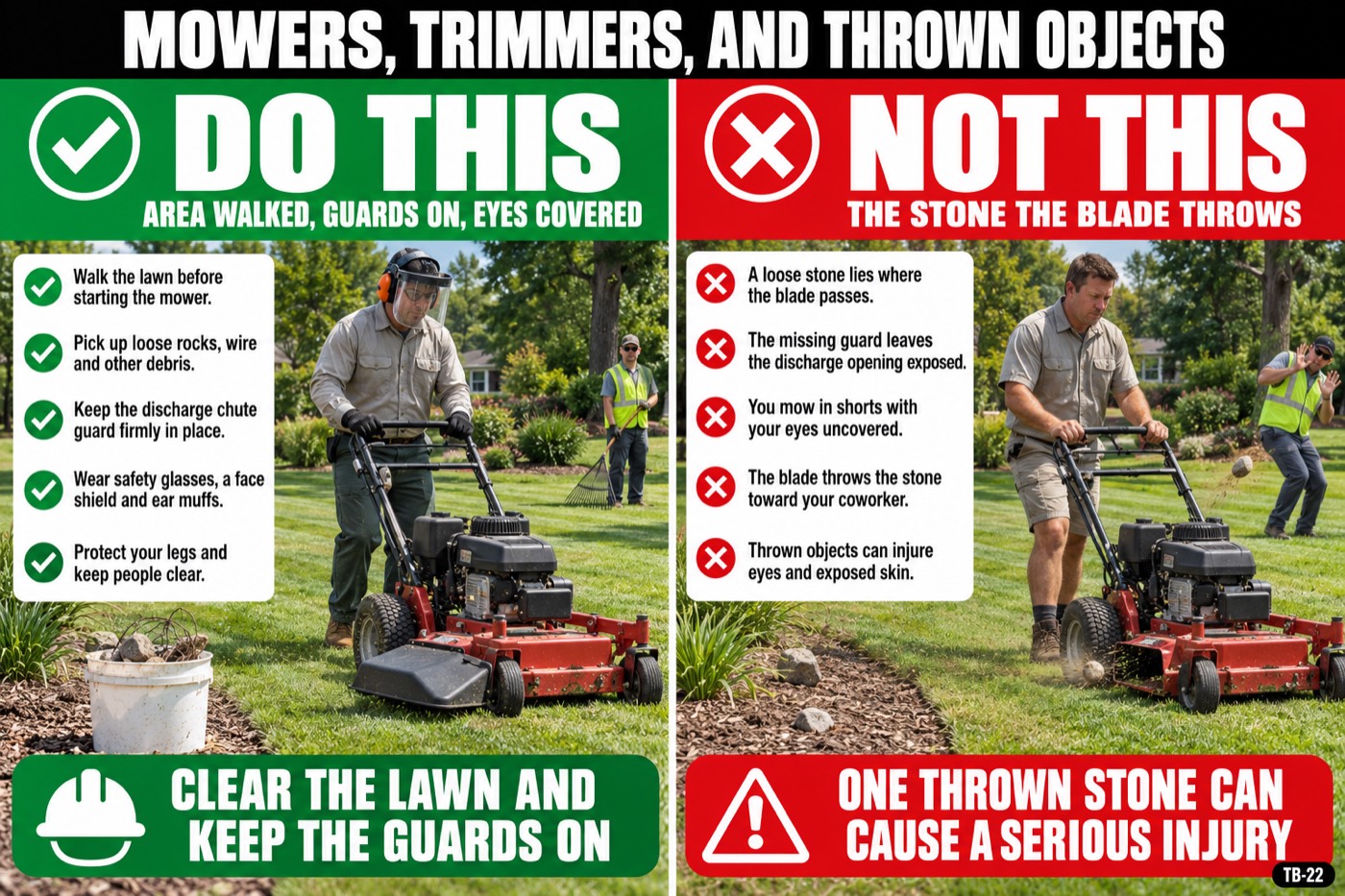
The person a mower hurts is usually not the one running it. It is somebody fifty feet away who never saw the rock.
The points
- A mower blade turns fast enough to throw a stone hard enough to kill. Discharge chutes and guards stay on.
- Walk the area before you cut. Pick up rocks, wire, bottles, and anything else the blade could find.
- Eye and face protection, hearing protection, and long pants. Every time, not just when it's convenient.
- Never clear a jam with the engine running. Shut it down and let the blade stop completely.
- Keep bystanders and the public at least fifty feet away, further downhill or downwind.
Why it goes wrong
Blade tip speed on a commercial mower is high enough that a thrown object leaves at highway speeds. Bystander injuries from thrown debris are common, and the person hit is often nowhere near the machine.
Slope is the other killer. Mow across a slope with a walk-behind and up and down with a rider, and know your machine's limit. Rollovers happen fast and a mower deck does not stop turning when it lands on you.
The discharge chute and the guards are the only thing aiming that energy at the ground instead of at people, which is why a chute that has been removed or wired up out of the way turns a routine pass into a hazard for everyone in the direction it faces. It gets removed because it clogs, and it goes back on before the engine starts.
Walking the area first is what removes the ammunition. Rocks, wire, bottles, cans, dog chains, irrigation heads and buried scrap all become projectiles, and thirty seconds of looking beats trying to predict where one will land.
Clearing a jam with the engine running is the injury nobody argues about afterward. A blade under load has stored energy and will turn again when whatever is binding it lets go, so the engine goes off and the blade comes to a complete stop before a hand goes anywhere near it.
Fifty feet of clearance to bystanders is a minimum, and it is not a circle. Downhill and downwind of the discharge needs more, and members of the public do not know any of this - keeping them clear is the operator's job, not theirs.
Questions for the crew
- What's on the ground here that could get thrown?
- Who's around us today, and how do we keep them clear?
- What's the steepest ground on this property and how do we handle it?
To close
Walk the area before you start it. Thirty seconds of picking things up.
To hold this talk with your crew
1
Read it aloud. Five minutes, before the work starts.
2
Ask the questions. A crew that talks is a crew that remembers.
3
Have them sign on their own phones, and the record is sealed.