Lags overhead: the impact driver, the line and your eyes
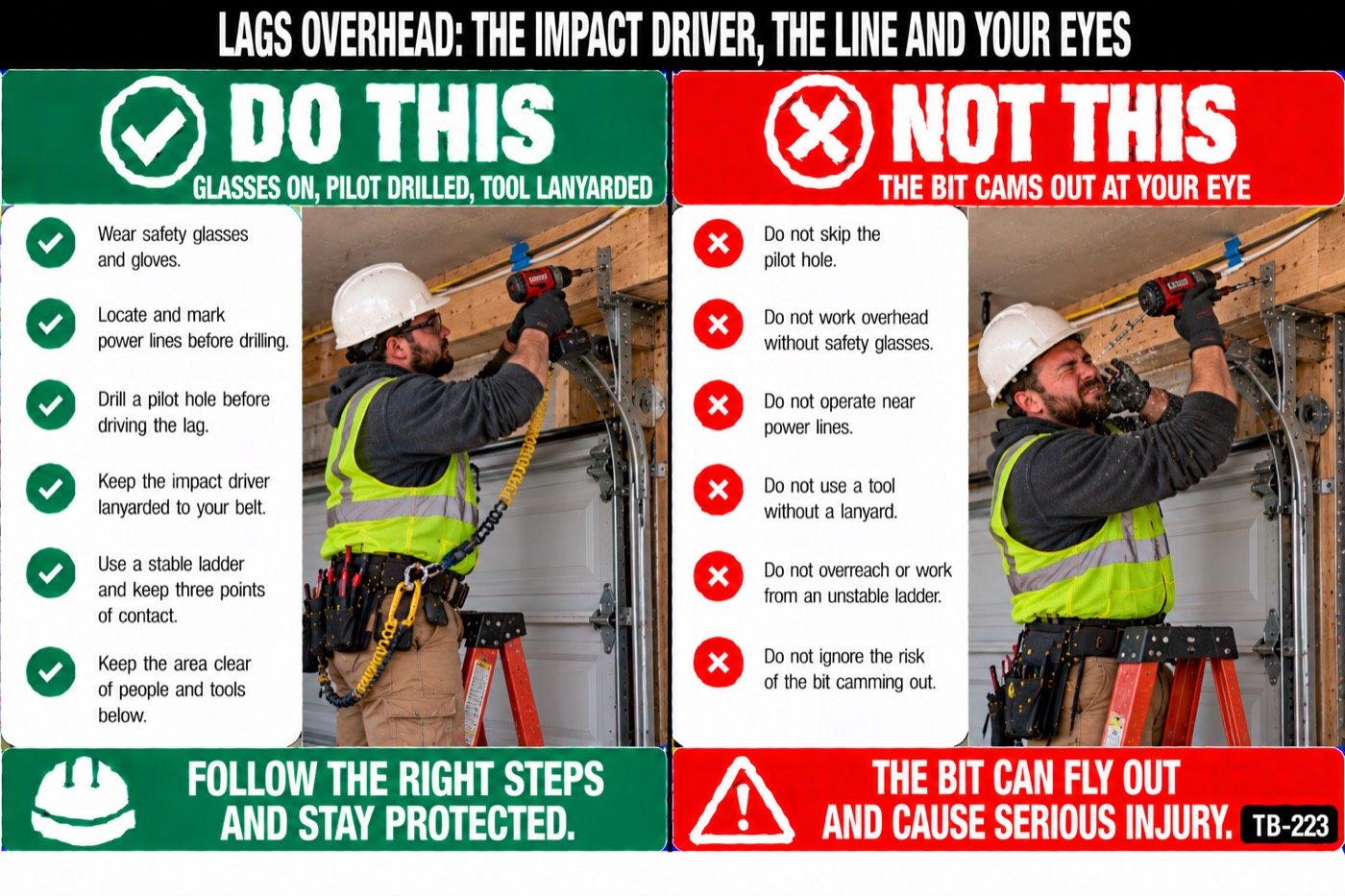
An impact driver puts over 100 foot-pounds through a 5/16 lag, and when you drive it overhead the bit is at eye level with your arms up. When the bit cams out, it comes at your face.
The points
- The bit that cams out, the lag that spins in a rotten header, the drill that finds a wire, the set screw that shears: door installers lose eyes and take shocks doing overhead work with the tool above their face.
- Eye protection under a door at all times. Rust, grit and splinters from the header rain down, and a sheared set screw or a snapped bit is a bullet at 18 inches.
- Lags go into the header and the jamb, not into drywall or trim. Drill the pilot, and if the lag spins without biting, the wood is gone and you go longer or move the bracket.
- Before you drill, know what is behind the header: the feed to the outlet, the lights, the AC line. A cordless drill through a 120-volt line still puts the shock through the chuck into you.
- Tools stay on a lanyard or in the belt on the ladder. A 4-pound impact driver dropped from 12 feet hits the guy at the foot at 28 feet per second.
Why it goes wrong
1926.302(a) covers the tool: electric tools double-insulated or grounded, never hoisted or lowered by the cord. 1926.300 covers guards and the condition of the tool, and 1926.102 puts the eye protection on you when there are flying particles. Overhead lag work produces all three hazards at once, and the eye is the part that does not heal.
An impact driver's hammer action is what drives a lag without a pilot, and it is also what throws the bit when the head strips. Overhead, the bit cams out toward your face, and a broken 1/4-inch hex bit is a piece of hardened steel at speed. Keep the bit seated and the body of the tool in line with the lag, and stop when it starts to chatter.
Track brackets and header brackets take 5/16-inch lags, 1-5/8 or longer, into solid wood. A 3/16-inch pilot hole keeps the lag from splitting the jamb and from spinning. A lag that spins in a header that has rotted from the flashing above is holding nothing, and the header bracket is what the spring shaft hangs on. Longer lag, new location, or a plate; never a lag that turns.
Before the first hole, look at both sides of the wall and follow the wiring. The opener outlet's feed drops through the header in many garages, and the exterior light and the keypad are wired through the jamb. 1926.416(a)(3) puts the duty on finding the circuit before the work, and a non-contact tester takes 10 seconds.
Everything you take up the ladder is a thing that can come down: the driver, the lag box, the level. Speed at impact from 12 feet is about 28 feet per second, and the person under the ladder is usually your partner. A wrist lanyard on the driver and the fasteners in a pouch, not a hand.
Questions for the crew
- What is behind this header and jamb where the lags are going?
- Whose glasses are on right now, and who took them off to see the level better?
- Who is standing under the ladder while the brackets go up?
To close
Every lag today goes into solid wood you have checked, with glasses on, the line found, and the tool on a lanyard.
To hold this talk with your crew
1
Read it aloud. Five minutes, before the work starts.
2
Ask the questions. A crew that talks is a crew that remembers.
3
Have them sign on their own phones, and the record is sealed.