Connecting: two bolts before the hook lets go
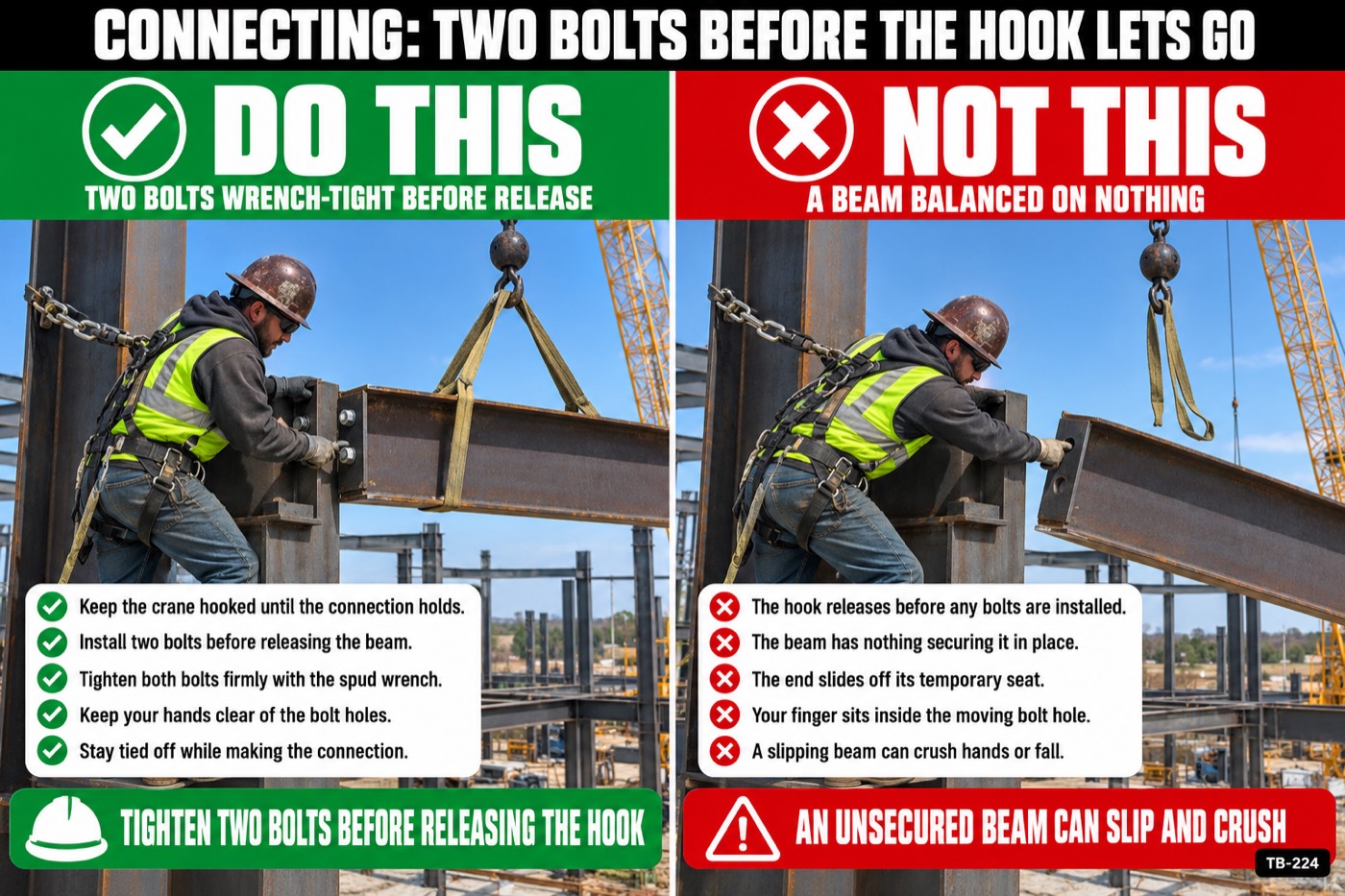
A 30-foot W18 beam weighs about 1,500 pounds. Set on its seat with no bolts in it, it stays there only as long as nothing touches it.
The points
- A beam that is sitting in its connection with no bolts is a beam that is balanced. The crane swings, the column moves an inch, and it drops through the bay with the connector on it.
- The load stays on the hook until every connection has at least two bolts, the size and grade the drawings call for, pulled up wrench-tight. Not started by hand, not one bolt, not a drift pin holding it.
- Diagonal bracing gets at least one bolt wrench-tight before release. At a column where two beams share the same bolts on the web, one bolt stays in and tight while the second beam comes in, or a seat holds it.
- The connector's position: on the column side of the connection, off the beam that is still on the hook, and never with a hand or finger in the hole. Line it up with the spud wrench or the drift pin.
- The connector tells the crane when to release, nobody else. Until they say it, the hook holds the weight.
Why it goes wrong
The two-bolt rule is the one line in Subpart R that comes straight from a body count. A beam set on a seat or a shear tab with nothing through the holes is held by friction and luck. The crane boom sways, the far end lifts a quarter inch, and the beam walks off its seat. That has happened with the connector sitting on it.
Wrench-tight means the nut is run up with a wrench until the parts are in firm contact, not spun on by hand. It is not the final torque, that comes later with the impact or the tension-control gun, but it is enough that the beam cannot shift. Two bolts, same diameter and grade as the erection drawings, because a smaller bolt in a bigger hole is a pin, not a connection.
A drift pin is for lining up holes, not for holding a beam. It has no thread and no nut. The pin goes in, the bolt goes in the next hole, the pin comes out, and the second bolt goes in where the pin was. If the only thing through the connection is a pin, the beam is not connected.
Where two beams frame to opposite sides of a column web and share the bolts, pulling the bolts to set the second beam leaves the first one with nothing. The rule is that at least one bolt with its nut wrench-tight stays in the first connection, or a seat or equivalent device carries the beam while the shared bolts are out.
Hands: a beam coming in to a shear tab closes the gap between the web and the tab with the full weight of the beam behind it. Fingers in the hole to feel the alignment come out flat. The tapered end of the spud wrench goes in the hole, the beam is levered until the holes line up, and the bolt follows. Your fingers never go where the steel is about to be.
Position: the connector sits or stands on the piece that is already bolted, the column or the beam that is done, and reaches to the incoming piece. Straddling the beam that is on the hook means riding it if the rigging slips or the crane drifts. Tie off to the column, not to the beam that is coming in.
Questions for the crew
- Who is connecting today, and what are they tying to at each column?
- Which connections on this level share bolts on a column web, and what holds the first beam while the second comes in?
- Where are the bolts staged so the connector is not waiting on a bucket with a beam on the hook?
To close
Today the hook does not open until the connector has two bolts wrenched tight and says so out loud.
To hold this talk with your crew
1
Read it aloud. Five minutes, before the work starts.
2
Ask the questions. A crew that talks is a crew that remembers.
3
Have them sign on their own phones, and the record is sealed.