Ladders in offices: the door that opens into it
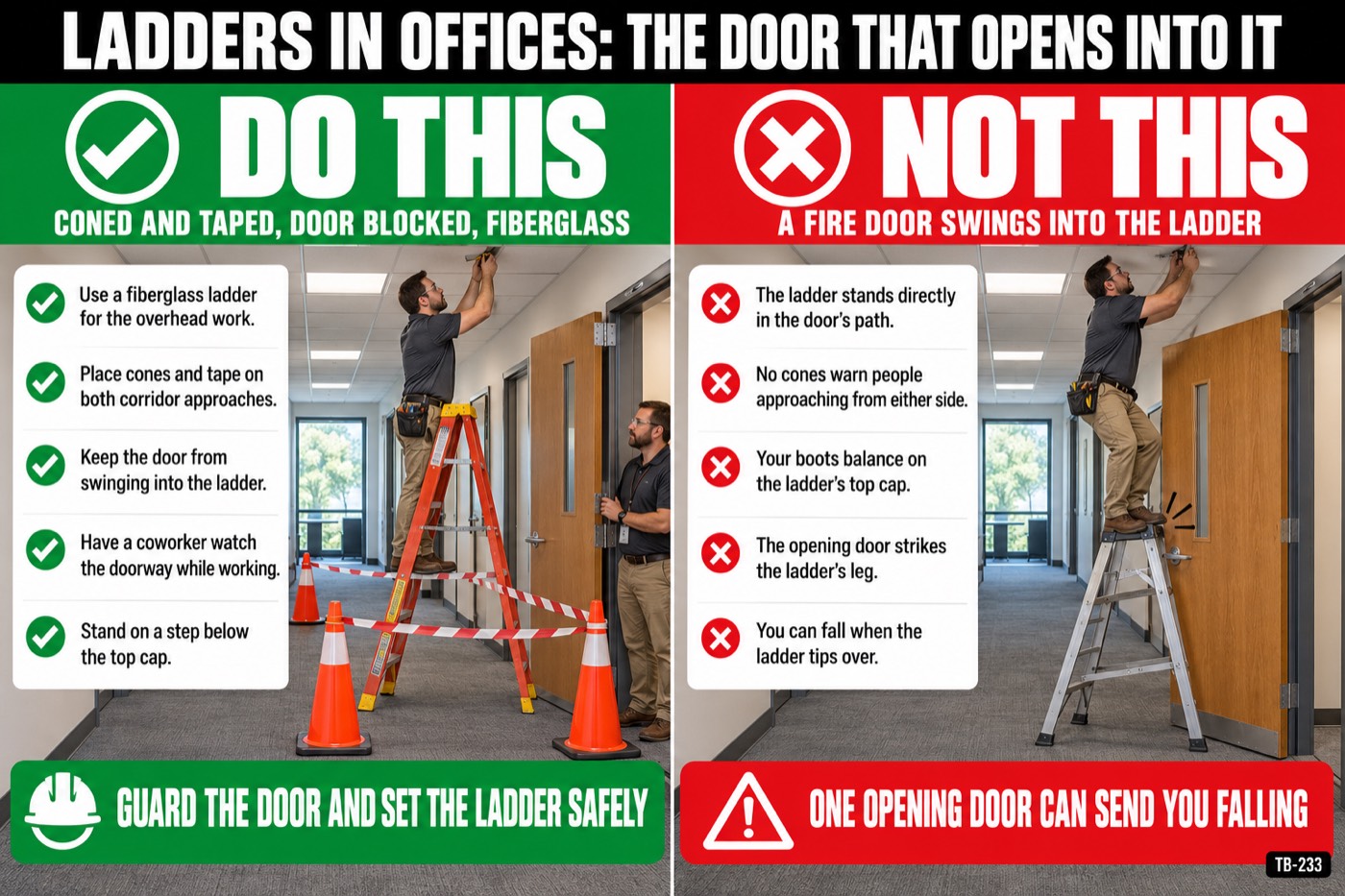
A fall from the top of a six-foot stepladder lands your head at about 15 miles an hour. It does not take a roof; it takes a hallway and a door.
The points
- The ladder in an office building goes down for ordinary reasons: a door swings into it, the feet slide on a waxed floor, or you stood on the top cap to reach the grid and leaned. Eight feet onto tile is a broken neck, and the office worker walking under it gets your drill in the head.
- Fiberglass near anything electrical. The rule says nonconductive side rails wherever you or the ladder could touch energized equipment, and above a ceiling that is 277-volt lighting and open boxes you cannot see; an aluminum ladder makes you the path to the floor.
- The top and the top step of a stepladder are not steps. If you need them to reach, you need a taller ladder or a platform ladder, and the job waits until you have it.
- A ladder in a doorway, a corridor or a stairwell gets secured or barricaded, and the door gets locked, blocked open, or watched by somebody standing at it. A fire door with a closer swings at chest height with 30 pounds behind it and does not know you are there.
- Stable and level, spreaders locked, all four feet down. Carpet over a pad, polished stone in a lobby, and a stair tread are all places a ladder walks; put it on the level floor, or use the leveler and the platform the ladder was built for.
Why it goes wrong
A stepladder falls sideways, almost never forward, and the trigger is reach. Your belt buckle goes past the side rail, the far feet unload, and the ladder pivots on the two feet nearest you. From the top step that pivot puts your head about nine feet up with nothing to grab. Move the ladder instead of reaching; it costs a minute and it is the difference in almost every stepladder fatality report.
Office buildings run lighting at 277 volts and the ballasts, whips and abandoned circuits above the grid are rarely marked. An aluminum ladder that touches a bare conductor while you are touching the grid puts the current through your chest. 1926.1053(b)(12) requires nonconductive side rails where contact is possible, and above a ceiling contact is always possible. Fiberglass only, and leave the aluminum extension in the truck for the outside work.
The door is the office-building ladder hazard nobody plans for. Corridors and stairwell doors have closers, people walk through them looking at a phone, and the door hits the ladder rail at the height of your knees. The rule allows two fixes: secure the ladder, or barricade the passage. In practice the barricade is a cone and tape on both sides of the door, the door locked or propped open with permission, and if you cannot do either, a person at the door.
Stairs on a ladder have their own talk in the library; here the point is the extension ladder in the stairwell reaching a landing or a ceiling. The rails extend at least three feet above the landing, the base sits on the level floor or a stair leveler, never on a tread with the other leg on the next tread down, and the stairwell door still swings. Tie the top off if there is anything to tie to.
Carpet lets the feet sink and skate; polished tile and terrazzo are slippery when clean and worse when the cleaning crew just left. The rule calls for slip-resistant feet or securing on slippery surfaces, and it says the feet are not a substitute for placement. Check the floor with your boot before the ladder goes up, and never set a stepladder on a desk, a chair, or a box to gain a foot.
You are working over people who are not on your crew and did not sign anything. Tools go up on a lanyard or in a bucket, the area under the ladder is coned, and if the corridor is the only route out for a floor of office workers, the work happens before eight or after six. The building manager knows the traffic; ask.
Questions for the crew
- Which doors on this floor open toward where we are setting a ladder today, and who is controlling each one?
- Is there an aluminum ladder on this job at all, and what is it for?
- Where is the spot today where the six-footer is a foot short, and what are we using instead of the top step?
To close
Every ladder set in a doorway or corridor today has a cone and tape on both sides before anybody climbs it.
To hold this talk with your crew
1
Read it aloud. Five minutes, before the work starts.
2
Ask the questions. A crew that talks is a crew that remembers.
3
Have them sign on their own phones, and the record is sealed.