RF at antennas: the heat you feel too late
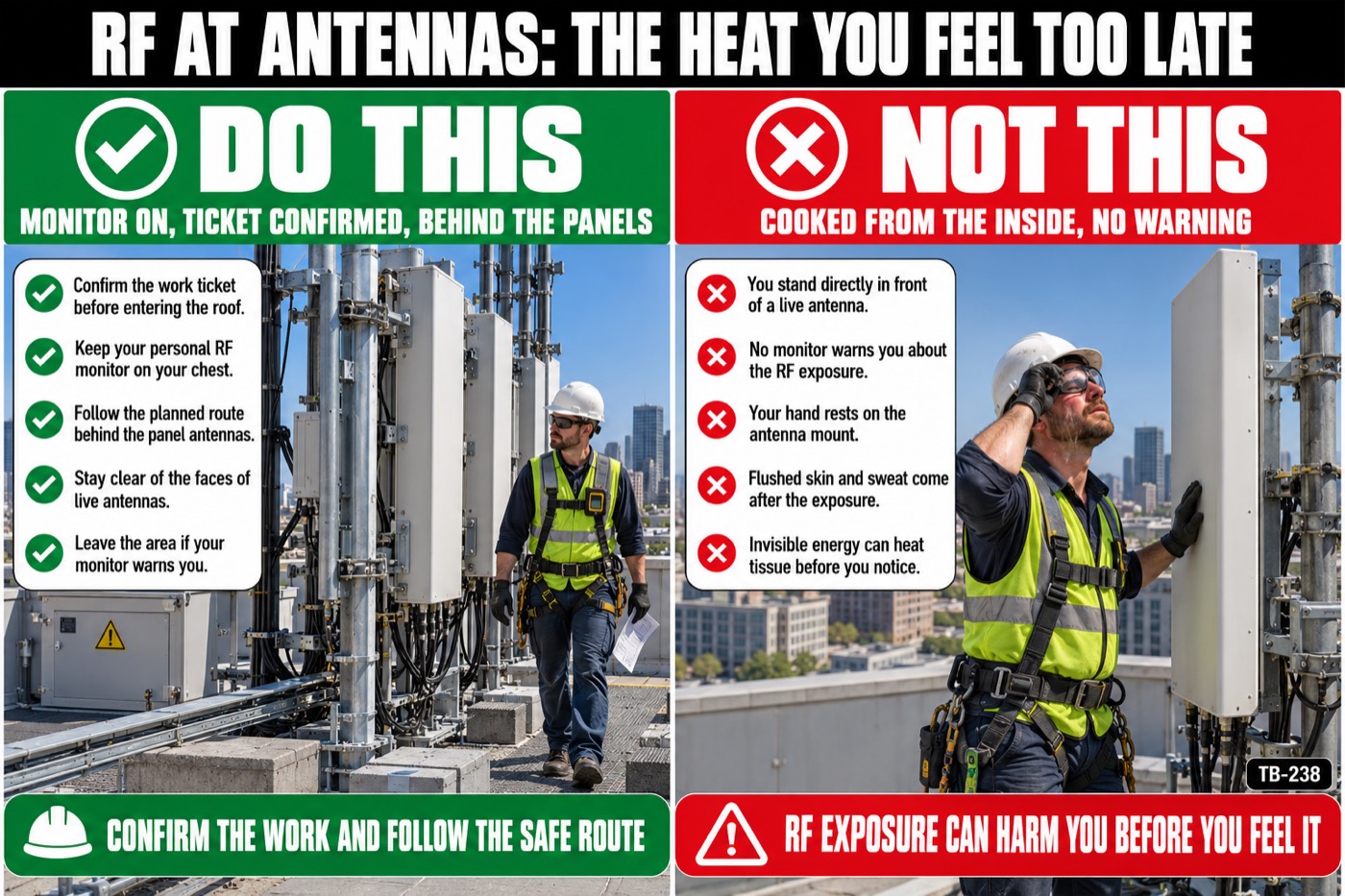
A cell panel antenna on that roof looks like a sheet of gray plastic. In front of it the radio energy can exceed the worker exposure limit within a few feet, and you feel nothing until your tissue is already warmer than it should be.
The points
- RF heats you from the inside, and the eye and the testicles are the parts that cannot shed the heat; the injury is a cataract or a burn you do not feel as it happens. Touch a metal element that is energized by RF and you get a contact burn as if you had grabbed a soldering iron.
- The limits: OSHA's guide is 10 milliwatts per square centimeter averaged over six minutes, and the FCC worker limit is 5 milliwatts per square centimeter above 1,500 megahertz and lower at 700 and 850, averaged over six minutes; the public limit is one fifth of the worker limit. The carrier's site drawing shows the distances at which each is exceeded, and those lines are real.
- Nobody works in front of a panel face or on top of a small cell that is on. The lockout is a phone call to the carrier's operations center with the site ID, a confirmed power-down, and a ticket number you keep; a padlock does nothing against a transmitter that is turned off and on from a hundred miles away.
- Read the sign: green NOTICE means past this line the public limit may be exceeded, yellow CAUTION means the worker limit may be exceeded and you need a monitor and a time limit, orange WARNING means power down before entering. The rule sets the red-and-black triangle as the RF warning symbol, and it means exactly what it says.
- A personal RF monitor on the chest, on and alarming, before anybody steps onto a roof with antennas; the route to your work does not pass in front of a panel, and powering down your carrier's sector does nothing about the other three carriers on the same roof.
Why it goes wrong
Radio frequency energy at 700 to 2,500 megahertz is absorbed by water, which is you, and turns into heat. Your skin has nerves for warmth on the surface; the heating from RF is inside, and the eye lens and the testicles have poor blood flow to carry the heat away. The practical injury for a tech is the six-minute problem: standing in front of a panel at three feet while you lash a cable, long enough that the average over the window is above the limit, with no sensation to warn you.
1910.97 was written in 1971; its 10-milliwatt guide is advisory, and the only hard requirement in it is the warning symbol. The number that governs a carrier's site is FCC 47 CFR 1.1310: for occupational exposure, frequency divided by 300 milliwatts per square centimeter from 300 to 1,500 megahertz, so about 2.8 at 850 megahertz, and 5 above 1,500, averaged over six minutes. For the public it is 1 milliwatt per square centimeter above 1,500 megahertz averaged over 30 minutes. Yellow, orange and red signs on the roof are where those numbers are exceeded.
In front of a typical cellular panel the worker limit is exceeded roughly a few feet out, and the public limit out to around 20 feet, depending on the number of channels and the power; behind and below the panel the levels fall off fast. That is why the route matters: a tech who walks across the roof behind the antennas and works below them is in a different world from one who sets a ladder in front of a face. Small cells on poles and building sides are lower power, but a face a foot from a small cell on a lift is not.
The lockout with the carrier is not a padlock. The carrier's network operations center can take a sector down, and it can bring it back up on a schedule or a trouble ticket without anybody on the roof knowing. So the power-down has a ticket number, a confirmed time window, a name at the NOC, and your monitor still on because the confirmation can be wrong. Multi-carrier rooftops mean one call per carrier, and the monitor is the thing that tells you which antennas are still on.
The sign program the carriers use is a standard set: blue INFORMATION, green NOTICE, yellow CAUTION, orange WARNING, and red DANGER, in that order of severity, with the 1910.97 red-triangle symbol on the ones that matter. A rooftop door with a yellow sign means the space beyond needs a monitor, time limits and a plan; an orange or red sign means a power-down first. The sign is not for the roofer or the HVAC crew to interpret; if you are the low-voltage crew on that roof, you are the one who knows what it means and you say it.
Broadcast and AM towers are a different scale, with RF burns from touching a guy wire or a fence, and those sites are not for a low-voltage crew without the site's own training. What you carry from this talk to a cell site is simple: monitor on, behind and below, power-down with a ticket, every carrier separately.
Questions for the crew
- Which antennas are on this roof, which carriers, and which sector are we working in front of today?
- Who is calling the NOC for the power-down, what is the ticket number, and how do we know the time window?
- Who has the RF monitor, is it on now, and what do we do when it alarms?
To close
Nobody steps onto that roof today until the monitor is on and the power-down ticket is confirmed for every antenna we will be in front of.
To hold this talk with your crew
1
Read it aloud. Five minutes, before the work starts.
2
Ask the questions. A crew that talks is a crew that remembers.
3
Have them sign on their own phones, and the record is sealed.