Data rooms: nothing in here is off
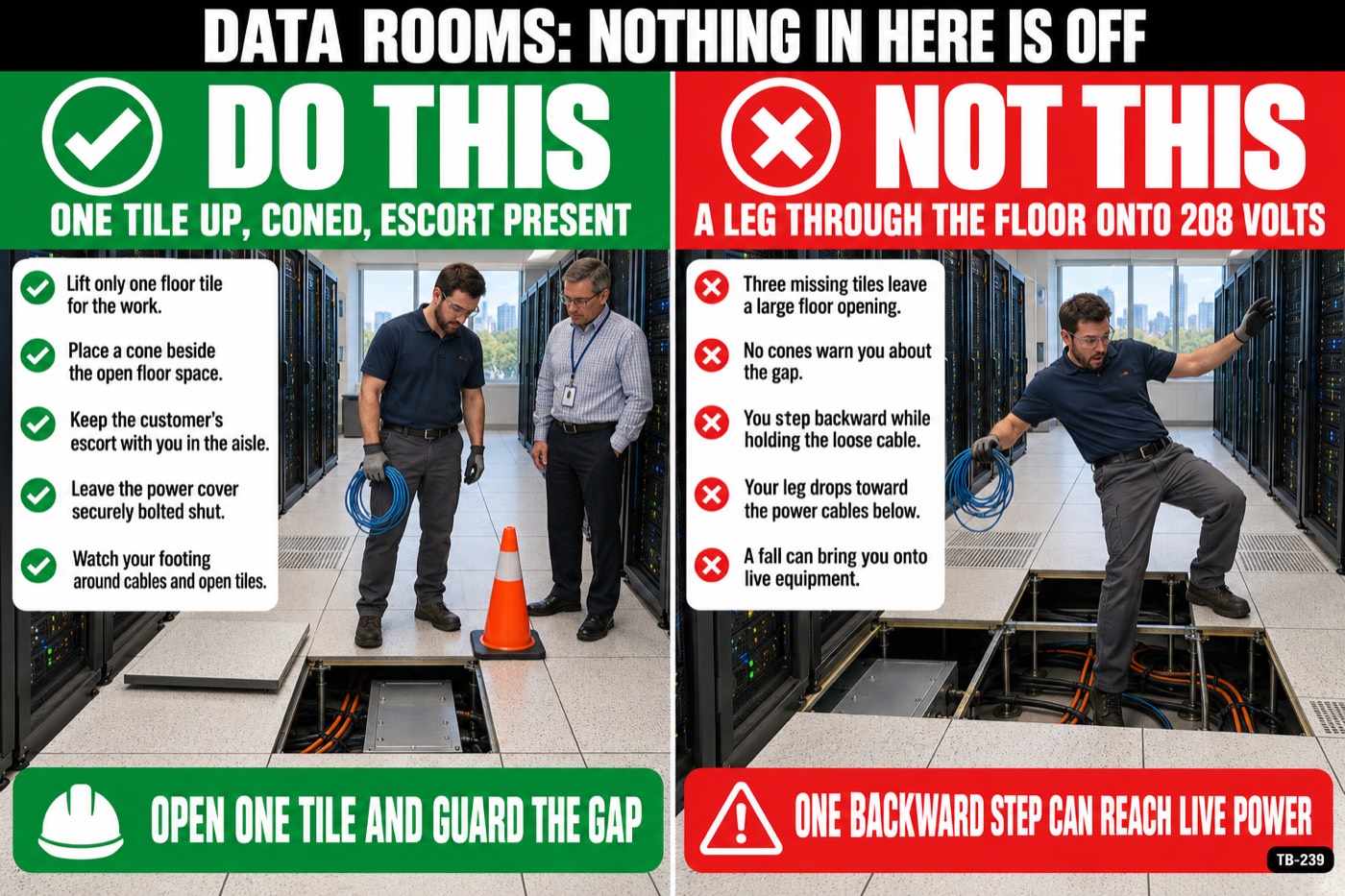
Every rack in this room is fed from two sides, the UPS keeps them live when the utility drops, and the battery room keeps the UPS live. There is no switch you can throw for your work, and you are not the one who gets to throw it.
The points
- The data room's injuries: an arc from a tool across a 208-volt PDU bus, a leg through a lifted floor tile onto power whips two feet down, a wrench across a 480-volt DC battery string that cannot be turned off, and the fire suppression dumping while you are on a ladder. Everything here is live, and the rule says you find out where the live parts are before you begin.
- The PDU is 208 volts three-phase behind a bolted cover, and it is not ours to open. Landing a circuit in it is energized work for a qualified electrician with the arc flash label read; we land our conduit and stop at the cover.
- A lifted floor tile is a hole in a dim aisle. You lift one at a time, you stay at it or cone it, and it goes back before you walk away; under it are the 208-volt whips, and you do not stand on them, cut them or lean on them.
- The UPS battery room is a DC string at several hundred volts with no breaker between cells, and hydrogen when it charges. No metal ladders, no metal tools set on the cells, no watch or ring, and no work in there without the customer's people.
- Dust, canned smoke or a hot tool sets off the sampling smoke detection, and the suppression system counts down about 30 seconds and discharges. Before dusty or hot work the customer puts the system on bypass with a permit; when the pre-discharge horn sounds, you leave, you do not touch the abort, and nobody leans on the red EPO button.
Why it goes wrong
A power distribution unit in a data room takes 480 volts in, steps it to 208/120, and feeds dozens of circuits through a panelboard with a bus that stays live on the A side when the B side is off. The arc flash from a screwdriver across that bus is measured in calories per square centimeter on the label on the door, and the low-voltage tech has no gear for it. 1926.416(a)(3) puts a duty on the employer to determine before the work starts where energized parts are in the path of the work; in this room the honest answer is everywhere, and the work is planned around that.
The raised floor is 12 to 36 inches deep and under it are power whips in flexible conduit, cable trays, and sometimes water for cooling. A tile lifted for a cable run and left open is what the next person steps into, in an aisle lit for reading server labels, carrying a server. One tile at a time, a cone or a person at it, back down before you leave, and the tile puller stays with the open tile. Never lift tiles in a line that makes a trench across an aisle.
A UPS battery string is cells in series, commonly 40 or more, adding up to 400 to 500 volts DC nominal, and there is no breaker between cells; the string is live the moment the cells are connected. DC arcs do not self-extinguish the way AC does, so a wrench across two terminals welds and burns. 1926.441 requires ventilation, face shields, aprons and rubber gloves for battery work, and an eyewash within 25 feet; for us the rule is simpler: we do not touch the string, we run our cable through the room only with the customer's escort, and nothing metal goes on top of a cell.
Sealed lead-acid batteries give off hydrogen when charging, and the room's ventilation is there to keep it under 4 percent, where it becomes explosive. A fusion splicer's arc, a drill motor or a dropped metal tool are ignition sources. If the room smells of rotten eggs or the ventilation alarm is on, nobody enters; that is a customer emergency, not a cabling job.
Clean-agent fire suppression is set off by very sensitive air-sampling detection, and it is sensitive enough that drywall dust, a scorched cable jacket or canned smoke will trip it. The pre-discharge alarm runs about 30 seconds, then the agent releases at pressure, loud enough to damage disk drives and hard enough to lift tiles. The agent itself is designed to be survivable, but you leave on the horn and you do not stay to finish the pull. Hot work or dusty work in a data room needs the customer's permit and the system on bypass with their name on it.
The emergency power off button is by the door, it is red, and it kills the whole room, including the customer's business. Leaning a ladder on it, or setting a reel against it, is a real event that has happened. Know where it is, keep everything away from it, and know where the suppression abort switch is so you are not standing on it either.
Questions for the crew
- Who is the customer's escort for us in this room today, and what have they put on bypass?
- Which tiles are we lifting, and who is staying at each open tile?
- Where is our conduit landing, and who is the qualified electrician landing the circuit in the PDU?
To close
Nobody lifts a tile or opens a cover in that room today until the customer's escort has said what is on bypass and what is not.
To hold this talk with your crew
1
Read it aloud. Five minutes, before the work starts.
2
Ask the questions. A crew that talks is a crew that remembers.
3
Have them sign on their own phones, and the record is sealed.