Powder-actuated tools are firearms
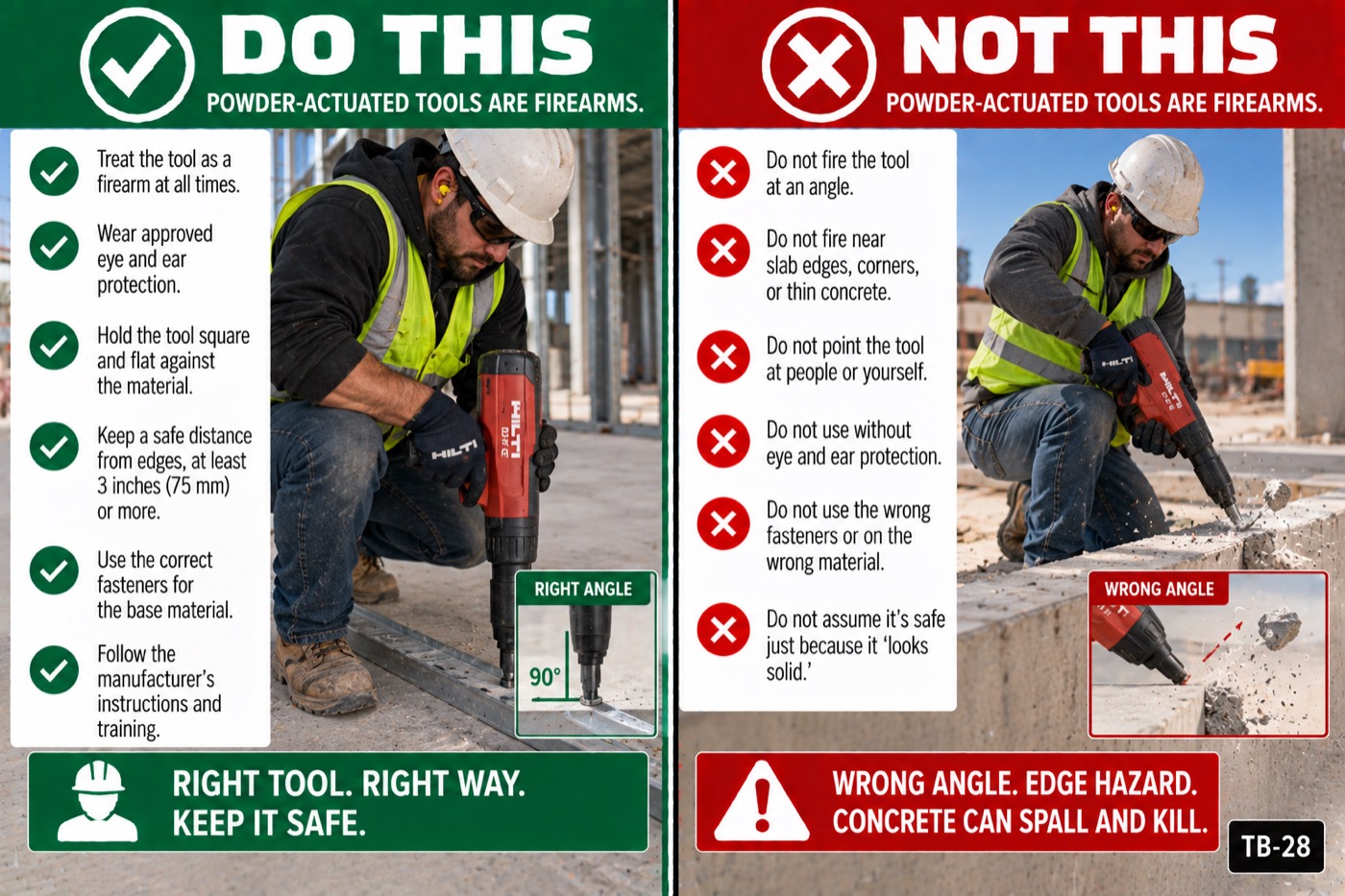
This tool drives a nail with an explosive charge. Everything about how we treat it should follow from that sentence.
The points
- Only a trained, certified operator uses one, and carries the card. The tool drives a fastener with an explosive charge.
- Never fire into hard or brittle material - cast iron, tile, glass block, hardened steel. The fastener comes back at you or goes straight through.
- Do not fire near an edge or into a thin section. A fastener through the far side is a bullet in someone else's work area.
- Load at the moment of use. On a misfire, hold the tool against the work for thirty seconds, then follow the manufacturer's steps.
- Eye and hearing protection on every shot, including the quick one you only need to make once.
Why it goes wrong
The certification is not paperwork. A powder-actuated tool has a firing pin, a charge and a projectile, and the training covers the specific tool in your hands - because the charge levels, the safety interlocks and the misfire procedure differ between them.
Hard and brittle material is where these go wrong. Cast iron, tile, glass block, hardened steel and very hard aggregate do not let the fastener bury; it ricochets back at the operator or shatters what it hits. Thin sections are the mirror image: the fastener goes straight through and becomes a projectile in whatever is on the other side, which on a job site is often another trade.
A misfire is the moment to slow down, not speed up. The charge may fire late. Holding the tool against the work surface for the full thirty seconds is what keeps the muzzle pointed somewhere harmless if it does.
Questions for the crew
- Who here is certified on the exact tool we are using today?
- What is on the other side of the wall or deck we are firing into?
- What do you do if it does not fire - and has anyone here actually had one misfire?
To close
Card in your pocket, eyes and ears on, and load it at the wall - not on the way to the wall.
To hold this talk with your crew
1
Read it aloud. Five minutes, before the work starts.
2
Ask the questions. A crew that talks is a crew that remembers.
3
Have them sign on their own phones, and the record is sealed.