Eye protection: what actually stops a fragment
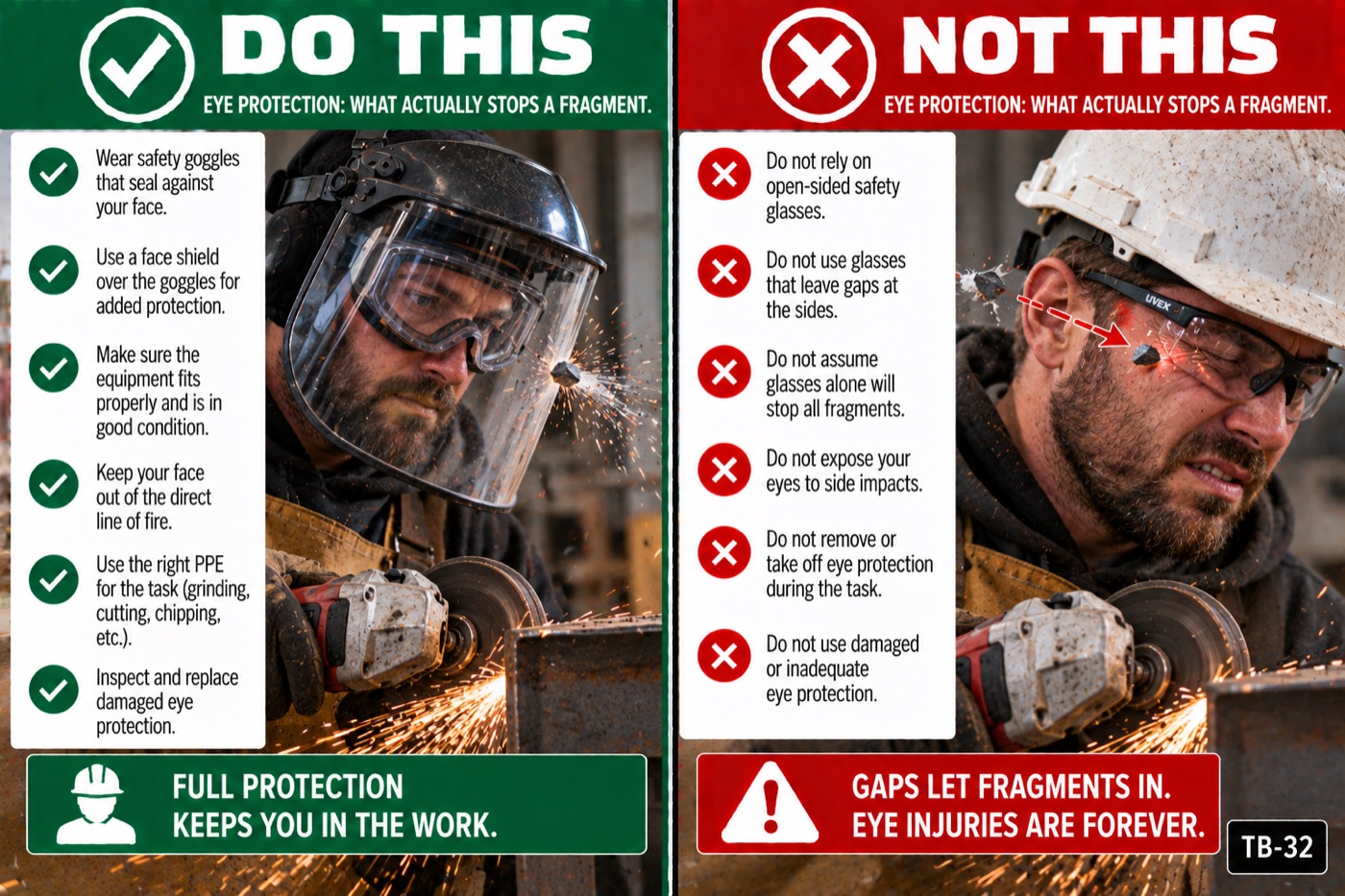
Almost every eye injury on a job site happens to someone who owned the right glasses and was not wearing them.
The points
- Prescription glasses are not safety glasses. No side shield and no impact rating.
- Look for Z87 on the frame, and Z87+ for high impact. A grinder needs the plus.
- Grinding, cutting and drilling overhead need a face shield over safety glasses, not instead of them.
- Replace scratched lenses. People push them up to see clearly, and that is the moment it happens.
- If something gets in, do not rub. Fifteen minutes at the eyewash, then have it looked at.
Why it goes wrong
Prescription glasses are not safety glasses. They have no side protection and no impact rating, and the lens material is chosen for optics rather than for stopping a fragment. Wearing them and assuming you are covered is the most common version of this mistake.
The marking is worth knowing. Z87 on the frame means it met the impact standard; Z87 with a plus means high impact, which is what a grinder, a cut-off saw or anything throwing metal actually requires. The difference is not cosmetic and it is stamped on the frame precisely so it can be checked.
Face shields and safety glasses are not alternatives to each other. The shield stops the large stuff and the spray; the glasses stop what comes underneath and around it. Grinding overhead is the case where people wear one and get hit by what the other would have caught.
Scratched lenses are the quiet cause. A lens you cannot see through gets pushed up onto the forehead so you can do the fiddly bit, and the fiddly bit is exactly when something comes off the work.
Questions for the crew
- Look at your glasses right now - what does the frame say?
- Who is grinding or cutting today, and do they have a shield as well?
- Has anyone here taken something in the eye? What were you doing at the time?
To close
If your lenses are scratched enough that you want to look over them, swap them out today.
To hold this talk with your crew
1
Read it aloud. Five minutes, before the work starts.
2
Ask the questions. A crew that talks is a crew that remembers.
3
Have them sign on their own phones, and the record is sealed.