Temporary power: GFCI, grounds and puddles
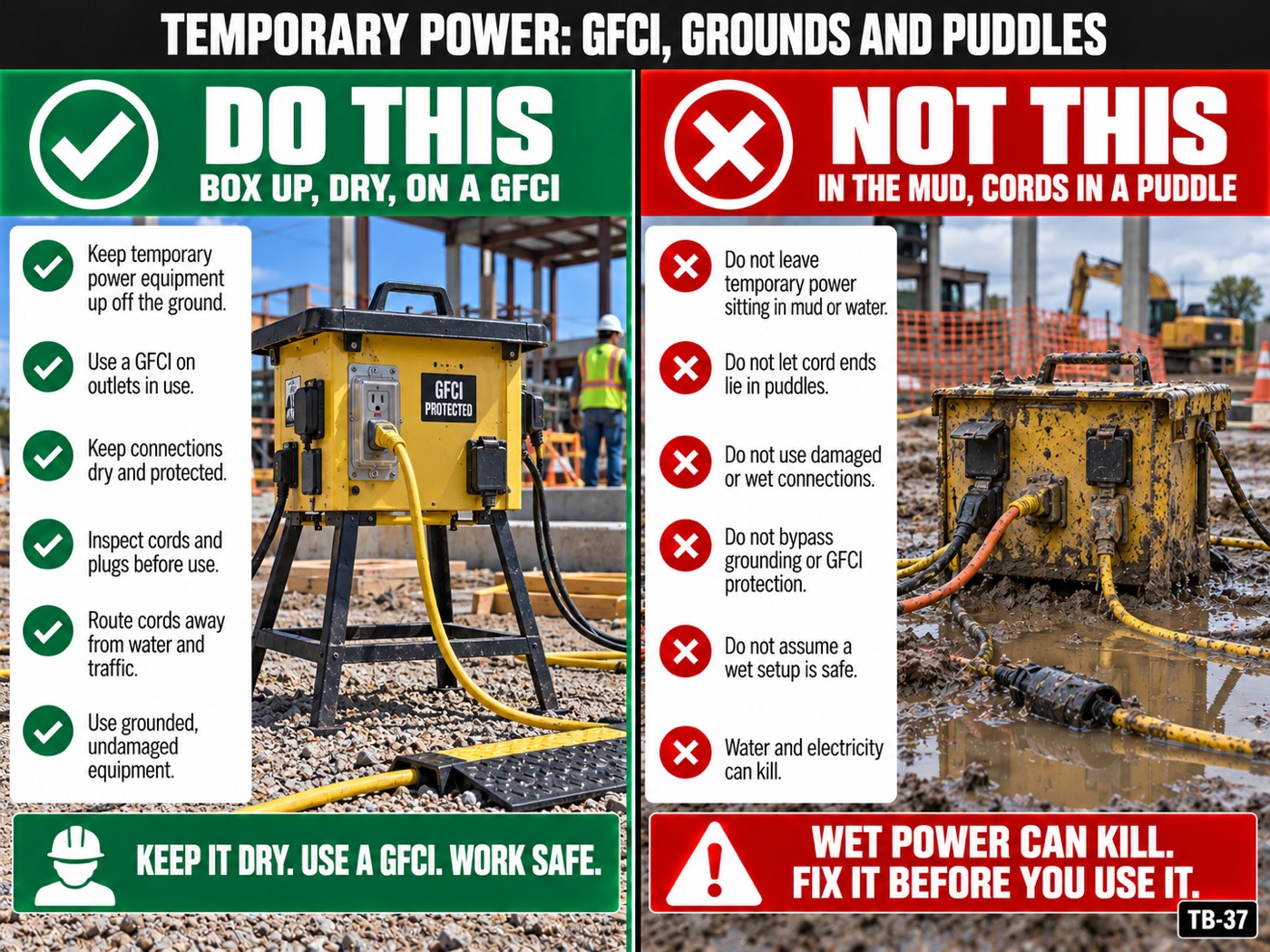
Everything we plug in today is running on wiring that was installed fast, by whoever got there first, with no inspection behind it.
The points
- Every temporary circuit gets GFCI protection or a documented assured equipment grounding conductor program. There is no third option.
- A cord with the ground pin missing is defective. Cut it out of service; taping it does nothing.
- Push the test button on the GFCI at the start of the shift. A device that never trips in testing will not trip for a person.
- Keep connections up off the ground and out of standing water. A cord end in a puddle is a live puddle.
- Generators feeding cords and tools get bonded the way the manufacturer specifies, not the way it worked last time.
Why it goes wrong
Temporary power is more dangerous than permanent wiring for a simple reason: it is installed under time pressure, moved constantly, dragged across surfaces it was not meant to cross, and nobody signs off on it. Every one of those things is a defect waiting to appear.
A GFCI is not a fuse and does not do what a fuse does. A breaker protects the wire from an overload; a GFCI watches for current leaving the circuit through something other than the return wire - through a person, usually - and cuts it in a fraction of a second, before the current can stop a heart. That is why the rule allows only two options, GFCI protection or a documented assured equipment grounding conductor program, and why most small crews pick the first one.
The test button is the part that gets skipped. A GFCI is an electronic device that fails, sometimes to the on position, and a device that does not trip on the test will not trip for a person either. Four seconds at the start of the shift is the whole cost.
The missing ground pin is the classic one. Someone breaks it off to fit a two-prong outlet and the cord keeps working perfectly, which is the problem - nothing tells you the protection is gone until a tool goes to fault and the case becomes live. Cut those cords out of service. Tape does not restore a ground path.
Water is the multiplier for all of it. A connection lying in a puddle energizes the puddle, and standing water is exactly what raises the amount of current going through anyone who touches the tool.
Questions for the crew
- Where is our power coming from today, and is it GFCI protected?
- Has anyone got a cord with a damaged plug or a missing ground pin?
- Where is water going to collect on this site when it rains?
To close
Push the test button on your GFCI before you use it. It takes four seconds.
To hold this talk with your crew
1
Read it aloud. Five minutes, before the work starts.
2
Ask the questions. A crew that talks is a crew that remembers.
3
Have them sign on their own phones, and the record is sealed.