Getting on and off the roof
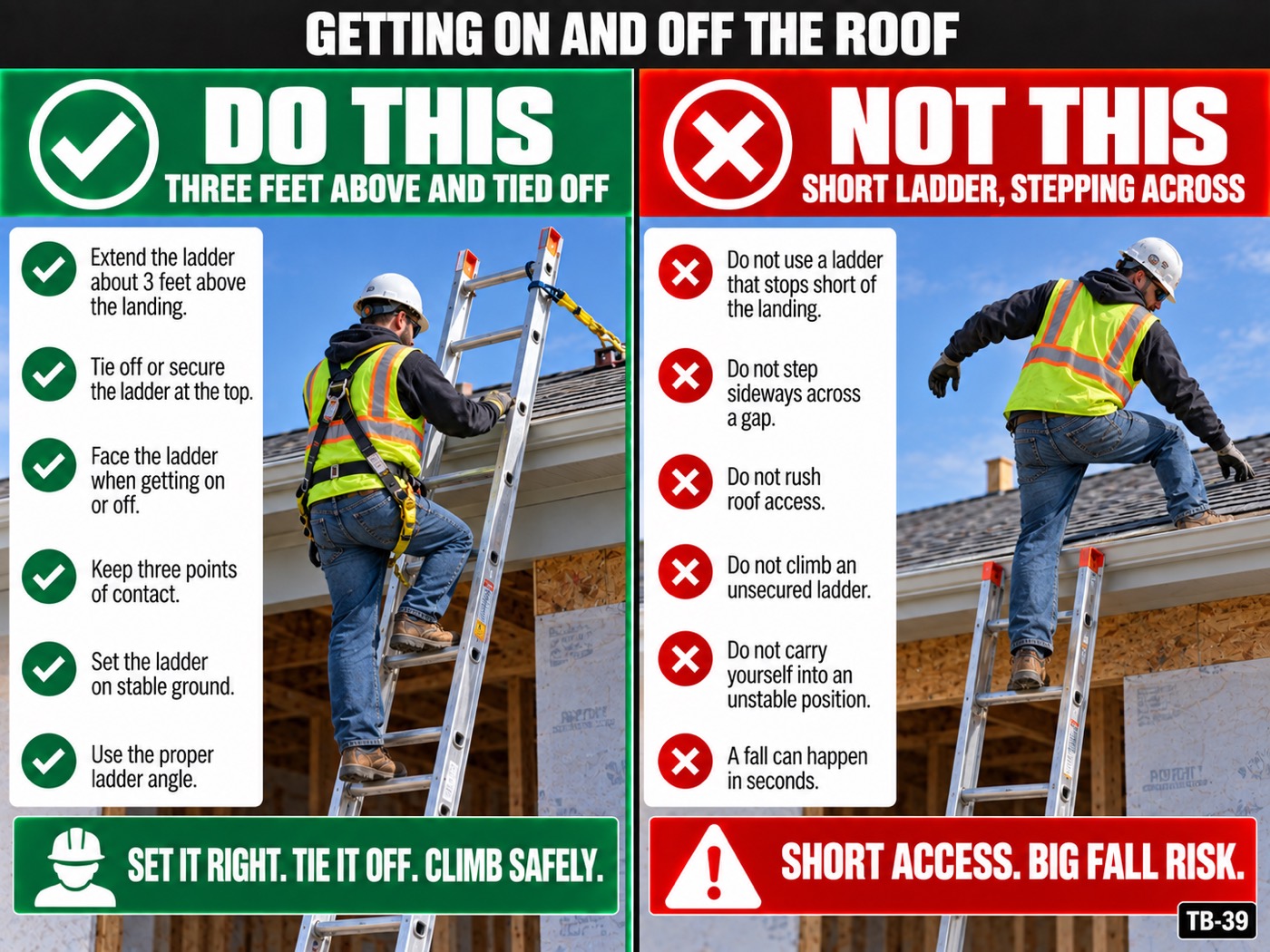
Nobody falls off a roof in the middle of it. They fall at the two seconds where they change from ladder to roof.
The points
- The ladder extends at least three feet above the landing, so there is something to hold at the transition.
- Tie the top off. A ladder that shifts as you step across is a common way people come off a roof.
- Three points of contact up and down, with nothing in your hands. Hoist material separately.
- Set the base one foot out for every four feet of working length, on firm level ground.
- The step from the roof back onto the ladder is where people rush. Slow down for that one step.
Why it goes wrong
The transition is the dangerous part, and the three-foot extension above the landing exists entirely for it. Without it there is nothing to hold at the exact moment your weight shifts from the rungs to the roof, so people grab the roof edge, the gutter, or nothing at all.
Tying off the top is what stops the ladder sliding sideways during that shift. A ladder that is only leaning is held in place by friction at two small points, and the sideways force of a person stepping across is precisely the force that breaks it.
The one-to-four rule for the base - one foot out for every four feet of working length - is not arbitrary. Too steep and the ladder tips backward with you on it; too shallow and the base slides out. And it only holds if the ground under the feet is firm and level, which on a job site usually means it needs something under it.
Three points of contact means two hands and a foot, or two feet and a hand, which means nothing in your hands. Carrying a bundle up a ladder is the compromise everyone makes and it removes the entire margin. Hoist it, or make two trips.
Coming down is worse than going up, because you are tired, you are facing away from the ladder as you find it with a foot, and you have already done this ten times today without incident.
Questions for the crew
- Does our ladder actually extend three feet above the roof line?
- What are we tying the top off to?
- What material has to go up today, and how is it getting there?
To close
Tie the top of that ladder off before the first trip up, not after somebody notices it moving.
To hold this talk with your crew
1
Read it aloud. Five minutes, before the work starts.
2
Ask the questions. A crew that talks is a crew that remembers.
3
Have them sign on their own phones, and the record is sealed.