Rooftop units: the edge, the wind and the start signal
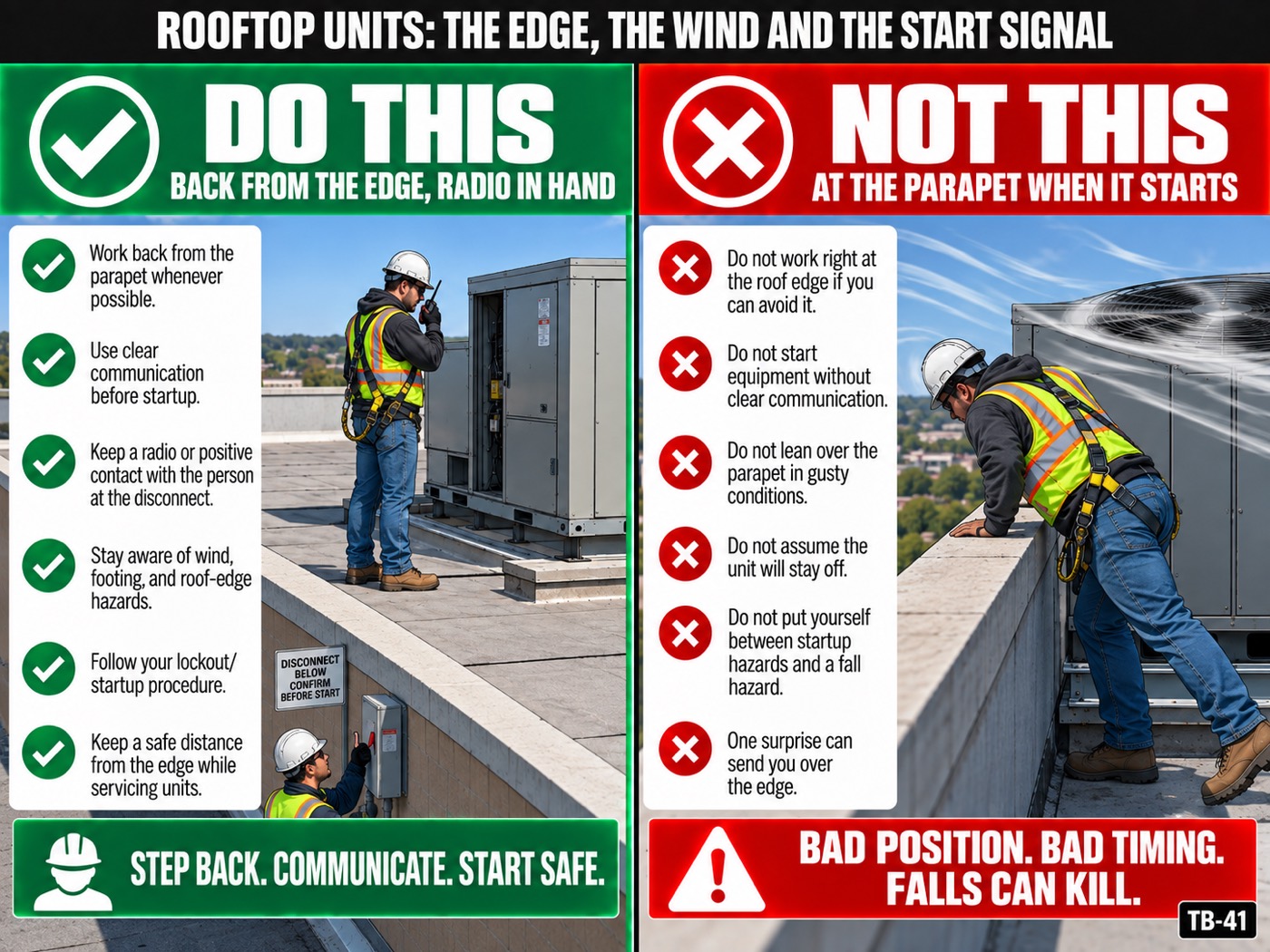
The unit is in the middle of the roof, so nobody thinks about the edge. Then somebody backs up with a panel.
The points
- Within six feet of an unprotected edge you need fall protection. Up to fifteen feet you need it or a marked safe area, even for a ten-minute job.
- A knee-high parapet is a trip hazard at the edge, not a guardrail. Do not treat it as one.
- Panels and covers get laid flat and weighted. A gust takes the panel and the person holding it.
- Lock out the unit before you reach inside. A rooftop unit starts on a thermostat call with nobody near a switch.
- Check the surface before you drag anything across it. Hot bitumen, loose ballast and wet membrane are all slips.
Why it goes wrong
For rooftop service work, closer than six feet to the edge requires fall protection and closer than fifteen requires it or a marked designated area, and the reason people skip it on rooftop units is that the unit is nowhere near the edge. But the work moves - you fetch a part, you carry a panel, you step back to look at something - and the roof is flat with nothing to tell you where you are.
A parapet is the specific thing people misjudge. A wall at knee height reads as a boundary but functions as a trip point at exactly the wrong place. Unless it is at guardrail height and built to take the load, it is a hazard rather than protection.
Wind is the second one, and it does not need to be a windy day. A panel or an access cover is a sail; a gust that would not move you at all will take a four-by-four-foot sheet, and it takes it while somebody is holding the edge of it near an unprotected side. Panels get laid flat and weighted the moment they come off, not leaned against the unit.
The start signal is what makes rooftop units different from most equipment you service. There is nobody at a switch. A thermostat two floors down calls for cooling and the fan starts, and it will do that while your hand is inside the cabinet. That is what lockout is for, and 'I am only in there a minute' is the exact circumstance in which it happens.
The surface itself changes through the day. Hot bitumen softens, loose ballast rolls under a boot, and a membrane that was dry at seven is slick with dew or condensate runoff by mid-morning.
Questions for the crew
- How far is the unit from the nearest unprotected edge, and how are we protecting that?
- Where does this unit get locked out, and does everyone know?
- What is the wind doing, and where are panels going when they come off?
To close
Lock it out before your hands go in. Ten minutes of work is still ten minutes with your hands in a machine.
To hold this talk with your crew
1
Read it aloud. Five minutes, before the work starts.
2
Ask the questions. A crew that talks is a crew that remembers.
3
Have them sign on their own phones, and the record is sealed.