Block saws: water, electricity and a blade
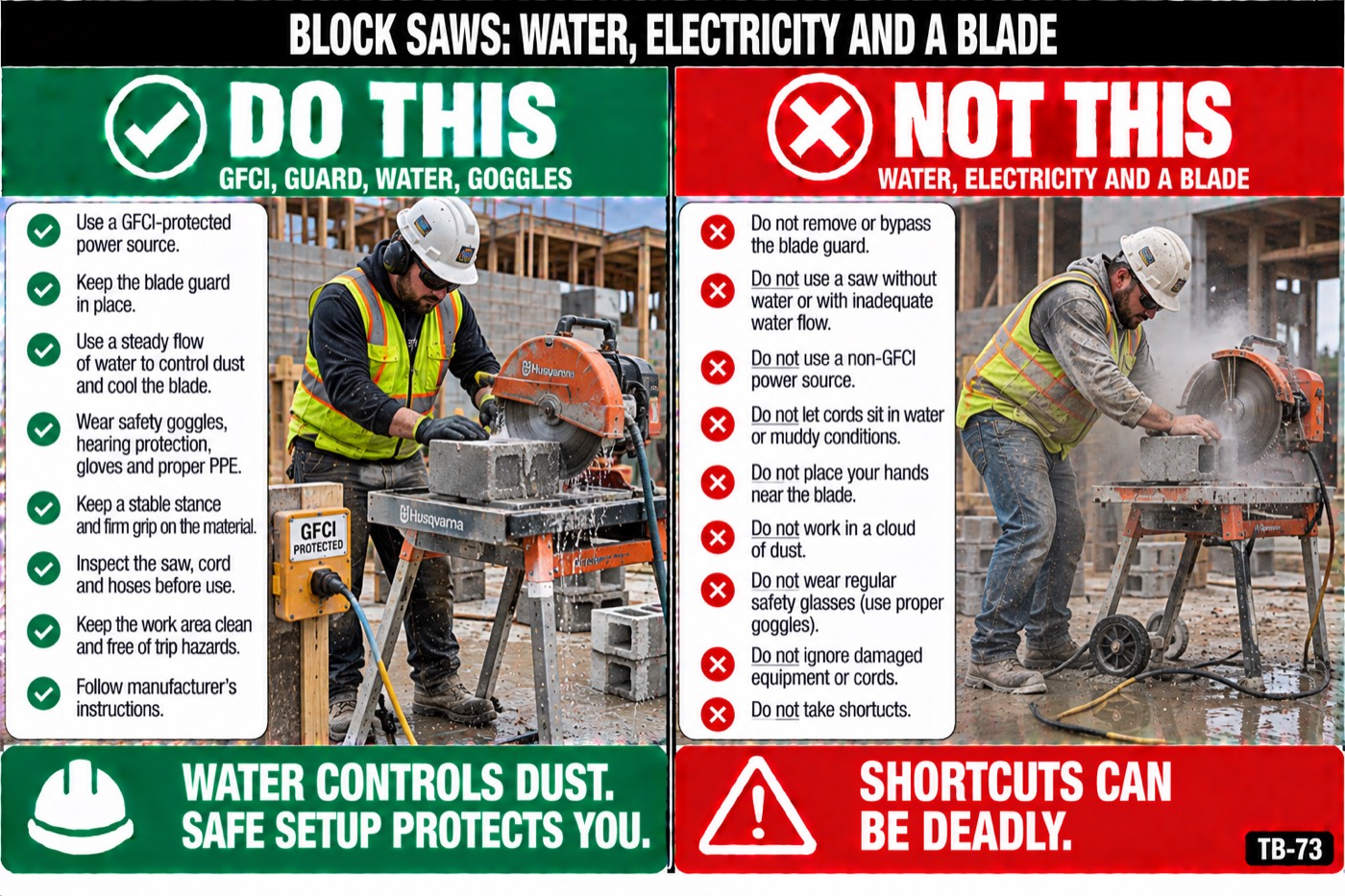
A masonry table saw runs a 14-inch diamond blade at about 2,500 RPM through a stream of water, and the cord that feeds it is lying in that water. Two of the three things there that can kill you are invisible.
The points
- The wet saw puts water, electricity and a spinning blade in the same square yard. Masons get shocked when the pump or the cord is wet and there is no GFCI, and they lose fingers when a block rocks into the blade.
- Every masonry saw has a guard, a semicircular enclosure over the blade, and it stays on. The guard is what keeps a blade fragment or a chip out of your face when the blade breaks.
- The saw, the water pump and the cords run through a GFCI, and the plugs and connections stay out of the water. A cord with a cut in the jacket lying in the slurry is out of service.
- The block sits flat on the table against the fence, and the cut is straight, not twisted. Twisting the block or cutting freehand pinches the blade and throws the piece or breaks the blade.
- The blade is rated for the saw's RPM, checked for cracks and missing segments before you start, and the water is running before the blade touches block. Cutting dry with a wet blade cooks the blade and fills the air with silica.
Why it goes wrong
Water and slurry conduct electricity. If the pump or the motor insulation fails, the frame of the saw and the water on the table can be live, and the mason is standing in the runoff. A GFCI trips at about 5 milliamps. Without it, 50 to 100 milliamps through the chest can stop a heart, and a mason standing in wet slurry is the best ground on the site.
29 CFR 1926.702 says masonry saws are guarded with a semicircular enclosure over the blade and a method to retain blade fragments. The guard stays on and is not bent back to see the line better. If you cannot see the line with the guard on, you set the block up differently.
Diamond blades fail from cracks in the steel core, from lost segments, and from being run above their rated speed. Check the blade before the first cut of the day and after any drop. Tighten the arbor nut, and confirm the blade RPM rating is at or above the saw's speed. A bent blade from being dropped on the floor comes out.
The pinch happens when the block is not flat against the fence, when it is fed too fast, or when a small piece is held with fingers next to the blade. Keep the hands to the sides of the block, not behind the cut line, and use a push block for anything too small to hold with the hand well clear. Slivers get cut another way or not at all.
Slurry runs off the table and onto the ground, and it goes where the cords are. Cords hang on hooks off the ground, plugs stay dry, and the GFCI gets tested with its button at the start of the day. Change the water so the pump does not clog, and keep the slurry out of the walkway where it turns to grease.
Silica has its own talk. The saw's part of it is simple: the water is the control, so the water is on and hitting the blade before you cut, and a saw with the pump broken is a saw that is not running until it is fixed.
Questions for the crew
- Where is the GFCI for the saw and the pump today, and has anyone pushed the test button this morning?
- What condition is the blade in, and when did someone last look at it for cracks?
- Where does the slurry run on this setup, and are the cords and plugs out of it?
To close
The saw runs through a tested GFCI with the guard on today, and any piece too small to hold against the fence with the hand clear of the blade gets cut another way.
To hold this talk with your crew
1
Read it aloud. Five minutes, before the work starts.
2
Ask the questions. A crew that talks is a crew that remembers.
3
Have them sign on their own phones, and the record is sealed.