Masonry scaffolds: the cube of block on one end
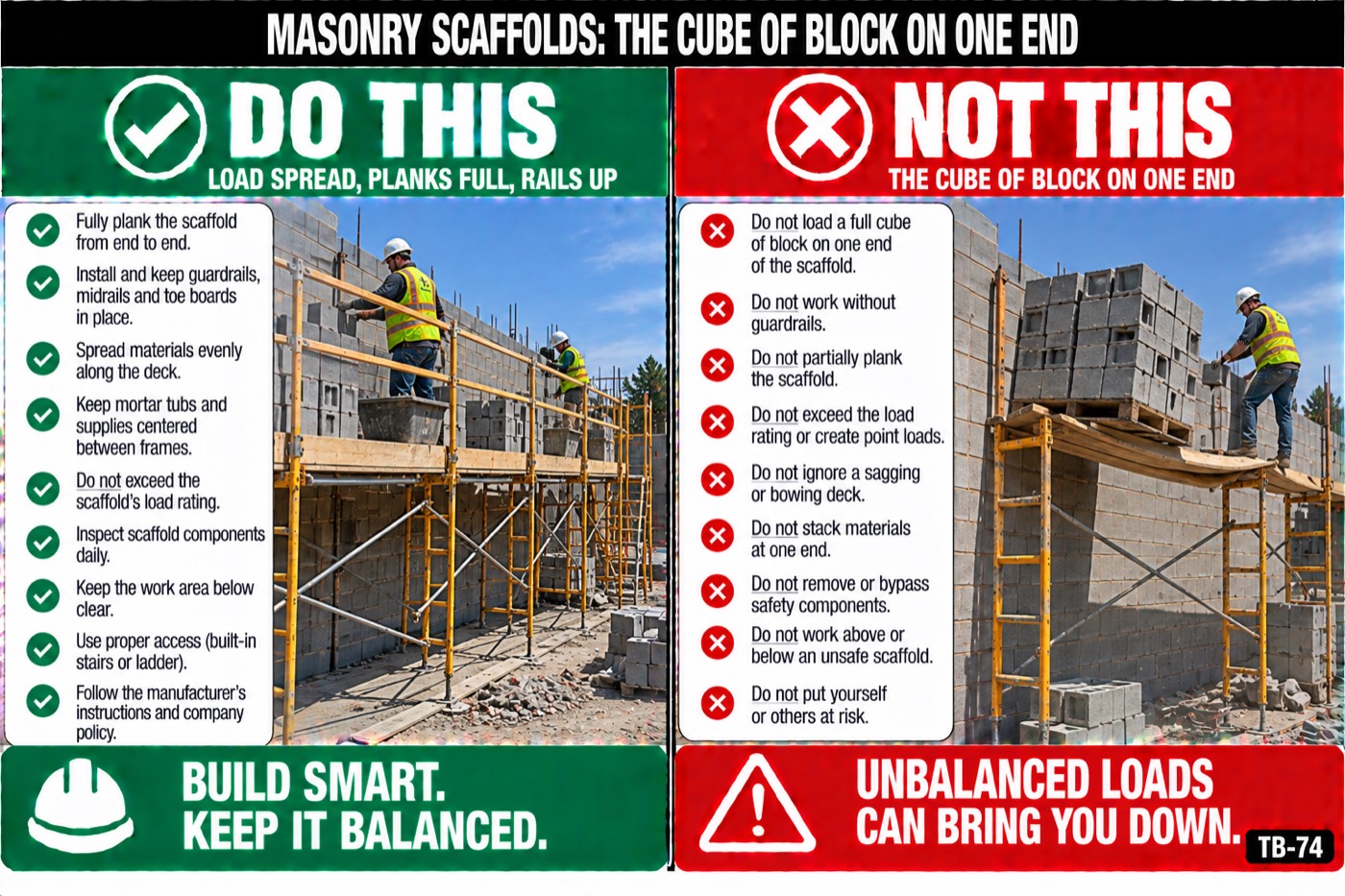
A cube of 8-inch block weighs about 3,000 pounds and sits on about 16 square feet. That is close to 200 pounds a square foot on a platform rated for 75, before the crew and the mud tubs get on.
The points
- Scaffold planks break and frames buckle when block is stacked on one end of a run. When it goes, the mason goes with it, and the block lands on whoever is below.
- A scaffold carries its own weight plus at least 4 times the most it will ever be loaded with. A mason's scaffold is heavy duty, 75 pounds a square foot, and a cube of block puts about 200 on the spot it sits on, so where the forklift sets it matters.
- A competent person inspects the scaffold before every shift and after anything that could have affected it: the forklift bumping a leg, a windy night, a delivery. That means someone with the authority to shut it down.
- Block goes over the frames and bearers, spread along the platform, never on a side bracket and never at the end of a run over a cantilever. Mud tubs sit over the legs, where the load goes straight down.
- Planks are scaffold grade, overlap at least 12 inches over a support or are cleated, no gap over an inch, and never a plank that ends with nothing under it. Guardrails go on at 10 feet.
Why it goes wrong
Do the math once and it stays with you. A standard 8-inch block is about 35 pounds. A cube is around 90 blocks, so 3,000 pounds or more, sitting on a footprint of roughly 4 by 4 feet. A mud tub full of mortar is about 200 pounds. Two masons, two tenders, a cube and two tubs on a 7-foot bay is well past 75 pounds a square foot unless the load is spread.
29 CFR 1926.451 puts it in numbers: each scaffold and component supports its own weight plus at least 4 times the maximum intended load. Planks are placed so no gap between them or to the uprights is more than 1 inch. A competent person inspects before each shift. Nothing gets loaded past its rated capacity. And fall protection at more than 10 feet.
The forklift operator sets the cube where the mason points. If the mason points at the end of the run because it is convenient, the operator says no. The cube goes over a frame, on the back half of the platform, and the mason works the front. Side brackets are for a mason to stand on, never for materials, and a cube on a bracket tips the whole scaffold.
The 4 to 1 factor is not a cushion for overloading. It covers the things nobody measures: the impact when a cube is set down hard, the plank with a knot, the leg that has sunk an inch into wet ground since it was leveled, the frame that is not quite plumb. Load to the rating and those things stay covered. Load past it and you are using up the safety factor for convenience.
Base plates on mud sills, on ground that has not softened overnight. A scaffold that was plumb Friday and leans Monday has moved, and the competent person looks at it before anyone climbs. The wind loading on a scaffold wrapped in debris netting is another thing that changes overnight.
A block that falls 20 feet is doing about 25 miles an hour when it hits. Toeboards or screens on the working platform, nobody working or walking under the scaffold, and the drop zone marked. The mason on top is not the only one the scaffold can hurt.
Questions for the crew
- Where does the forklift set the block on this scaffold today, and who told the operator where?
- Who inspected this scaffold this morning, and what has changed since yesterday?
- What is under the planks at the end of the run where the next cube is going?
To close
Every cube of block today lands over a frame and never on a bracket or the end of a run, and nobody climbs the scaffold before the competent person has looked at it.
To hold this talk with your crew
1
Read it aloud. Five minutes, before the work starts.
2
Ask the questions. A crew that talks is a crew that remembers.
3
Have them sign on their own phones, and the record is sealed.