Housekeeping is a safety issue, not a chore
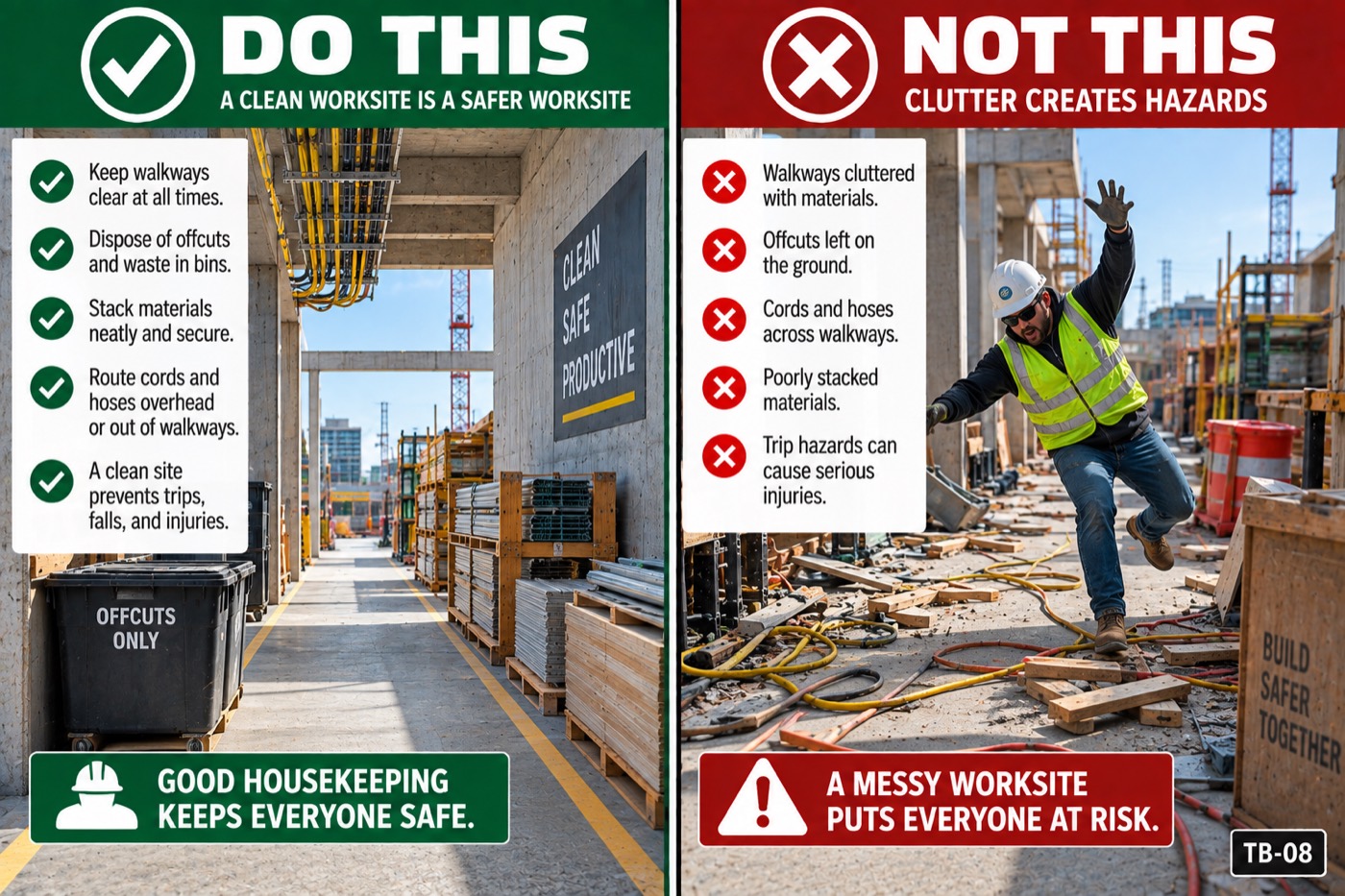
Look at the ground around where you are standing. Everything on it got put there by one of us.
The points
- Slips, trips, and falls on the same level are among the most common injuries on any site, and nearly all of them come from something left where it didn't belong.
- Clean as you go. A pile you plan to deal with later is a hazard right now.
- Keep walkways, stairs, and exits clear. Someone will use them in the dark or in a hurry.
- Cords and hoses get run overhead or along walls, never across a path.
- Nails get bent over or pulled. Stacked material gets banded or blocked.
Why it goes wrong
A messy site slows everything down as well as hurting people. Time spent looking for tools in a pile is time not spent working, and a site that looks disorganized signals to everyone on it that standards are low.
General contractors and inspectors read housekeeping as a proxy for how you run everything else. A tidy site rarely gets a hard look; a messy one always does.
Same-level falls are dismissed as minor and are not. A trip on flat ground puts a person down with no time to get a hand out, and wrists, elbows, hips and heads take the impact. These are among the most common serious injuries on any site, and every one of them started with something left where it did not belong.
The reason 'clean as you go' works and 'clean up at the end' does not is that the pile is a hazard for the entire time it exists. Deferring it means accepting that hazard for the rest of the day, usually in a walkway, usually in worse light by the afternoon.
Two specifics worth naming: nails in scrap get bent over or pulled, because a board with a nail up goes through a boot sole; and stacked material gets banded or blocked, because a stack that has been leaning for a week will pick the moment somebody walks past.
Questions for the crew
- What's the worst trip hazard on this site right now?
- Whose job is it to clear it, and when?
- What could we change about how we stage material to stop the pile forming?
To close
Pick the worst one and deal with it before you start. It takes two minutes now and an hour after somebody goes down.
To hold this talk with your crew
1
Read it aloud. Five minutes, before the work starts.
2
Ask the questions. A crew that talks is a crew that remembers.
3
Have them sign on their own phones, and the record is sealed.