Hanging ceilings: a 5/8 sheet weighs 100 pounds
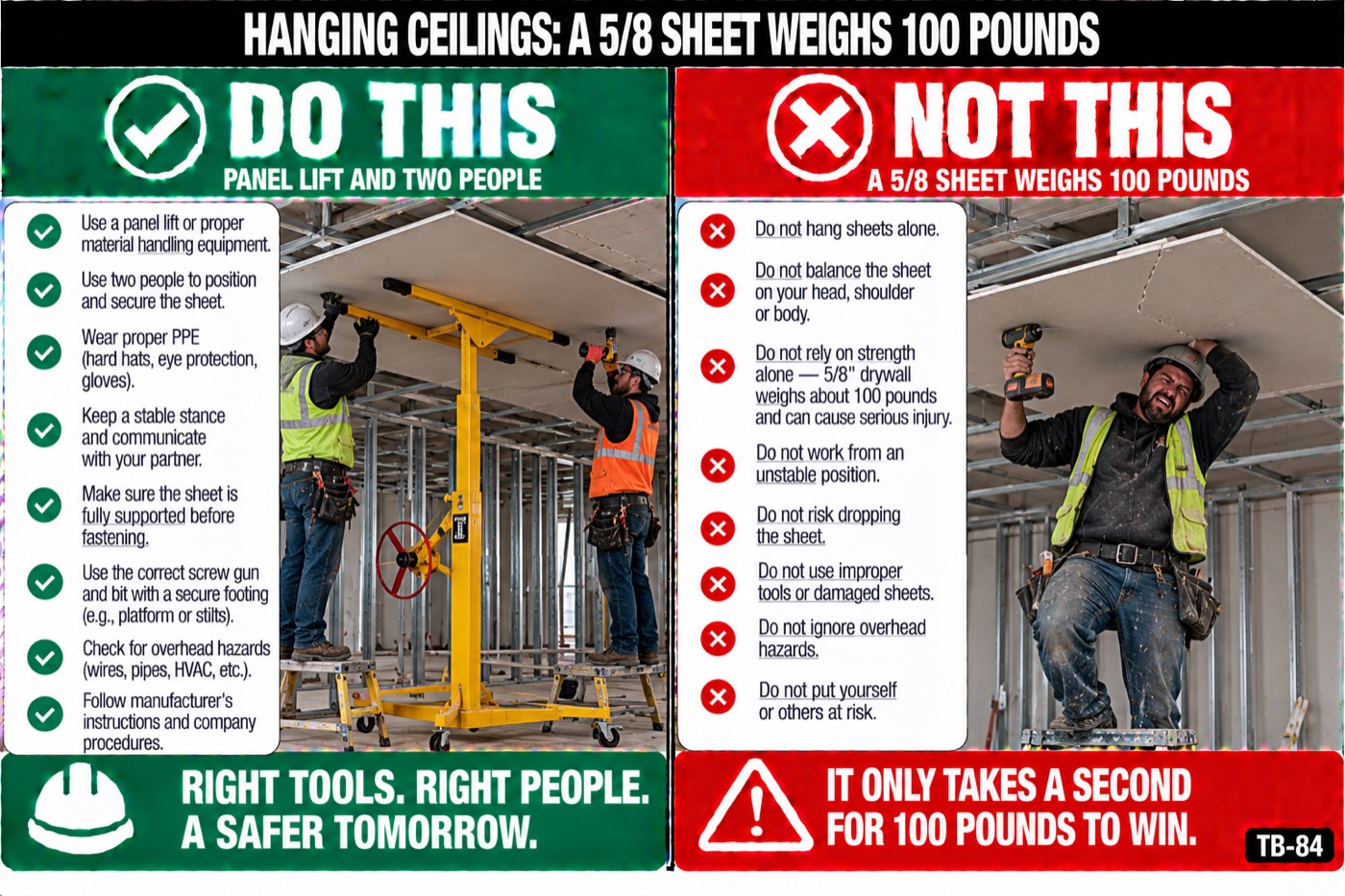
A 4-by-12 sheet of 5/8 board weighs about 100 pounds. Held over your head with your arms straight, your shoulders are carrying it, and they were not built for that.
The points
- Overhead drywall wrecks shoulders and backs slowly and drops sheets on heads fast. The rotator cuff tear comes after a few years of pressing 100 pounds up with your arms; the broken nose and the crushed fingers come the day the sheet slips off the T-brace.
- No rule gives you a lifting weight, so the rule is the employer's duty in 1926.20(b): look at the work before it starts, and do not let anyone use a method or a tool that is not up to it. A ceiling sheet with the wrong number of hands on it is exactly that.
- Ceilings go up on the panel lift. It cranks the sheet to 11 feet, holds it against the joists, and you screw with both feet on the floor. If there is no lift, a full sheet on a ceiling is two people and a deadman, never a single pair of arms and a knee.
- The screw gun over your head: 1-5/8 screws, the gun set for depth, elbows in and the gun close to the body, and a break in the pattern every few sheets. Arms straight up and locked for an hour is how the shoulder goes.
- Stocking the job: sheets carry on edge with two people, hands on opposite ends, and a stack leans against a wall at 4 or 5 degrees off vertical with the bottom blocked so it cannot walk out. A stack that falls flat is 3,000 pounds coming down on a leg.
Why it goes wrong
Half-inch 4-by-8 board is about 54 pounds. Five-eighths Type X in a 4-by-12 is close to 110. A ceiling sheet is held at full arm extension while the first screws go in, and every pound at that reach is many times the load on the shoulder joint. This is the job that builds the rotator cuff tear, the neck strain and the lower back that goes at 45.
The panel lift rates about 150 pounds and has a winch brake. The sheet sits on the hooks face down, cranks up, and tilts to the ceiling. Mistakes that hurt: cranking with the wheels unlocked so the lift rolls, loading a sheet on a lift that is already tilted, and leaning the sheet against the cradle instead of setting it on the hooks so it slides off at 8 feet.
A deadman or T-brace is a 2-by-4 with a crosspiece, cut a half inch longer than the ceiling height. It takes the weight while the screws go in. It does not hold the sheet by itself, and the sheet it is holding will come down on whoever is under it when the T slips on a dusty floor.
The screw gun runs 4,000 RPM and a slipped bit goes into the hand holding the board. Depth-set noses keep the screw from tearing the paper, and a gun with a collated strip lets one hand stay on the sheet. Eye protection stays on overhead, because the dust from the screw and the paper falls straight into your face.
Stocking is where the crushing injuries are. A bundle of 5/8 board is two sheets, and a lift of 30 sheets on a cart is about a ton and a half on casters. Stacked flat on the floor it is fine; leaned against a wall with the bottom kicked out it is a wall that falls on you. Stacks go where the floor can hold them and nobody is walking under a leaned sheet.
The common mistake is the two-person crew that turns into one. The helper goes for screws, the hanger keeps the sheet up with his head and one hand to save thirty seconds, and the sheet comes down on his face. The sheet waits on the lift or on the floor until the second set of hands is back.
Questions for the crew
- Is there a panel lift on this job, and if not, who are the two people on every ceiling sheet today?
- Where are the sheets stacked, and what is keeping the leaned stack from walking out at the bottom?
- Who has a shoulder or a back that is already hurting, and what are they hanging today?
To close
Today every ceiling sheet goes up on the lift or with two sets of hands, and nobody holds a sheet overhead alone while someone goes for screws.
To hold this talk with your crew
1
Read it aloud. Five minutes, before the work starts.
2
Ask the questions. A crew that talks is a crew that remembers.
3
Have them sign on their own phones, and the record is sealed.