Stilts: a fall that starts at head height
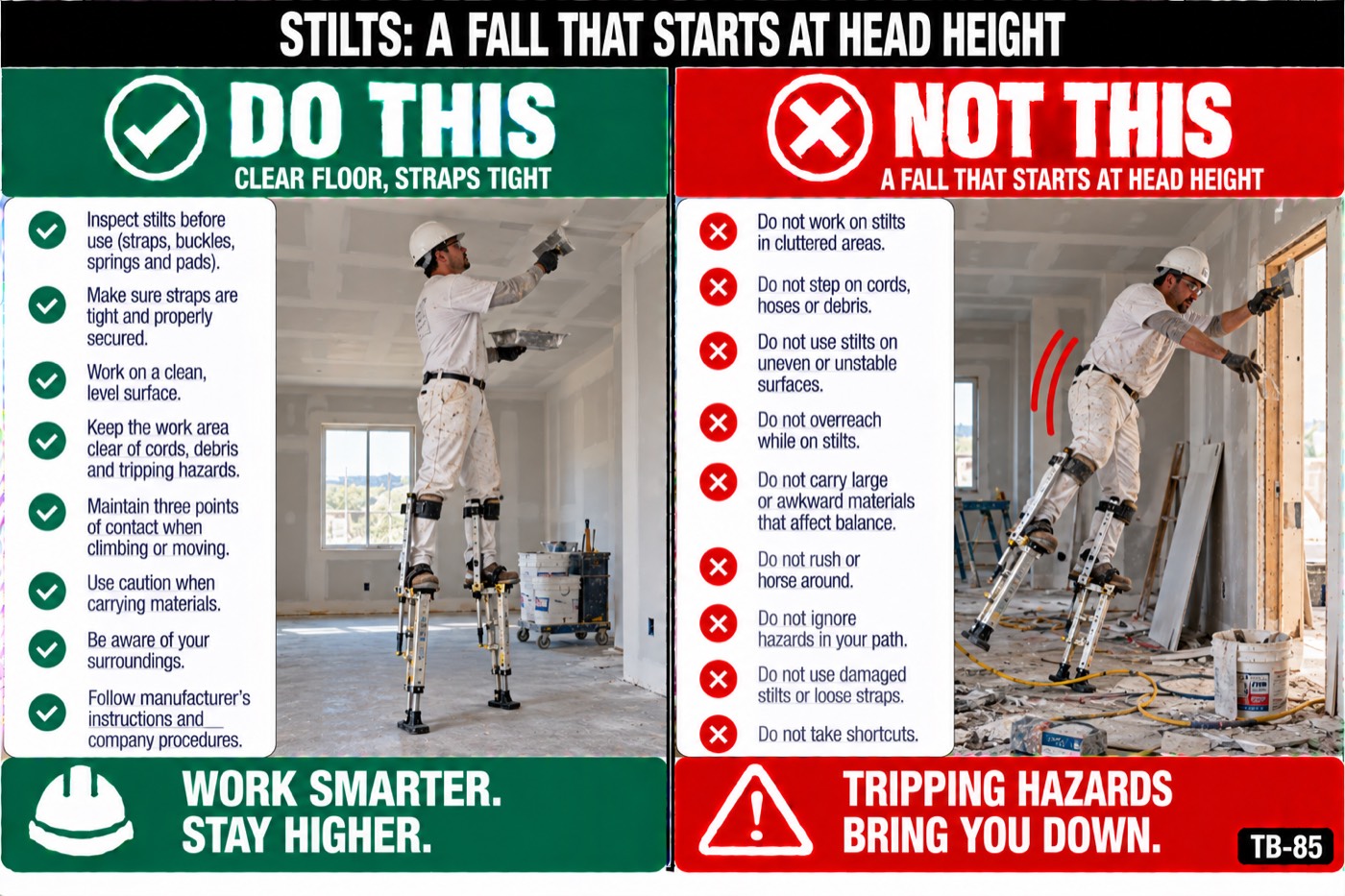
On 40-inch stilts your head is 9 feet off the floor and your feet cannot step to catch you. A trip on stilts is a fall that lands on your face, your wrists or the back of your head.
The points
- A stilt fall is a head-first fall. The straps hold your legs to the stilts, so you cannot get a foot out to save it, and you go down from a standing height of 8 or 9 feet with your hands full of a mud pan and a knife.
- The rule is short: the floor you walk on stilts has to be flat and free of pits, holes, obstructions and debris, stilts go on a scaffold only if it is a large-area scaffold, a guardrail there gets raised by the height of the stilts, and nobody alters the stilts without the maker's say-so.
- Before you strap in: walk the room on foot, kick every cord, screw bucket, scrap of board and drop cloth out of it. Doorways, thresholds, the step down into a garage and a floor register are the trips.
- Where stilts do not go: stairs, within reach of a stairwell or an unguarded edge, on a bakers scaffold, on a floor with debris, and on wet or muddy floors. Where local rules ban them, they stay in the truck.
- Strap check every morning: the leg straps, the foot plate bolts, the spring on the ankle and the rubber feet. A strap that has been cut and knotted is a stilt that is going to let go on the step.
Why it goes wrong
Stilts put you at 18 to 40 inches above the floor. The fall from 40 inches is not the number; the number is where your head is when you go over, which is 8 or 9 feet up, and the speed it hits at from there. Wrist fractures, broken jaws and skull fractures are the stilt injuries, and the wrists break because putting the hands out is all you can do.
1926.452(y)(3) says flat and free of pits, holes and obstructions such as debris. That is the whole floor, every time, because you cannot look down at your feet on stilts the way you do walking. A screw on a concrete floor rolls under a stilt foot the way a marble does under a shoe.
Doorways are the trip that catches experienced people. The threshold, the drop from the finished floor to the slab, the door itself swinging, and the fact that the top of the frame is now at your chest. A 34-inch doorway at 40 inches is a place where you turn sideways and go slowly, or take the stilts off.
Bakers scaffolds and stilts do not mix. The rule allows stilts only on a large-area scaffold, and then the guardrail has to go up by the height of the stilts. A bakers platform 6 feet up with a 40-inch stilt on it puts your feet at 9 feet with no rail that means anything.
Cords and hoses are the debris that walks in after you have cleared the floor. The sander's cord, the mud pump hose, the extension cord for the lights. They get run along the walls or overhead, and anyone who drops one across the floor while stilts are on says so out loud.
The common mistake is the last little bit. The room is done, the stilts come off in the next room, and the finisher walks across the hall on them to save the two minutes of unstrapping. The hall is where the boxes and the cords are.
Questions for the crew
- Which rooms today are getting stilts, and who is walking them on foot first?
- Where are the doorways, steps down and floor registers on this floor?
- When were the straps and feet on the stilts last looked at, and by whom?
To close
Stilts go on today only in a room that has been walked and cleared first, and they come off before a doorway, a stair or a scaffold.
To hold this talk with your crew
1
Read it aloud. Five minutes, before the work starts.
2
Ask the questions. A crew that talks is a crew that remembers.
3
Have them sign on their own phones, and the record is sealed.