Cutting into a wall: the cable behind the board
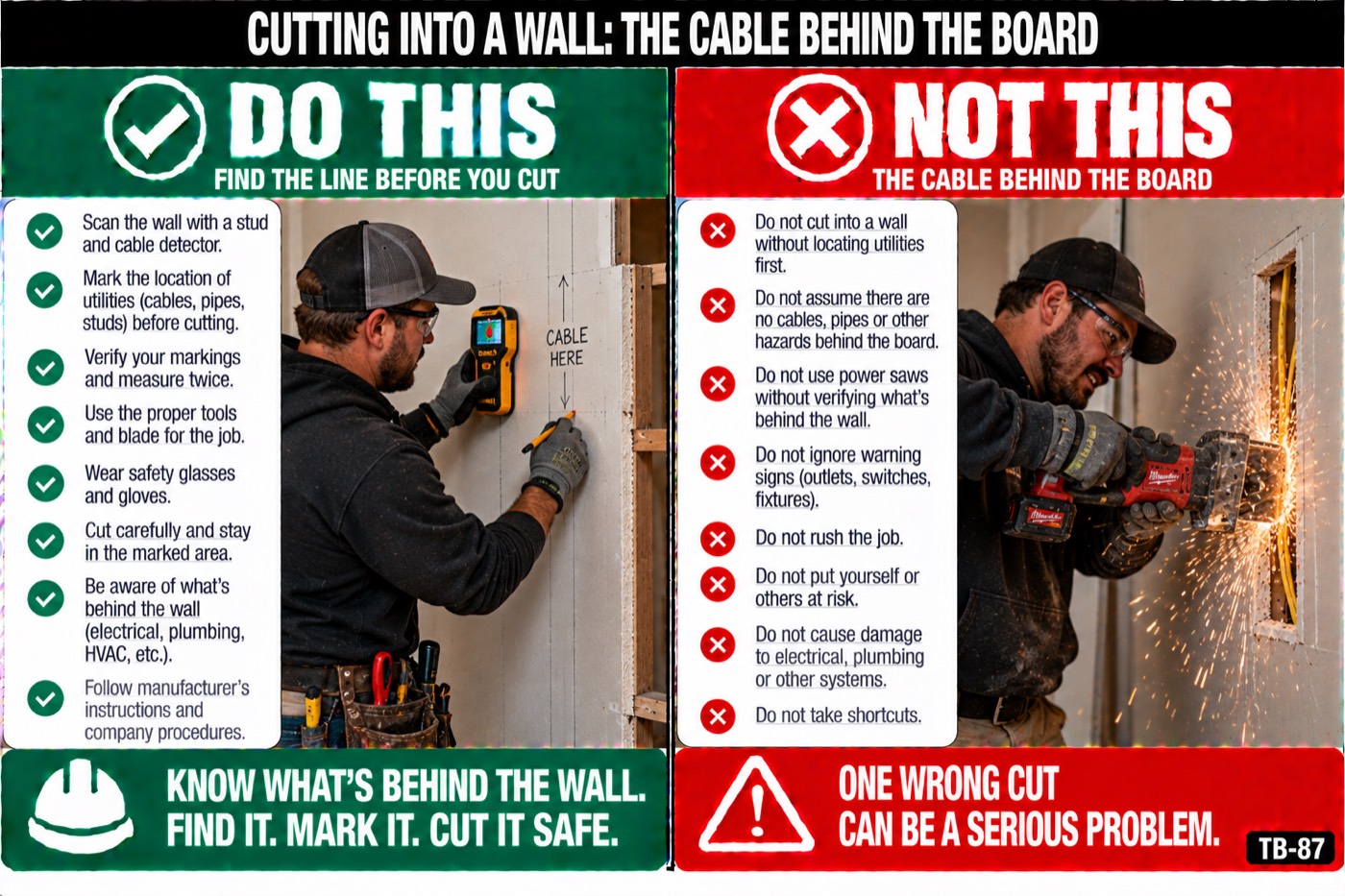
A rotozip bit is 1/8 inch wide and spins at 30,000 RPM. It goes through the jacket of a 120-volt cable the same way it goes through the paper on the board, and you find out when it does.
The points
- Cutting blind into an existing wall finds three things: a live cable, a water line, or a gas line. The cable puts 120 volts through the tool into your hand, the water line leaks inside the wall for a month, and the gas line is the one that takes the house.
- The rule is 1926.416(a)(3): before the work starts, the employer finds out by asking, looking or using an instrument whether an energized circuit, exposed or hidden, is where the work could touch it, and tells the crew where it is.
- Before the first cut: the breaker for that room off and tested off with a non-contact tester at the outlets and switches, a stud finder with AC detection run over the cut line, and a look at where the outlets, switches and fixtures are on both sides of the wall, because the cables run between them.
- Cut shallow. Bit depth set to the thickness of the board plus a little, 5/8 to 3/4 inch, a small hole first, a light and a look inside before the cut gets bigger. On new board over old framing, the box cutout runs counterclockwise around the outside of the box with the cable pushed to the back.
- Screws find pipes too. A 1-1/4 inch screw is right for 1/2 board on wood; a 2-inch screw over a stud with a PEX line notched into it is a leak you will not see. Nail plates are supposed to be there where a line is within 1-1/4 inch of the stud face, and supposed to is not the same as there.
Why it goes wrong
The cut into a live cable does one of two things. The bit shorts hot to ground and the breaker trips with a flash and a bang, which is the good outcome. Or the bit nicks the hot conductor, the tool body or the cable jacket becomes live, and the shock goes through the hand and across the chest. On a ladder, the shock is also a fall.
Cables in a house are usually stapled within 12 inches of a box and run horizontally at outlet height and vertically to switches, but usually is the word. Old work, added circuits and a homeowner with a drill put cable anywhere. The stud finder with AC detection finds live cable behind 1/2-inch board; it does not find a dead cable, a water line or a gas line. That is what the small hole and the light are for.
1926.416(a)(3) puts the finding-out on the employer before work begins: inquiry, direct observation or instruments. On a remodel that means the foreman has looked at the panel, asked the owner or the electrician what is in the wall, and walked the cut lines with a detector before anyone picks up a saw.
Water lines in a wall are copper or PEX, and where a hole or notch is drilled near the edge of the stud, the line can sit within an inch of the face. A screw or a bit into copper sprays; a screw into PEX may seal on the screw and leak slowly for weeks, into the bottom plate and the subfloor. A wet spot on the board a week after you hung it is that screw.
Gas lines are black iron or corrugated stainless tubing, and CSST is thin enough that a screw goes through it. A gas smell at any point in cutting or screwing means everyone out, no switches touched, and the gas company from the sidewalk. There is no version of finishing the cut first.
The common mistake is the plunge cut at full depth. The bit is set for 1-1/2 inches because it was last used on a double layer, and the first cut into the old wall goes 1 inch past the back of the board and into the cable stapled to the stud. Depth gets set for the wall you are cutting today, not the last one.
Questions for the crew
- What is on the other side of each wall we are cutting today, and who has looked at the panel?
- Where are the outlets, switches and fixtures on this wall, and which breaker is off?
- Is the rotozip depth set for 1/2 board, 5/8, or whatever it was last week?
To close
No cut goes into an existing wall today until the circuit is off and tested, the line has been scanned, and the bit is set to the depth of the board.
To hold this talk with your crew
1
Read it aloud. Five minutes, before the work starts.
2
Ask the questions. A crew that talks is a crew that remembers.
3
Have them sign on their own phones, and the record is sealed.