Nail guns: the nail through the hand
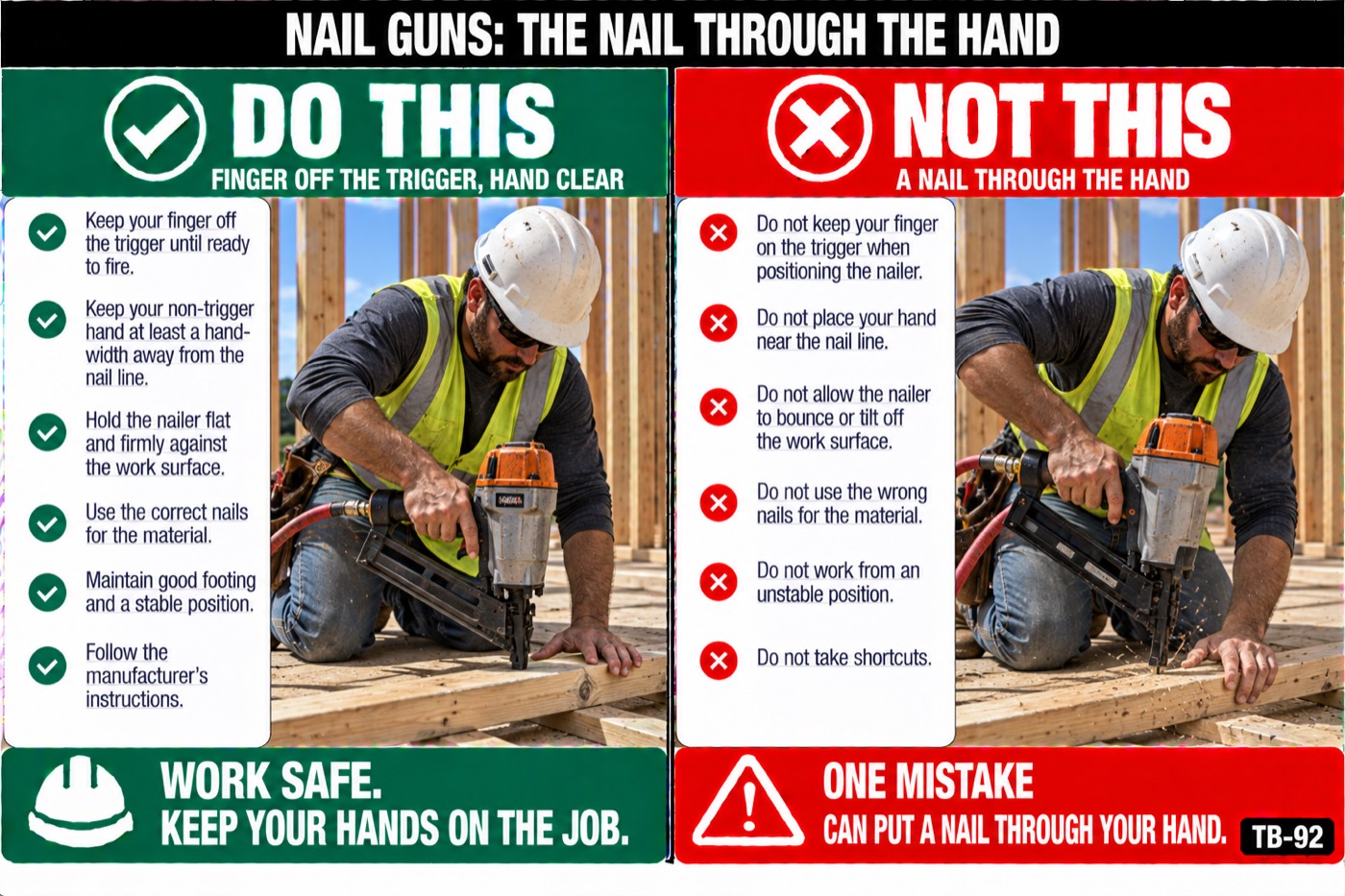
About 37,000 people a year end up in an emergency room with a nail in them. Most of those nails went into a hand, and most were fired by someone who did not mean to pull the trigger.
The points
- A framing nailer at 100 PSI drives a 3 1/4 inch nail through a 2x4 in a fraction of a second. It does the same through the hand holding the board, and it does not slow down for bone.
- The contact-trip trigger is what fires the second nail. With your finger held on the trigger, every bump of the nose fires: a bounce off a knot, a brush against your leg while you climb, the nose catching the stud you are reaching past.
- The rule for pneumatic nailers over 100 PSI is a safety on the muzzle that keeps the tool from firing unless the nose is pressed against the work. Never wire it back, tape it down or take the spring out.
- Finger off the trigger unless the nose is on the wood. Carrying, climbing, handing it over, clearing a jam: the finger is outside the trigger guard, and the hose is disconnected before you open the nose.
- Hold the board with your hand well clear of where the nail can come out. Nails follow knots and grain and exit the side of the board; the other hand stays at least a hand-width from the line of fire.
Why it goes wrong
The 37,000 figure comes from the OSHA and NIOSH nail gun guide, which counts emergency room visits from nail guns each year, contractors and homeowners together. Among apprentice carpenters, two out of five were hurt by a nail gun in their four years of training, one in five twice, and one in ten three times or more. This is the most common tool injury in framing, and most of them are never reported.
Two mechanisms do most of the damage. Blow-through and ricochet: a nail hits a knot or another nail, turns, and comes out the side of the board into the hand holding it, or skips off and flies. Double fire: the recoil bounces the nose off the wood, and with the trigger held the tool fires a second nail before it is back in position, often into the hand or the leg.
A full sequential trigger makes you press the nose down first and then pull the trigger, one nail at a time, in that order. A contact-trip or bump trigger fires whenever both are pressed in any order, which is what lets a swinging tool fire on a bump. The injury rate with a contact trip is about twice the rate with a sequential trigger; the time saved on sheathing is a few percent.
The rule in 1926.302(b) is written for the tool itself: secured to the hose so it cannot come loose and whip, and a muzzle safety on any automatic-feed nailer running over 100 PSI. Keep the pressure at the tool where the manufacturer says, usually 70 to 120 PSI. More pressure is not more power; it is more blow-through and more recoil.
The positions that get people hurt are the awkward ones: toe-nailing, nailing toward yourself, reaching past a stud, one-handed from a ladder, and nailing with the tool against your thigh. Before an awkward nail, put the other hand somewhere the nail cannot reach and look at where the tip could exit. If you are on a ladder, one hand is for the ladder.
A nail in the body stays in until a doctor takes it out. Ring-shank nails tear on the way out, and a nail near a tendon or a joint is a surgeon's job. Wrap it, keep the hand up, and go. A nail in the chest, the neck, the eye or the head is a 911 call, not a ride in the truck.
Questions for the crew
- Which guns on this truck are set to bump fire, and who is using them today?
- Where is your other hand when you toe-nail or shoot a header, and how close is it to where the nail could come out?
- When did someone on this crew last take a nail, and did anyone hear about it?
To close
Today every nailer on this site is carried with the finger off the trigger, and any gun with the nose wired back comes off the job.
To hold this talk with your crew
1
Read it aloud. Five minutes, before the work starts.
2
Ask the questions. A crew that talks is a crew that remembers.
3
Have them sign on their own phones, and the record is sealed.