Circular saws: the guard that sticks open
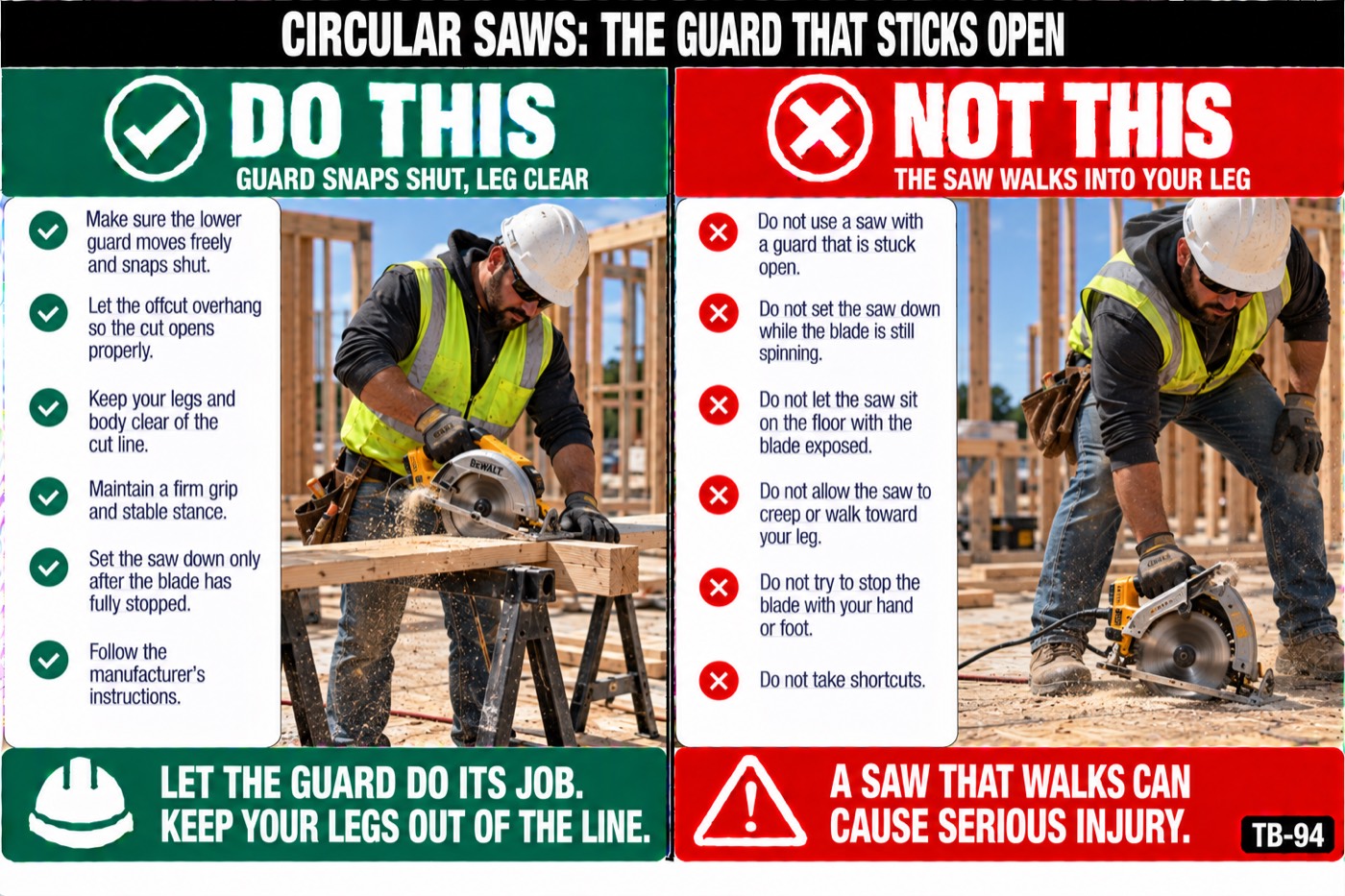
A 7 1/4 inch blade spins at about 5,000 RPM, and when you set the saw down with the guard stuck open, it walks. It walks across the subfloor toward the nearest leg.
The points
- A circular saw with a stuck guard keeps cutting after you let go, and the blade takes a leg or a hand faster than you can pull back. Most circular saw injuries are to the hand steadying the board and the leg under the cut.
- The lower guard has to snap closed on its own every time you lift the saw out of the cut. Check it before the first cut every day; sawdust, pitch and a bent guard all keep it open, and a guard wedged open with a block is a saw that comes off the job.
- Support the board so the cut opens instead of closes. Cutting between two sawhorses with the cut in the middle pinches the blade, and a pinched blade kicks the saw back at you.
- Where the blade comes out the bottom, nothing of yours is there: not the hand steadying the board, not the knee it is resting on, not the cord. Never cut a board across your leg.
- Cordless saws start when the trigger is pressed. Lock the trigger or pull the battery before it goes in a bag, a bucket or the truck, and never carry it with a finger inside the trigger guard.
Why it goes wrong
Kickback on a circular saw works like a table saw in reverse: the kerf closes, the back of the blade binds, and the saw climbs out of the cut and comes back toward you with the blade still turning. The board sagging in the middle between two supports is the usual cause, along with twisted stock and wet treated lumber. Support the board so the waste piece drops away from the cut, and let it drop.
The lower guard is spring-loaded and pivots around the blade. Sawdust and pitch pack into the pivot, the housing gets bent when the saw is dropped, and the guard starts hanging up. A stuck guard means a live blade when you set the saw down, and it walks; it also cuts its own cord. The rule in 1926.304 requires guards above and below the base plate, and the lower one has to return to cover the blade on its own.
For a bevel or plunge cut the guard is lifted with its lever, not held open with a thumb next to the blade while you move the saw. Starting a cut with the guard held open puts your hand on the guard beside the teeth, and that is where it is when the saw kicks.
Blade depth about 1/4 inch below the board. Deeper exposes more blade under the work, grabs more, and kicks harder. A dull blade burns and binds; a blade that hits a nail throws a tooth, and that is why eye protection is on for every cut. Change the blade with the saw unplugged or the battery out.
Cordless saws have no cord to yank, and that is the problem in a bag: a saw with the battery in fires when the trigger is bumped by a tape or a hammer. Lock it off or pull the battery at the end of the cut when it goes in the bucket. On a corded saw, the cord goes over your shoulder so it is never under the cut, and the rule in 1926.300 requires the constant-pressure switch that shuts it off when you let go.
Both hands on the saw, the board held by a clamp or a foot far from the blade, never a one-handed overhead cut from a ladder. If the blade walks off the line, let it stop and start over; twisting it back into the line is the bind that kicks.
Questions for the crew
- Which saw on this site has a guard that sticks, and what got done about it?
- How are you supporting the boards you are cutting today, and where does the offcut fall?
- Where do the cordless saws ride at the end of the day, and are the batteries out?
To close
Every saw gets its guard checked before the first cut today, and nobody cuts a board across a knee.
To hold this talk with your crew
1
Read it aloud. Five minutes, before the work starts.
2
Ask the questions. A crew that talks is a crew that remembers.
3
Have them sign on their own phones, and the record is sealed.