Trusses: braced as you set them, not after
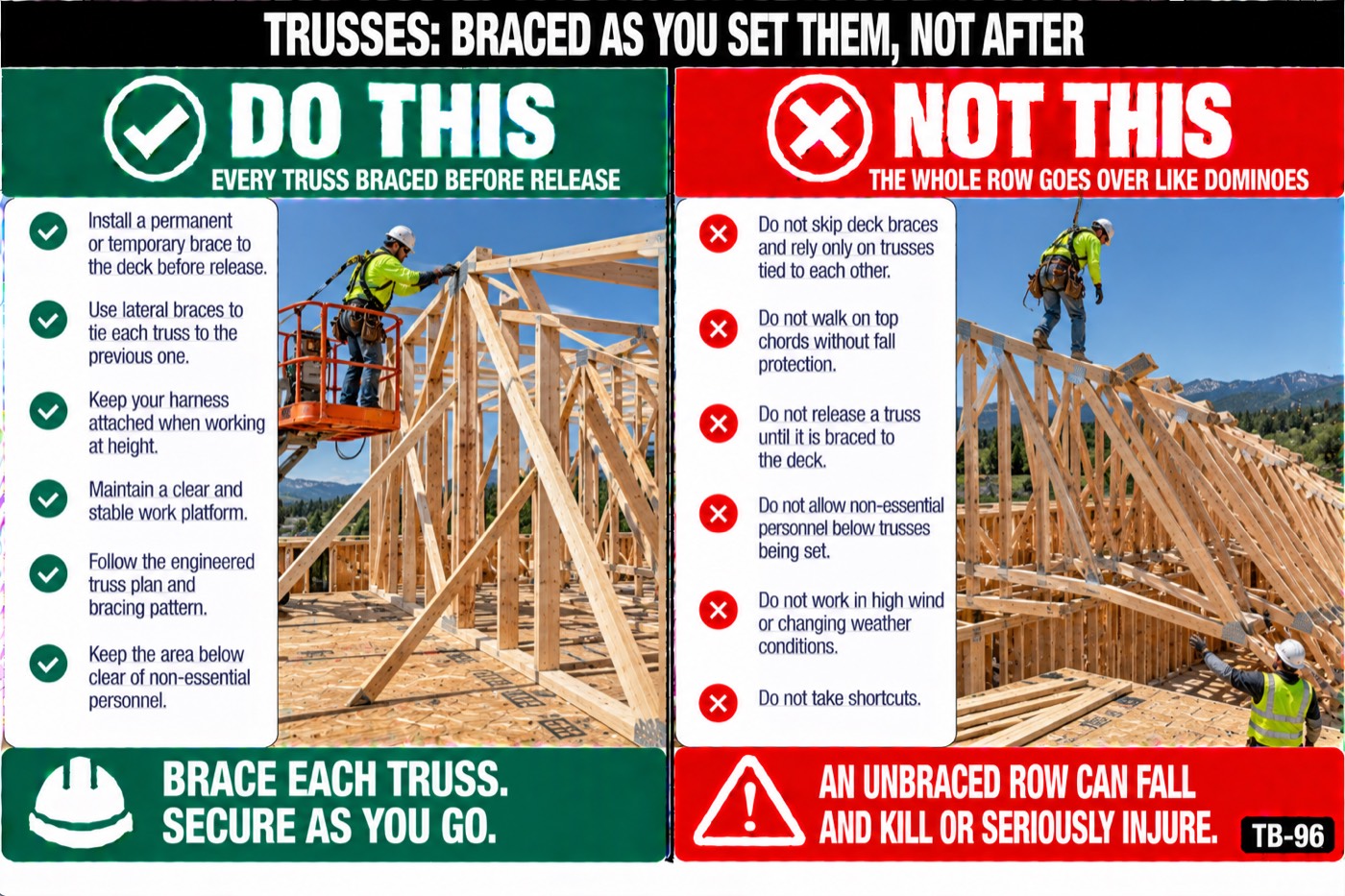
A 30-foot roof truss weighs around 150 pounds and stands on its own about as well as a playing card. The top chord you walk is an inch and a half wide, 10 feet over the subfloor and 20 over the ground outside.
The points
- Trusses go over two ways: the first one goes over because nothing held it, and the whole row goes over like dominoes because they were only tied to each other. Either way it comes down on the crew below.
- Brace the first truss to the ground or to the floor, plumb, before you let it go. Every truss after that gets a lateral brace on the top chord to the one before it, and diagonals go in every few trusses so the row cannot fold sideways.
- Walking the top chord is a fall, and at 6 feet or more the rule says you are tied off, behind a rail, or over a net. Residential framing stopped being an exception to that years ago.
- Set from a ladder, a lift or a platform below the top chord where you can. Where someone has to be up there, they are on a harness clipped to an anchor on a braced truss or a wall, never on the truss being set.
- The truss stack: never lean the bundle against the wall you just braced, and cut the bands with everyone clear of the pile. Trusses lying flat get supported at the ends and the middle, or the plates work loose.
Why it goes wrong
A truss is strong up and down and has almost nothing sideways; the top chord is a 2x4 on edge with a steel plate at each joint. A 24 to 30 foot residential truss weighs 100 to 175 pounds, a 40-footer 200 to 250, and a bundle of ten is a ton and a half. Every one of those numbers is coming down on somebody if the row folds.
The truss makers' bracing guide that came with the delivery, the BCSI sheet, gives the numbers: ground braces on the first truss, lateral braces on the top chords about every 10 feet for spans to 30 feet, every 8 feet for 30 to 45, every 6 feet for 45 to 60, and diagonals at about 45 degrees across the top chords every few trusses. The sheathing is the permanent top-chord brace. Until it is nailed on, the temporary bracing is the only thing holding the roof up.
Trusses tied to each other with no diagonal and no ground brace are a row of hinges. The set rotates as a unit, and crews have been killed under a set that went over with the crane line still attached. Never release the crane until the truss is braced, and never pull a brace to make room for the next truss without a replacement already nailed.
The fall protection duty in 1926.501(b)(13) is 6 feet for residential construction, by guardrail, net or harness. Off the inside of a truss that is a fall onto a subfloor covered in blocks and nails; off the eave it is 15 to 20 feet. Anchor to the top plate of a braced wall or to trusses that are already braced and sheathed, and use a retractable so the fall stops before the floor.
Set trusses from below where you can. Slide them up flat onto the walls from a ladder or a lift, tilt them up with a pole, and nail from a stepladder or a platform. When a crane sets them one at a time, it lifts from two points with a spreader bar for spans over 30 feet, with a tag line and nobody under the load. Lifting a truss flat by the peak bends it and pops the plates.
The stack comes off the truck flat, onto level supports on the ground, still banded. When a band is cut, the bundle spreads; feet and legs stay clear. A bundle propped against a braced wall is 1,500 pounds pushing sideways on braces that were sized for wind, and it is the load that puts the wall over.
Questions for the crew
- Who braces the first truss today, and to what?
- Where is the anchor for whoever goes up on the top chord, and is it on something that is braced?
- Where is the truss stack sitting right now, and what is it leaning on?
To close
Today no truss gets let go of until it is braced, and nobody walks a top chord without being tied to something that will hold.
To hold this talk with your crew
1
Read it aloud. Five minutes, before the work starts.
2
Ask the questions. A crew that talks is a crew that remembers.
3
Have them sign on their own phones, and the record is sealed.