Sheathing: the sheet nobody nailed
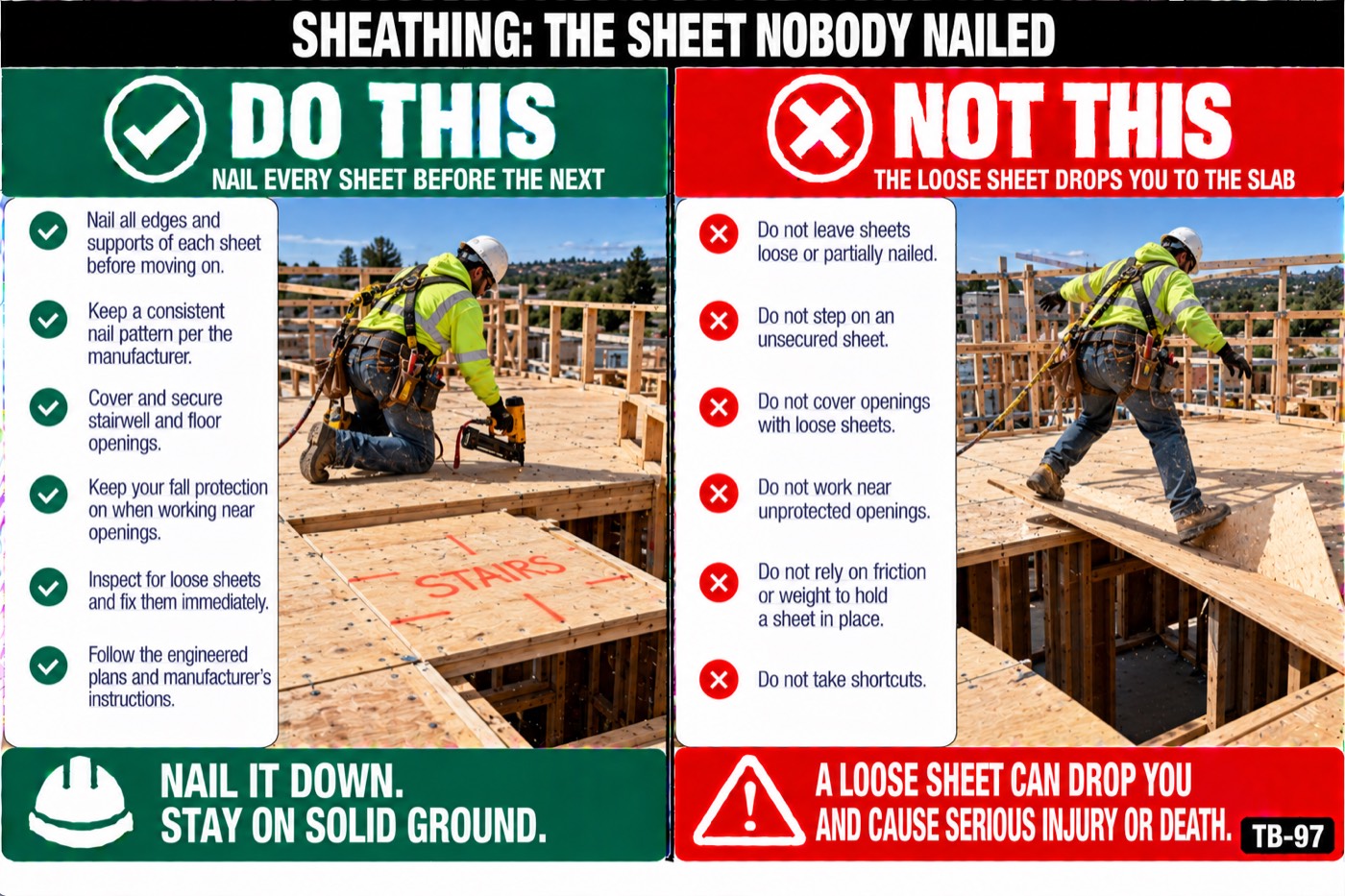
A sheet of 3/4 subfloor weighs about 70 pounds and looks exactly the same nailed down or laid loose over a stairwell. The person who finds out which is the one who steps on the corner.
The points
- The unnailed sheet slides, tips or gives, and you go 8 or 9 feet to the slab below, onto whatever is stacked down there. The sheet laid over an opening nobody marked does the same thing to the next trade.
- The edge you are sheathing toward is a leading edge, and at 6 feet or more you are protected: harness and anchor, a rail, or a net. Working off the last sheet you nailed is the practice; working out on a loose one is not.
- Every sheet gets enough nails to hold before the next one goes down. Tack the corners at least; a sheet with no nails does not exist on this deck, not even at break.
- Any opening covered with a sheet gets nailed down and marked HOLE or COVER in big letters. A cover that is not secured and marked is a trap, and the rule says it has to be both.
- Sheathe from below where you can: the first courses of roof sheathing from a ladder or a platform, floor sheathing from the deck you already have. Nobody walks joists or rafters at 6 feet or more without protection.
Why it goes wrong
The falls come from the corner over the opening, the sheet cantilevered past the last joist, the tongue-and-groove joint not driven home so the sheet rocks, and any sheet on a wet or frosty morning. From the first floor to the basement slab is 8 to 10 feet, and the landing zone is the basement with the lumber, the ledger and the rebar. On a roof, a loose sheet on a pitch is a sled.
The duty is in 1926.501: leading edges at 6 feet in (b)(2), holes at 6 feet in (b)(4), and residential construction at 6 feet in (b)(13). The cover rules in 1926.502(i) say a cover carries twice the load that can be put on it, is secured against wind, equipment and people, and is marked HOLE or COVER or color coded. The old slide-guard alternative for roofs was withdrawn in 2010; it does not exist anymore.
Nail as you go. Start from the braced end, snap the lines, lay the sheet, nail it, then step onto it to lay the next. The person spreading adhesive on the joists is out on the joists and is protected like anyone else. For the stairwell, frame the opening, nail a full sheet over it with 8d nails every 6 inches, and mark it; better, set the guardrail and skip the cover, because a cover gets pulled to bring up the tub.
Think about the anchor and the clearance. A 6-foot lanyard with a shock pack needs about 18 feet below the anchor before it stops you, which is more than a 9-foot floor has. On a floor deck use a retractable off a braced wall or a strap anchor across joists, or put up a rail. On a roof, the anchor goes on the first section sheathed, at the ridge.
A 4x8 sheet is 32 square feet of sail. At 25 miles an hour a gust takes a sheet off the stack or out of your hands at the leading edge, and it takes you with it. Weight the stack, keep it inside the braced area, and carry sheets two people on a windy day.
Weights: 3/4 tongue-and-groove OSB is about 70 to 75 pounds, 23/32 plywood about 70, 7/16 wall and roof OSB about 48. Carrying a sheet along a joist, you cannot see your feet, and at the edge there is nothing to grab.
Questions for the crew
- Which sheets on this deck right now are not nailed, and who knows about them?
- What openings are in this floor today, and what is over each one?
- Where is the anchor for the person at the leading edge, and how much clearance is under it?
To close
Before anyone leaves this deck today, every sheet is nailed and every opening is railed, or covered, secured and marked.
To hold this talk with your crew
1
Read it aloud. Five minutes, before the work starts.
2
Ask the questions. A crew that talks is a crew that remembers.
3
Have them sign on their own phones, and the record is sealed.