Stepladders on the subfloor: the top step and the lean
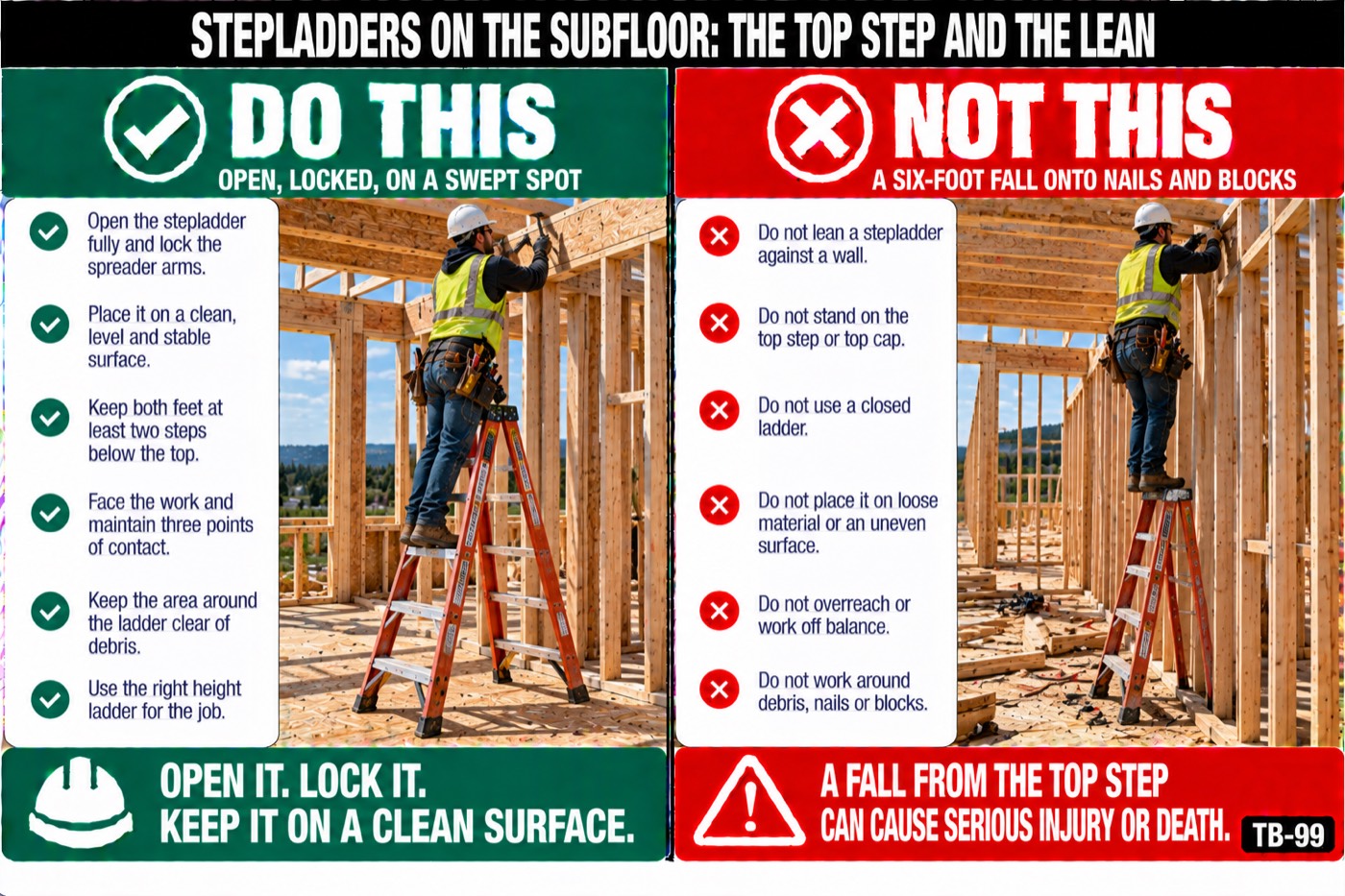
A stepladder leaned closed against a wall is standing on two feet instead of four. The top of a 6-foot stepladder is a 6-foot fall with nothing to grab, onto a subfloor covered in offcuts and nail points.
The points
- Most framing ladder falls are short ones: 4 to 8 feet, off a stepladder onto the subfloor, into a wrist, a hip or the back of the head. The subfloor is not soft, and what is lying on it is blocks and nails.
- The top and the top step of a stepladder are not steps. The rule says so, and so does the label: the highest place you stand is two steps down.
- A stepladder is used open and locked, on all four feet. Leaning a closed stepladder against a wall is using it for something it was not designed for, and the rule bans that too.
- Every ladder stands on a stable, level surface. On a subfloor that means the feet on the sheathing, not on sawdust, offcuts, a loose sheet of OSB or a bucket. Sweep the spot first.
- The extension ladder to the deck reaches 3 feet above the landing and is tied at the top or held at the bottom. Nobody moves a ladder with someone on it, and nobody goes up one carrying a load that needs both hands.
Why it goes wrong
The rules are all in 1926.1053(b): the top or top step of a stepladder is not used as a step, in (b)(13); ladders are used only for what they were designed for, in (b)(4); on stable and level surfaces unless secured, in (b)(6); side rails extend 3 feet above the landing, in (b)(1); and no moving, shifting or extending a ladder while someone is on it, in (b)(11).
A stepladder fall from the top step is a tip or a step off the side. You reach sideways for the header or the nail, your belt buckle goes past the rail, and the ladder rotates on two feet or you step into air. Hands go out; the wrist breaks. From 6 feet the head can hit the plate on the way down. Keep the buckle between the rails and move the ladder instead of reaching.
A closed stepladder leaned against a wall has two feet on the floor, no spreaders locked, and feet that were made to sit flat, not to angle. It slides sideways off the stud or the feet skate on sawdust. If you need a ladder that leans, buy one made and rated to lean, or use an extension ladder set at four to one.
The subfloor is the worst floor a ladder stands on. Sawdust is ball bearings, a scrap of plywood tilts under one foot, and near the leading edge the feet can drop between joists. Sweep a spot, put the feet on the sheathing over a joist, and keep the ladder 6 feet back from any edge or opening unless there is a rail.
The extension ladder from the ground to the deck stands on graded fill that settles and turns to mud after rain. Level the base, use the ladder feet, tie the top to a stud, and hoist tools and lumber up on a rope or by hand from below. One hand on the rail always means the nail gun goes up on the hose or in a bucket, with the finger off the trigger.
Match the ladder to the person. A Type I ladder is rated for 250 pounds, a Type IA for 300, and a framer with a tool belt and a header is already there on a light-duty ladder. Cracked rails, missing feet, a bent spreader or a split step means the ladder is tagged and off the site today, not the ladder someone else gets.
Questions for the crew
- Which ladders are on this site today, what are they rated for, and which one has something wrong with it?
- Where does the ladder to the deck stand this morning, and what is it standing on?
- What are you doing today that puts you on the top step, and what is the other way to do it?
To close
Today every stepladder is open and locked on a swept spot, and nobody stands above the second step from the top.
To hold this talk with your crew
1
Read it aloud. Five minutes, before the work starts.
2
Ask the questions. A crew that talks is a crew that remembers.
3
Have them sign on their own phones, and the record is sealed.